DonCorson offers an in-depth, hands-on review of the Arnold & Son Constant Force Tourbillon, a timepiece he wore for three weeks. His report delves into the watch's intricate design, technical innovations, and real-world performance, providing valuable insights into this modern horological marvel. This article is a must-read for anyone interested in the fusion of traditional English watchmaking aesthetics with cutting-edge constant force mechanisms.
A tour de force of modern watchmaking, no pun intended, the Arnold & son Constant
Force Tourbillon is a masterful, fully thought through modern dress watch . I had the opportunity to wear this watch for 3 weeks to prepare this report.
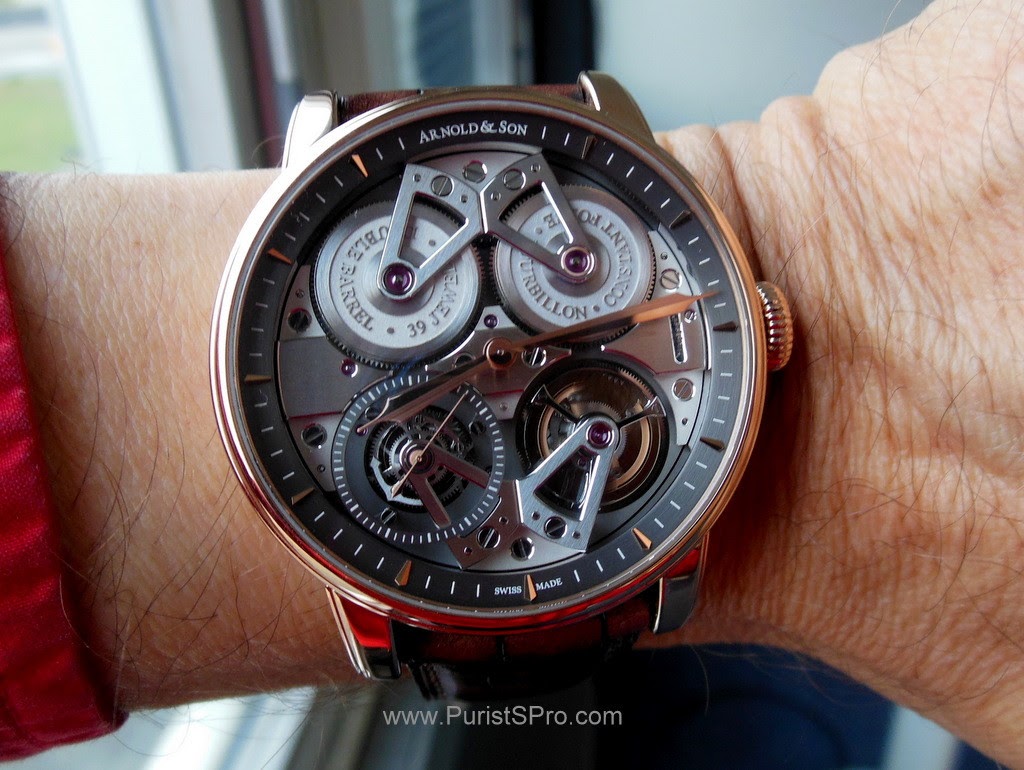
This watch is a real show-off, one can see the entire mechanism, arranged as it is perfectly symmetrically, through the dial. The movement has a geometrical
architecture with just enough visual tension to keep us looking. The axles of the double barrels of the energy storage, the constant force mechanism and the tourbillon form a square, each axle held by a large ruby in a triangular cock, traditionally English, the traditional look broken, however, by the skeletonisation. This set of perfectly symmetrical triangles forming a square is then lodged in the circle formed by the thin dial ring and the case. In spite of all this visual attraction the hands are easy to see, even in poor light. The hands are relatively massive and their finishing is polished on one half and brushed on the other, thus adapting too and visible in every light condition. This one common problem of open faced and skeletonized watches, the readability, is no problem at all for this watch.


What is the interest in adding a constant force mechanism to the tourbillon? Well, the tourbillon should reduce the anisochronism caused by positioning errors, but doesn't help any for the anisochronism caused by the difference in energy coming from the barrel as the main spring unwinds. The solution to this problem since around the year 1500 has been the fusee, today it is a constant force mechanism. For those of you wanting to know all the gory details, take a look at the Swiss patent CH709068A2.

The particularity of this constant force mechanism is that it also serves as a dead beat second indication, the spring furnishing the energy to the tourbillon being reloaded once a second. That this mechanism is very successful in maintaining a constant force for the tourbillon is evident from Arnold's testing results, an amplitude difference of less than 5° between fully wound at 90 hours. The watch is specified for 90 hours autonomy, but continues to run for another 20 hours after that point. It is just that the amplitude is no longer constant after 90 hours having some impact on the rate accuracy. That the watch is no longer running with constant force is also visible as the second hand no longer jumps in that case, but sweeps. Thus it is easy to see that winding is necessary.

The tourbillon itself is a traditional one minute tourbillon with a central balance and consists of 67 pieces. It is very light as the constant force has not been integrated in the troubillon, but is separate. Not traditional at all is the balance form, it being of two arcs in rose gold, not the traditional ring. This balance form is reserved in the Arnold line-up for the Constant Force Tourbillon.

I did not do any formal rate testing such as taking measurements every day and producing statistics from that. I did however check the time once a week and found that after 2 weeks the watch had lost 2 seconds. That results in a rate error of 0.14 seconds a day. Not bad! During the entire time I had the watch I did nothing but wind it about once every two days. Note that winding has a good feel and one has a good grip on the generous crown. With that kind of accuracy when worn daily on the wrist we can conclude that the combination of a tourbillon with a constant force mechanism does very good things for the timekeeping of a watch.

With the movement open to sight from the front and the back it is a great opportunity for the watchmakers at Arnold & Son to show their finishing prowess, with they do. The four big bridges under the dial and on the back and are steel with the rubies in white gold chatons, the rest of the movement is made of German silver. The bridges are all beautifully finished by hand with a fine brushing on the surfaces and highly polished bevels. The internal corners are rounded and not sharp as English tradition requires (see also Roger Smith, for exmple). The quality of the polishing even holds up under the microscope where one can also see that it is really hand polished and shows none of the telltale signs of machine polishing. The screws are polished (even the bottom of the slits!) and beveled and the watchmakers at Arnold are very proficient at the difficult art of snugging up screws without making any mark on them. Personally I am a big fan of this kind of bridges and finishing.
The main bridges each only hold one axle in a big ruby and have two positioning pins and one screw. The total effect with the polished rounded pin ends and flat polished screws visible in the brushed surface of the bridge is perfect.

The case in 18K 5N (red) gold is 46mm in diameter. This is my only quibble with this watch, it is simply too big for my wrist. On the other hand its other qualities have enabled me to wear it daily without a complaint for almost a month. And despite its size it is comfortable to wear. The case is of a quite complicated rounded form with a double step bezel. The warm color of the 5N gold is a good compliment to the gray main plate and the grays of the bridge brushing changing with the angle of light impinging on it.


I would like to thank the people at Arnold & Son who provided me this watch which is a great joy to wear. The size of the watch does make it very visible and I often had those, “show me your new watch” comments, the watchmakers immediately bringing out their magnifiers. And 100% of the comments were positive. The constant force mechanism also emits a solid comforting tick every second, it is like you are carrying your one second pendulum clock around with you. I love it.


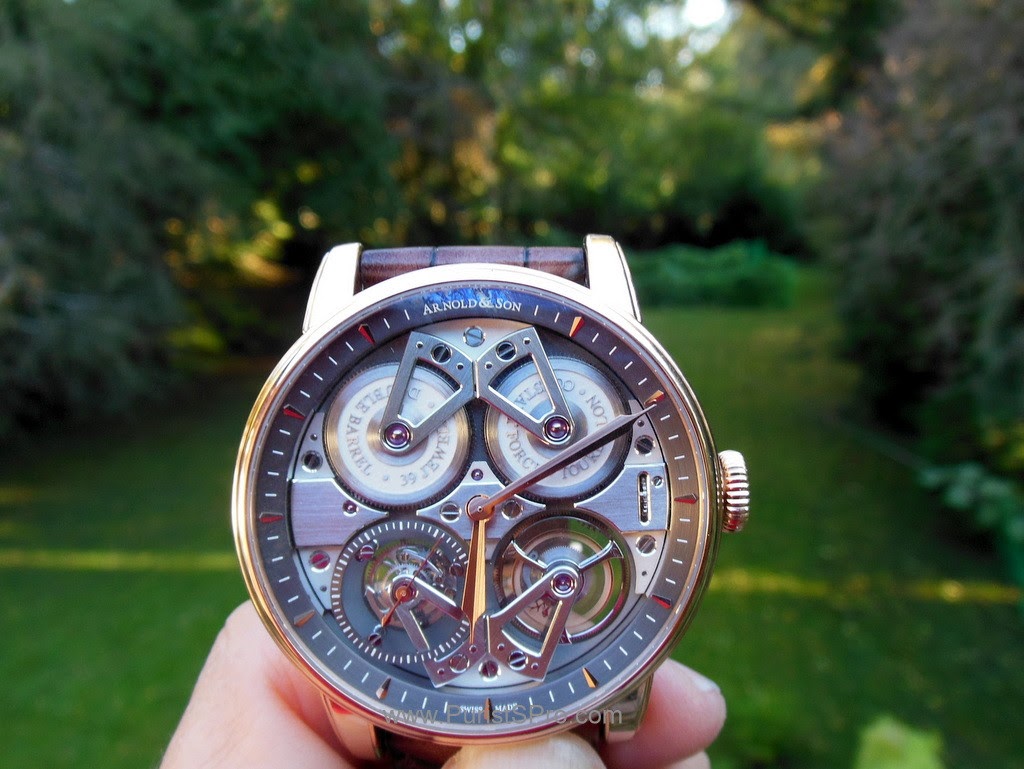


Note that even in bad light the watch is readable.


Together with the competition, Arnold Constant Force Tourbillon and Louis Moinet 20 Second Tempograph.


