Spellbound delves into the pivotal role of the 1970s in watchmaking history, a decade marked by the Quartz Revolution's challenges and subsequent innovations. He highlights three historically significant non-mechanical watches: the Derby Swissonic Digital Jumphour, the Girard Perregaux Casquette, and the Bulova Accutron Spaceview. This exploration underscores how Swiss and American manufacturers responded to the era's technological shifts, shaping the future of horology.
One must not underestimate the importance of the 1970's.
There is no need to go into detail as to the challenges to the mechanical watch making industries that were brought on by the Quartz revolution, but these were trying times for watchmakers on both sides of the pond. In many ways, the Americans were more pro-active than their European counterparts in embracing the new technologies with companies like Texas Instruments, HP and Electro-Data mass developing modules for watches like the Pulsar LED P1 which was released in 1972. Many Swiss firms hesitated as to what direction to take, and as a result, the Swiss watch industry suffered. By the end of the 70's, the future was uncertain and the watch bearing public were being inundated by a flood of cheap accurate electronic watches from Hong Kong and Japan.
This whole state of affairs did however lead to innovation as some Swiss houses rose to the challenge, jumping onto the bandwagon almost for fear of their future. Even the mighty Omega and Jaeger LeCoultre had released their own versions of a quartz digital watch.
But as I delve further into this fascinating era in watchmaking history, a number of watches stand out as historically significant non-mechanicals, each embracing differing technologies.
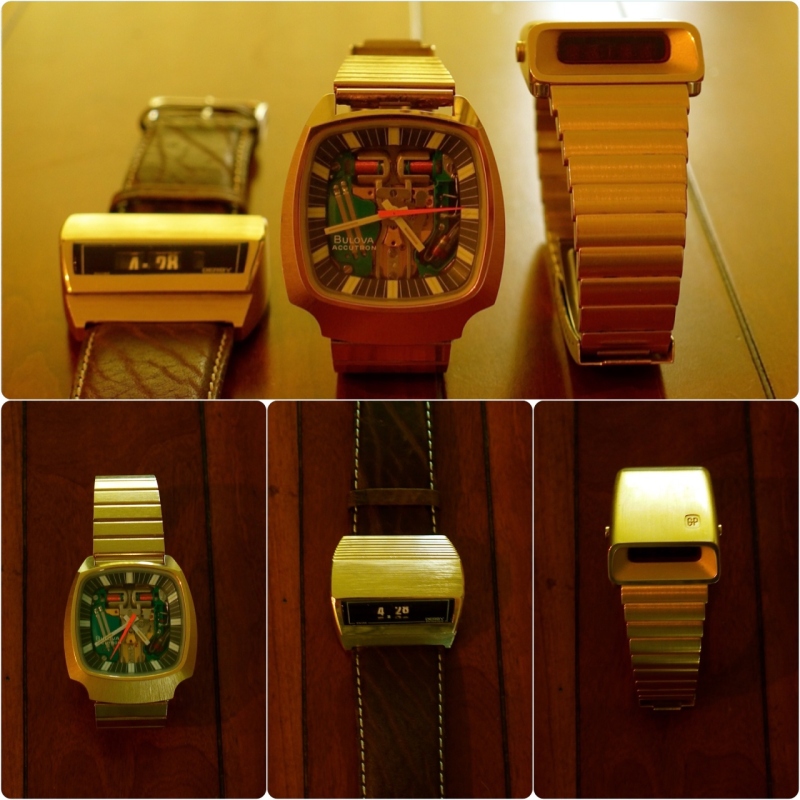
The Derby Swissonic Digital Jumphour.
Introduced in 1974 by Derby SA, a subsidiary of ESA, and marketed in France under Jaz, the Derby Swissonic married mechanics with electric power through a 1.5V cell driving a column wheel movement (ESA 9176). The power generated by the cell was run through an electromagnetic coil which in turn rotated the magnetic balance wheel and this power was somehow transferred to the gears that rotated cylindrical drums that made up the hour and minute hand. The jumping hours and minutes were achieved through the inventive use of tiny springs that were prone to malfunction. The futuristic design perhaps drew inspiration from the Patek Philippe "Cobra" prototype watch from 1958.
The Girard Perragaux Casquette.
Girard Perragaux went all out on this one, investing in an internal R&D team to focus on developing a totally in-house "solid state" watch, so called as they had no moving parts. GP even went so far as to use pre-aged quartz crystals (baked) to ensure accuracy and durability. With a production run of just over 8,000 watches over a 2 year period, this venture was hardly profitable given the initial outlay, and soon the high energy consuming LED watches gave way to the efficient LCD's that started to appear in the mid-70's.
For more information on the GP Casquette please visit my recent post:
The Bulova Accutron Spaceview.
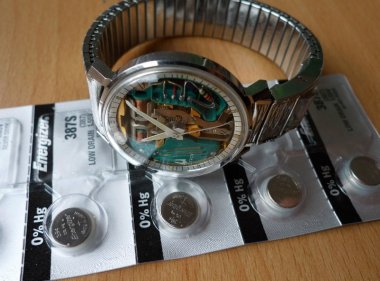
First launched at the end of 1960, the Accutron is considered by many as the first electronic wristwatch. As most of you know, it utilizes a 360 hertz tuning fork in between two electromagnetic coils, an invention by Basel born Max Hetzel who joined Bulova in 1948. In the early Seventies, in order to increase sales, Bulova developed a display model for salesmen to demonstrate the unique tuning fork technology. In a fortunate turn of events, customers started asking if the display models were available for sale. Demand was so high for this novel type of watch with visible innards through the dial that Bulova started to produce the newly named "Spaceview" on massive scale. By the time they ceased production in 1977, over 4 million humming tuning fork Accutrons had hit the market.
There is a 4th watch that I also consider as historically significant in terms of non-traditional non-mechanical watches, and that is the Amida Digitrend Prism Jump Hour, the inspiration for the MB&F HM5. Unfortunately for now, the Amida eludes me so I will leave this one out until I find a nice working specimen.
I am sure there are other significant watches from the Seventies that I have yet to discover, and hopefully some of you might be able to point me in the right direction.
But I think that there is one thing we all can agree on. It was an important decade in terms of visionary design and technological innovation, only to be follow by a rather dull Eighties and a return to some stale designed mechanicals.
I am very fortunate to have come across working "New Old Stock" examples of these three watches, and yes I know we share a passion for mechanicals, but there is no debating the historical significance not only of the space age designs, but of different technologies that bridged the gap between the death and rebirth of the Swiss watch industry.
Dean
 This message has been edited by Spellbound on 2014-03-18 08:43:46