Métiers d’Art Les Univers Infinis
The Artistic Crafts of the Manufacture pay tribute to the art of tessellation
• Second series in the Métiers d’Art Les Univers Infinis collection, inspired by the work of the Dutch artist Maurits Cornelis Escher
• A tribute to the graphic expression of the periodic paving technique known as “tessellation”
• A subtle blend of the Artistic Crafts cultivated by the Manufacture: engraving, enamelling, gemsetting, guilloché work and the new technique of gold and mother-of-pearl marquetry
• A mechanical self-winding movement, entirely developed and crafted by VAcheron Constantin
• A limited, numbered series of 20 watches for each model, all certified by the Hallmark of Geneva
Representing the second chapter in a collection presented in 2012 at the Salon International de la Haute Horlogerie in Geneva, the new Métiers d’Art Les Univers Infinis creations, inspired by the work of Dutch artist Cornelis Escher, pursue this glowing tribute to the graphic art of tessellation.
Vividly expressing the creativity of the Master Craftsmen whose skills are so greatly valued by the Manufacture, they illustrate the ties between watchmaking and culture that Vacheron Constantin has been perpetuating ever since its founding. At the crossroads between past, present and future, these timepieces embody the challenges taken up by the artisans of Vacheron Constantin and governed by a combination of talent, discipline and instinct.
Representing a symbiosis of several crafts, the new Métiers d’Art Les Univers Infinis trilogy uses the technique of periodic paving to create a strikingly hypnotic effect. Another skill highlighted by Vacheron Constantin, gold and mother-of-pearl marquetry, is associated with those of engraving, enamelling, gemsetting and guilloché work to create trompe l’oeil dials featuring infinitely entwined elements of geometry, movement and symbolism. The space on the dials is filled with perfectly interlocking repetitive motifs, thereby creating a world of optimal illusion and perspective, beautifully framed by a white gold case. The slender bezel ensures a maximum dial opening, while the elegant hands are hollowed so as to provide full expressive scope for the art of tessellation.
The Hallmark of Geneva certified watches are driven by Calibre 2460, a mechanical self-winding movement entirely developed and crafted by Vacheron Constantin. In addition to its reliability, it bears manual finishes performed in keeping with the finest Fine Watchmaking traditions. The polished angles, hand-drawn flanks, circular-grained mainplate, bridges adorned with a Côtes de Genève motif and the gold oscillating weight featuring the elegant crossweave guilloché pattern, are all clearly visible through the sapphire crystal case-back.
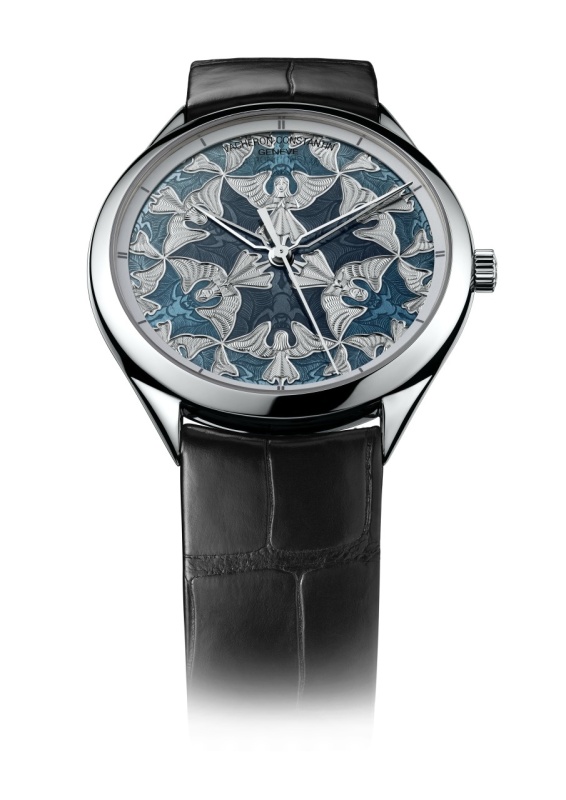
Angel Watch
Engraving, guilloché work and Grand Feu enamel
On the dial of this fascinating model, angels and demons face off in a contrast that is both symbolic and
aesthetic. The former are in light, the latter in darkness, yet neither side appears to prevail over the other.
Inspired by research conducted by Maurits Cornelis Escher on the “circular boundary” – involving décor
composed of infinitely multiplied elements radiating out from a central point – the watch portrays these
respective figures through a subtle combination of the arts of engraving, enamelling and guilloché work, skilfully
playing on depth and shimmering mirror-like effects.
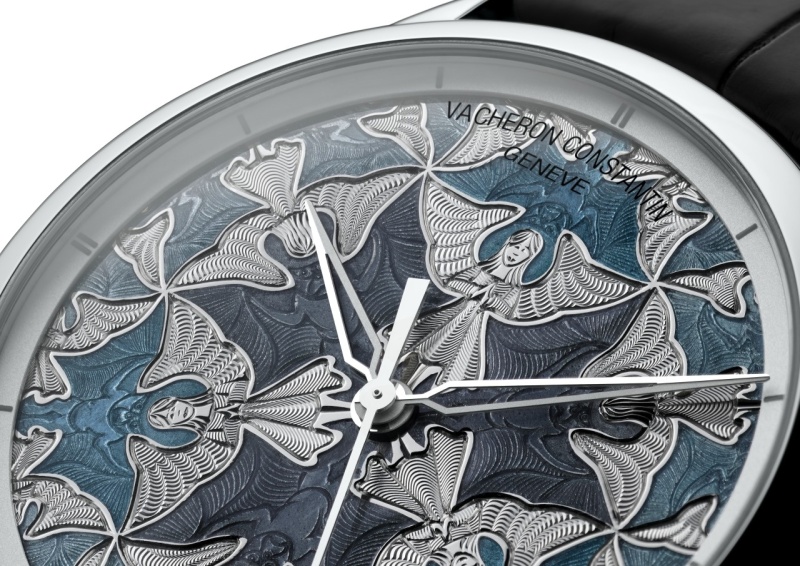
Working with a white gold base, the engraver first traces the outlines of the figures and then hollows them out as
cells using the champlevé technique. Next comes the copperplate engraving that defines the details of the
demons. The enameller fills the cavities thus hollowed out, an operation requiring infinite precision in that the
repetitive symmetry of the pattern simply cannot tolerate even the tiniest flaw. After several firings in the kiln,
during which the grey and blue colours are progressively set in place, the artisan applies a final layer of
translucent enamel to the imps in order to accentuate the depth of the engraved motifs. The guillocheur then
moves into action to craft the angel robes and wings by patiently incising the colourful material. It is extremely
rare that guilloché work on an enamelled model is done as the last phase, precisely due to the extreme
complexity of such an operation, since any slip of the tool could jeopardise the precious work of an entire team
of artisans.
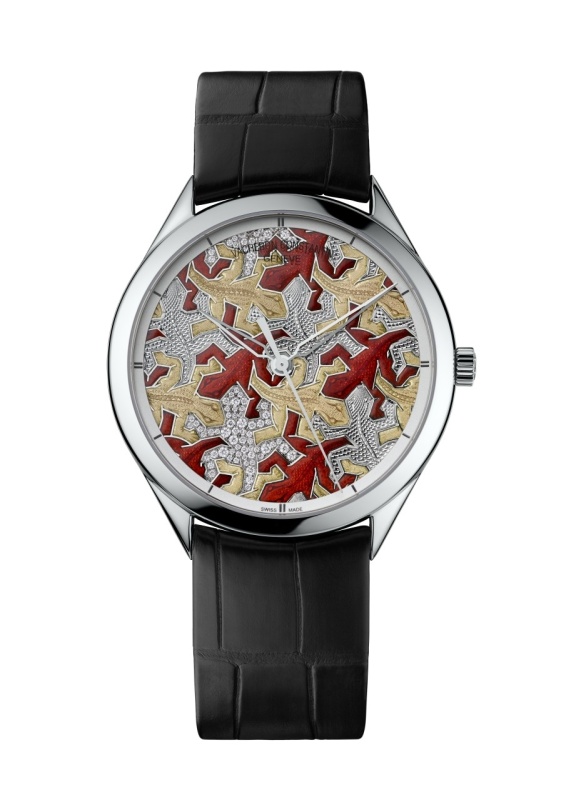
Lizard watch
Engraving, Grand Feu enamelling, gemsetting and guilloché work
Red, brown, gemset or silver-toned, the lizards take over the dial to create a captivatingly animated effect.
Inspired by one of the Dutch artist’s lithographs named Reptiles, the watch springs to life beneath the
intermingled effect of four ancestral decorative arts.
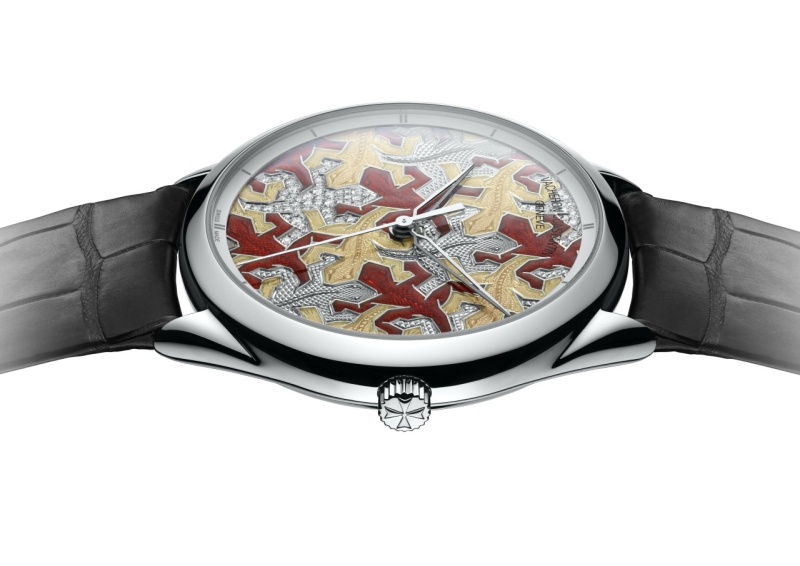
The engraver begins his work by hollowing out the motifs from a yellow gold base. The enameller then fills in
the lizards heading southwards with a taupe-coloured enamel, while those going west are coated in crimson red.
The gemsetter then chooses to adorn the coats of certain reptiles with round-cut diamonds and finally, the master
guillocheur dextrously enlivens the remaining lizards by highlighting their tiny scales measuring just a few
tenths of a millimetre.
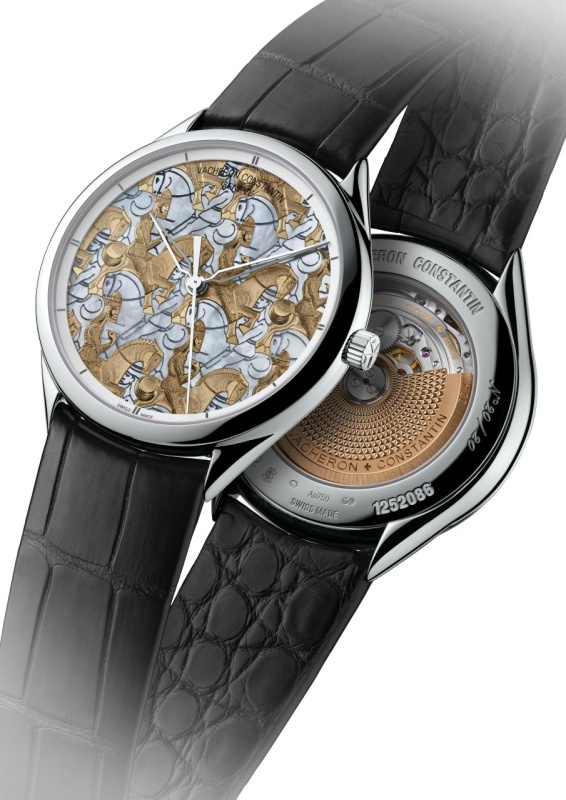
Horsemen watch
Engraving meets gold and mother-of-pearl marquetry
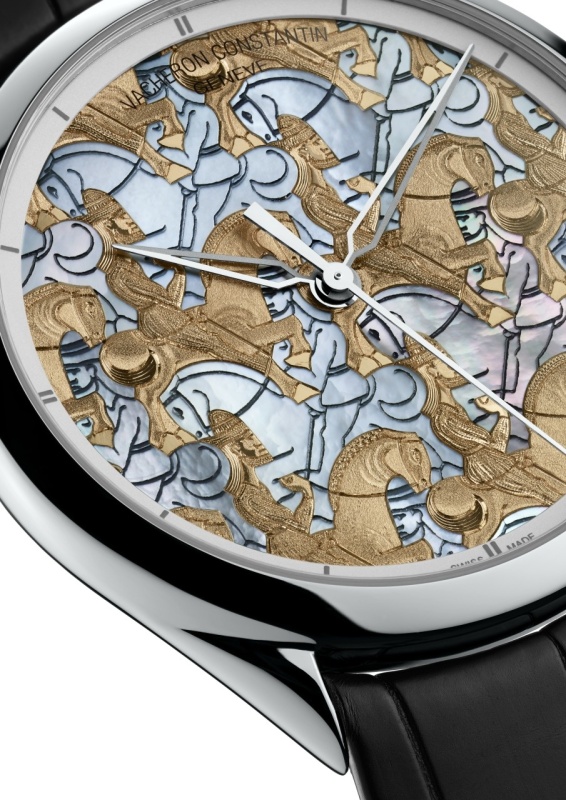
The majestic Ottoman horsemen with their inimitably proud bearing straddle the dial crafted in a superb gold and
mother-of-pearl marquetry pattern. The shimmering colours of the materials mingle in perfect harmony.
The art of marquetry has been practised since time immemorial. The Egyptians used it in the form of precious
stones and ivory inlaid into cosmetic cases and furniture. In the Middle Ages, Venice and the Byzantine empire
exported luxury objects to the West featuring black and white geometrical motifs created by inlaying gold, ivory
or mother-of-pearl into wooden veneers in a subtle range of lighter to darker shades.
The marquetry artist crafts a particularly complex object by adjusting two diametrically opposing materials. Each
horseman is first cut out from gold and mother-of-pearl before being meticulously assembled, like a puzzle, on a
gold base. There are no visible gaps between the figures – a tough challenge indeed within such a small space.
Mother-of-pearl calls for extreme attention, since it is extremely fragile and must feature the perfect combination
of thickness, specific colours and shapes, smoothly combining curves and straight lines in order to follow the
lines of its gold counterpart. At the end of the process, the engraver perfects the horsemen and horses by
hollowing out the details of their anatomy.
The art of tessellation: an infinite vision of spaceBorn in the mists of time and named after the Latin word tessela, meaning paving stone or tile, the art of tessellation – or paving – spans many civilisations and cultures. It consists of small interlocking squares forming a motif that occupies the entire space of a picture without leaving any gaps, tessellations cover floors, walls and ceilings to form subtle geometrical landscapes. From 4000 B.C, this mosaic technique adopted by the Sumerians, a people of Mesopotamia. While the Romans also made it one of the main decorative motifs in their architecture, it was doubtless the Moors who raised this technique to an authentic art form in the period stretching from 700 to 1500 AD, since the Islamic religion forbade them from representing human beings and any real objects.
This technique has also proved interesting for mathematicians, who have viewed it as an artistic expression of their science and their logic. Such scholars include Archimedes, the famous Greek scientist from the 1st century B.C., who studied geometrical paving; as well as the astronomer Johannes Kleper, who presented a certain number of polygonal tessellations in his work entitled Harmonice Mundi. More recently, artists Bridget Riley and Victor Vasarely have drawn inspiration from this art of which Maurits Cornelis Escher is undoubtedly one of the most famous contemporary exponents.
Maurits Cornelis Escher: artistic geometryDutch graphic artist and engraver Maurits Cornelis Escher (1898-1972) based his work upon subtle plays on architecture, perspective and space. Admirably associating perfect execution and imagination, he was a past master in the art of toying with visual senses and even reason in order to invent new spatial representations and worlds that exist only on flat surfaces. His travels to Spain instilled in him a passion for the paving technique of which he saw some remarkable examples in the Moorish tiles of the Alhambra in Grenada, and the Cordoba Mosque. Comprising a strong mathematical element, his work lies on the borderline between art and science. For the artist, the possibility of replacing the abstract geometrical shapes of the motifs by figurative designs became a genuine passion and an infinite source of inspiration.