Independents
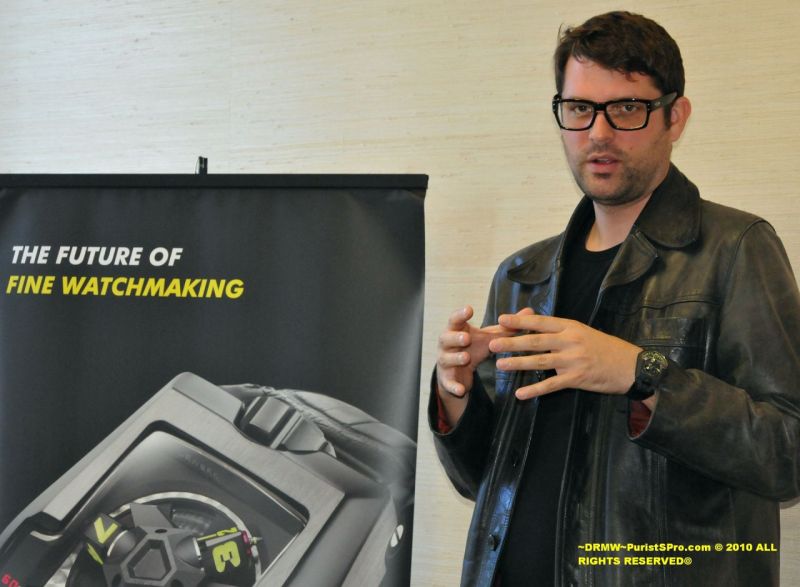
DRMW presents an insightful interview with Felix Baumgartner, co-founder of URWERK, offering a deep dive into the brand's philosophy and innovative approach to watchmaking. The post explores URWERK's origins, its unique time display mechanisms, and the challenges of pushing horological boundaries. This article distills the key takeaways from the discussion, providing valuable context for understanding URWERK's distinctive place in the independent watchmaking landscape.
"URWERK was born from a meeting in 1995 between two brothers, Felix and Thomas Baumgartner, both gifted watchmakers, and friend Martin Frei, a talented artist and designer.These young men were united by their common passion for measuring and portraying time. A long discussion, a sharing of philosophies and dreams, culminated in a decision to create their own vision of time.
Martin Frei sketched and honed the design of the timepiece while the Baumgartners spent the next two years developing the technical aspects of the movement and complication. Inspired by the 17 century Campanus Night clock, the team aimed to distill timekeeping to its very essence, to calm the perception of time by removing all extraneous indications and distractions."
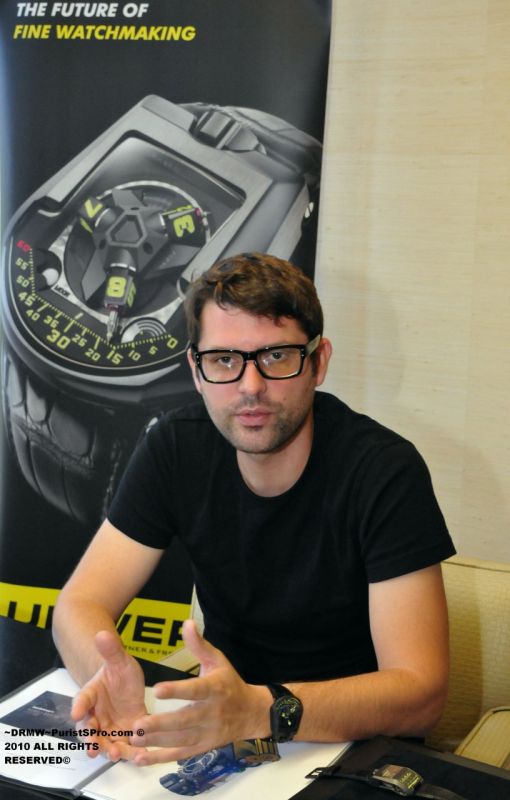
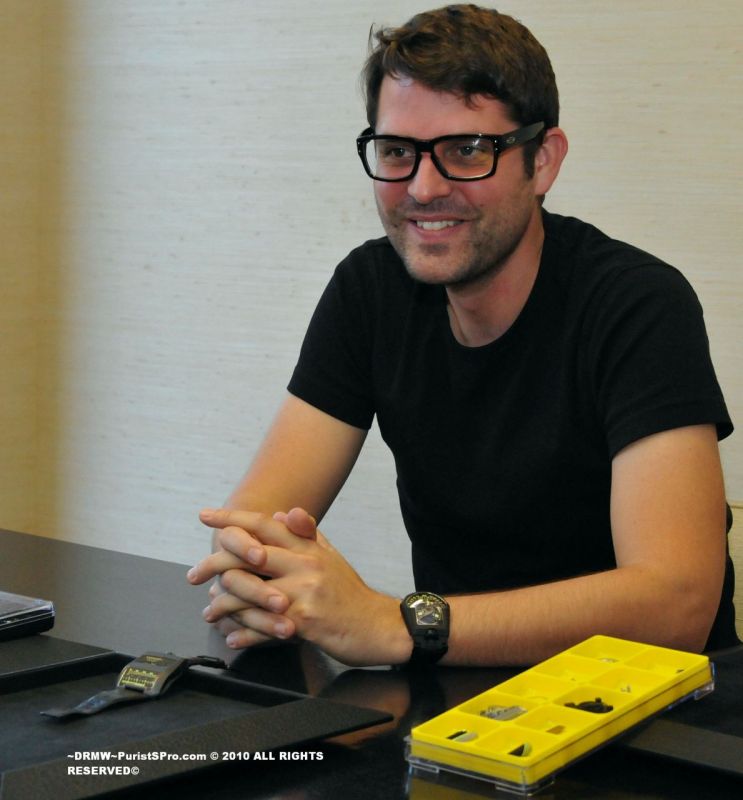
Felix: Firstly URWERK is derived from 'UR' and 'WERK'.
UR. The city of Ur was the very place where our perception of time was molded over 6000 years ago by the moving shadows cast by the obelisks of Ur. These giant sundials unveiled the mysteries of the earth's movement through space. The Sumerians, the people of Ur, declared that the passage of these shadows through the course of one year should be partitioned into12 units, thus laying the foundation for a system of timekeeping which has endured to this day.
WERK. In the German language, 'werk' means to work, create, evolve,shape, forge and to arouse emotions.
At URWERK our challenge is to show that watchmaking is not only about traditional complications it’s also about new ideas and possibilities, new invented mechanisms. This actually my reason for being a watchmaker, I'm a third generation watchmaker so I don’t want to repeat what my father and grandfather did better than me. So I was aware that I cannot be better than them. As you can see with other watchmakers you see in the museum, in traditional watchmaking, actually I became depressed in the 90’s as I saw all these nice watches, clocks and pocket watches. It was just so well done and even today in traditional watchmaking you don’t find this quality again, you cannot. So what we do is concentrate on new mechanisms, new ideas, and new possibilities.
It’s absolutely the goal to give a new value to, give a new feel to watchmaking. It’s not all about mechanisms, it’s about the concept of the piece, the aesthetics, it all comes together actually. This is what I try to do since 13-14 years.
Felix: The time indication comes from the history from the old watchmaking and old clock making history. In 1652, two Italian watchmakers invented a time indication for the Pope. At the time the Pope ask for a clock he can read by night. So the Italian clock makers had the idea to make this wondering hour indicator. Actually the hours were transparent and the minutes were transparent. Behind the dial was a petroleum lamp and the light went through the transparent hour numbers so actually you saw in a very comfortable way the time by night, so it comes from the history. So yeah you have at Urwerk, you have lots of details which comes from history actually, more less everything comes from history, just reinvented. To bring it out today, with the possibilities of today, and the sense of today.
The next idea comes from basically a technical evolution and comfort evolution out of the satellite indication. So the logical evolution out of the 103, 202.......the next step, the next evolution.
Felix: The URWERK 110 'Torpedo' will be presented in January 2011 at SIHH. It will NOT replacing the 2 of them (103 and 202) as it is an evolution of them . A very challenging evolution for us.
Felix: [ hesitates for a moment ]
I can show you the working movement that we’ve had for over a month the prototype. Would you like to see? Please DO NOT make photos of this!
Here is the first prototype, it’s quite fun and interesting. The 'Torpedo', It’s the nickname, we have not engraved the name yet.
Felix: Sorry, NO it’s too early, NO. Unfortunately no photographs please.
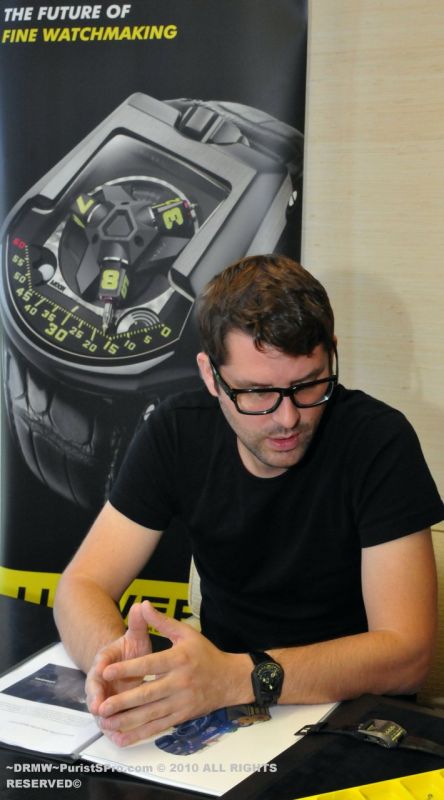
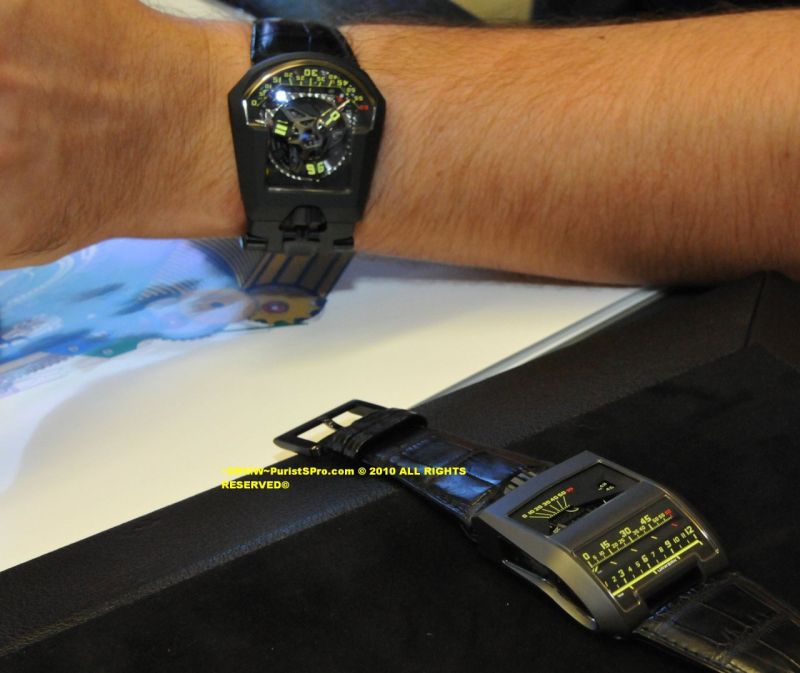
Felix: It was a 3 year development. The first year is between Martin Frei and myself. The second year goes to the construction, the engineering part, making the technical dossier. Third is for machining, prototyping, testing the movement. So this the 3 years we needed for this watch.
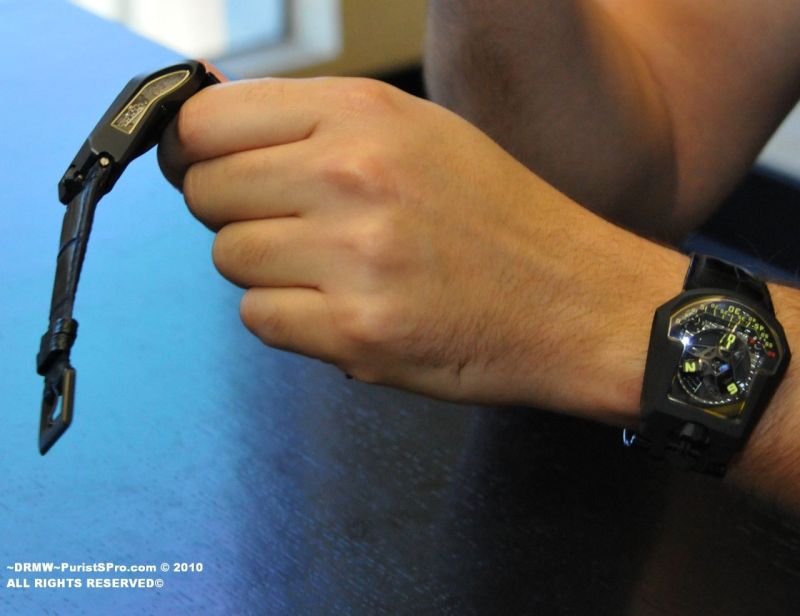
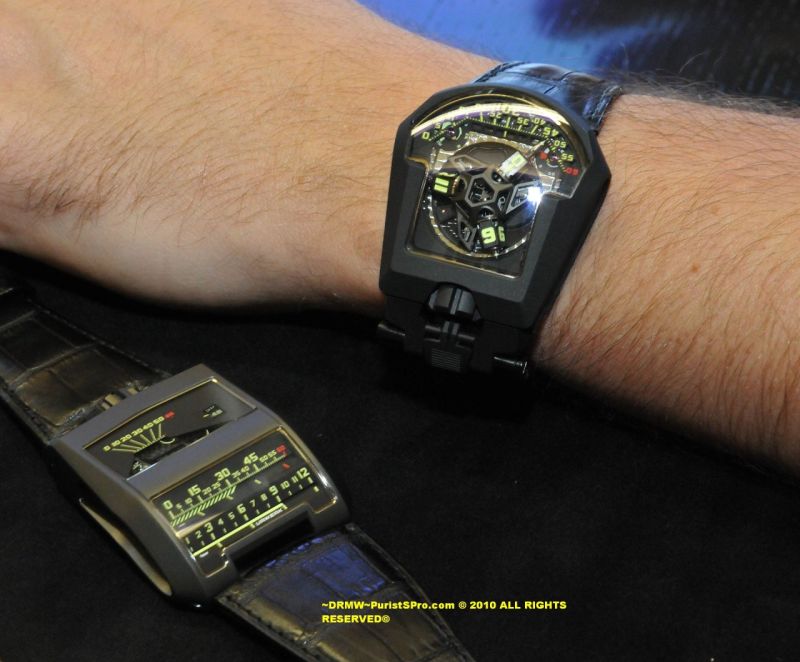
In the case of the cobra, 10 years , a dream of linear indications indicating the time. Then they saw Louis Cottier did it in the 50’s. Cottier was a traditional watchmaker in the 50’s for VC and PP who wanted to go in a new direction and collaborated with Aldier, a jeweler in Geneva, and created the linear minute & hour mechanism. This was the first inspiration, the indicators were similar to the cars of the American 1950’s that had linear speedometers. As a child I loved it a lot to have this style. Secondly the 2nd inspiration is the technical idea from Cottier which he made one piece but didn’t succeed to launch his own brand. He then sold the prototype to Patek and is now today in their museum. They haven’t launched the series for marketing and technical reasons. Cottier's model prototype due to gravity reasons only worked perfect in only one position the, the first position…which is flat, parallel to the ground, like on the wrist. We saw the piece and said cool! Cottier was a URWERK guy 50 years ago, because it was a different way to tell time, a cool way and intelligent way, you can read the time without turning the wrist. It touched us a lot and we thought, let’s do this! So we have 25 in black and 25 in white for the series.
We can only produce about 1 piece per month. Last year July/August we delivered the white ones and The black one we launched June/July and delivered at the end of August this year. 25 pieces each and that’s it. Then we move on to completely something else. There will not be a third edition like red or something.
You have two possibilities: Copper-Nickel or Silicuim.
The problem with Silicium is that it can break very quickly. The Copper nickel doesn’t break and you can make the piece thinner and even lighter without taking the risk for it to break. This procedure made it possible for Urwerk to make it work.
There is a second World’s First is the digital seconds. Every 2 seconds is indicated by a digital number. So mechanically the whole disc is turning. This a piece that never done before, so the cobra for URWERK had two challenges: making the biggest flyback mechanism ever and having the digital mechanism turning every 2 seconds. If you have a close look, each digital number is skeletonized. This makes this piece total weight 1.2grams, which is very light.
PPro: So how complex/ how many parts to all this?
Felix: You know in watchmaking, a marketing tool a lot of people use: ‘my movement has this many pieces...., 350 or even 860, or whatever’. I don’t count the pieces, and I don’t know how many pieces we have. And a newer marketing tool is ‘this pieces needs xx amount of hours of CNC machining’ we don’t use that, we don’t count that. We have our own CNC machines and technicians, all the pieces you can see are done in our workshop in Zurich.
Felix: The Carousel is produced out of one solid piece made of ARCAP, it a very delicate, incredible, and sensitive work for a CNC on the latest CNC machine that exists on the market to machine this piece. This is a 6 axis, 5 plus one because it can turn. Even the turbine is skeletonized, the telescopic minute hands, the satellites…so all these pieces. We have 50% of the pieces we cannot use since it is so delicate. After that machining, we have Quality Control, and we end up with 1 or 2 that pass that we can use.
We are always looking for new materials for its technical reasons and not for its marketing reasons. You can see that the last 10 years lots of brands that are using some funny materials. We also use quite a lot of traditional materials, very old school materials that are just better so the new material needs to really add something which is needed.
Silicium, for example, I don’t really see the place where it makes sense, I’m sorry here. It just breaks and it gives the poor watchmaker in 10 years who is to rebuild the piece out of Silicium, he may not be able to.
We approached ceramic companies but we haven’t found for the complex 3D case forms of URWERK, so it's not possible. Still there are limits. So If we would use the ceramic technique we would have to specially design a watch, so thus it is not an interest for us.
PPro: What is PE-CVD and AlTiN?
Felix: PE-CVD, it is a variation between PVD and DLC. Actually You know all these kinds of coatings are variations. This is very good for platinum and that we develop with Pressicoat to top the platinum. You have 2 natures of treatments. You have the optical aesthetic treatments where the goal is aesthetical to bring out the black or other color. And then you have technical where the goal is not the color but the goal is where the piece is more resistant. So we have on the dials and platinum cases we have optical reasons because we want to have for example black so optical treatment. But actually I personally prefer the technical treatment which for us is the AlTiN treatment, which we use often on our steel cases for the increase resistance.
AlTiN is Aluminum Titanium Nitride, it’s really not a typical watch maker treatment company, it’s more of a technical cutting tools. This the approach I personally prefer and that we use the AlTiN technical treatment.
Felix: It’s the big thing since 15 years. Please indicate me only one caliber that is working better than Rolex caliber or a 2892, just show me one of all the new movements. For me it’s not my challenge as a young watchmaker to recreating the wheel in a better way if it already exists. For me the challenge is to work where I can really add something interesting to watchmaking and this is what we try to do with URWERK. So this the main position of that point with URWERK, but we have plans on our own caliber. But we don’t want to have our own caliber just to have our own caliber which is actually better than a 2892 or a Rolex, It just doesn’t make sense. Doesn’t make sense.
For us the finishing, the important thing is to comfortably read the time. The hours and minutes are always matte or satin, we don’t polish there. We go in the logic of technical logic and in a legible logic. The different technique we use is satinee micro sand blasting and diamontage/diamond polish.
Felix: From the beginning to up until today, URWERK doesn’t do watches for a man and for a woman. We just make a watch. Even with the jewelry watches, there are men who like the jewelry watches. So we don’t care about that kind of marketing reflections. More than 25% of the 103 goes to women already, so it is up to them to choose.
PPro: Are the designs too masculine, do you want to shape it different for the female taste?
Felix: We are not working like that…we are not thinking ‘who is the buyer?’, ‘women or men’, ‘ or ‘old or young’. No. we are not doing marketing, we don’t do that.
PPro: Will Urwerk ever release a circular shaped case? Something different than the current case?
Felix:It is in reality, in the picture launch, so we have drawings for that. But as of today we have better ideas than making this round watch. So yes, We already have total concept and drawings and everything already done for a round watch.
Felix: I think the love for the culture of mechanical watchmaking will go on. And there will always people which don’t see the sense of it and others ones that can feel the passion for this so there’s no reason it goes over.
Felix: At URWERK it’s very simple. When we receive a watch for servicing, it’s one month of servicing time, but we make a security time of 1 month, but normally it’s 1 month. It can be a maximum of 2 months because we can have for example the summer holiday in between or the Christmas holiday . So we say normally 1 month when we are active at Urwerk so when we have holiday, it can be 2 months. There are 2 people in SAV at URWERK today and up until today we have no problem. We have 50 pieces in last year and this year it comes up to around 50 pieces we are servicing. So no problem.
You know in a company which is limited production… stable production, you can quite easily control that part. When you are a company with 40,000 or 400,000 watches a year, it is more sensitive.
Felix: I think the internet and made it possible that true artisansal smaller craftsman/smaller ateliers can exists today. Because thru the internet without big communication and big expenses, you can communicate what you are doing and you can explain what you are doing. So thru the internet and computer I think small companies as ours can exist today as we can reach very specific persons in our world, so it’s very important and great. Even when I am looking for a special object I need I go on the interent, this is just the third millennium you know, we are living today. Without internet, small companies like Urwerk would not exist today.
PPro: What kind of hobbies outside of horology do you have?
Felix: For me at the moment not so much free time, I have to be honest. In Geneva we built a small house, we move in with the family and I have 2 small kids. so between the 2 small kids and URWERK the small company, I’m totally no at the moment no hobbies.
I liked a lot sailing, for me no time but now I start again sailing, regatta in the Mediterranean Sea. I have friends they make the boat and we go to regattas. For me lots of music, it can be jazz, bebop, cool jazz. It can even be techno, it can be all kinds of good music. It’s like in watchmaking, you have very good traditional watchmaking and very good innovative, new watchmaking, it’s all about that.
Felix: Finally, It’s an exciting time now in watchmaking. We are going from classical watchmaking (you can compare it to classical music) now it goes open then it came from classical to jazz mucsi , rock-n-roll, etc…
So somewhere It’s still the beginning of it. It’s become more important, but we are still in rock, you have rock-n-roll, funk, you have disco. So there are some steps and I’m very positive to be alive today as a watchmaker and it’s great to have also people on the forum sites PuristSPro that likes this kind of evolution, it's great!
PPro: Thank you very much Felix!
Felix: Oh, it was my pleasure!
The Urwerk UR-101 is a unique creation from the independent watchmaker, representing one of their earlier forays into unconventional time display mechanisms. It stands apart from the brand's more complex satellite-hour indications, offering a distinct aesthetic and horological approach within their innovative catalog.
Details regarding the specific caliber and movement within the UR-101 are not widely publicized, consistent with Urwerk's focus on the external display and overall design. The case material is typically crafted from precious metals, often with a distinctive, ergonomic form factor that characterizes Urwerk's early design language. It features a time display that deviates from traditional hands.
For collectors, the UR-101 holds significance as an early example of Urwerk's experimental spirit and commitment to redefining timekeeping. Its rarity and unique display make it a notable piece for those interested in the brand's foundational designs and the evolution of independent haute horlogerie.
A close up look at the URWERK UR-CC1 Black COBRA "The UR-CC1 is a peerless timepiece - outside of even URWERK's own collection. On the UR-CC1, there are two horizontal indications displayed by two cylinders: one for the (jumping) hours, the other for the (retrograde) minutes. It took more than three years of research and development to overcome the technical challenges involved in linearly indicating the hours and minutes in this fashion. The resolution of three engineering puzzles allowed the U
I really love the pieces that Urwerk manufactures.
A close look at the URWERK 203 in Black Platinum. "The satellite complication is the nerve centre of the UR-203, crafted from ARCAP P40, a stable non-ferrous and non-magnetic alloy. The intricate structure is milled with micron-precision and then CNC machined to reveal the internal clockwork. Within the UR-203 the cams, the rubies and the transporters that ensure the ultra-precise alignment of the telescopic hands indicating the minutes, are all revealed. The precision of manufacture is incredib
Very cool, reminds me of the strange Patek Philippe that debuted in the 1950s or 1960s. But in a more pertinent and modern version. A watch without hands is always unique, there may be other watches that also don't have hands that are easier to read; but this watch will still be able to be appreciated even by owners of other handless watches. Thanks for the photo and the review DRMW!
Hello Patrick, Appreciate you looking. Yep, the Patek is a one-off prototype , created by Louis Cottier and is in the museum's collection. As parts had to be handmade in steel by Mr. Cottier and the technology in the 50's was very limited, it unfortunately does not work properly. However URWERK took it to a new level as noted in the interview and photos. and we now have the UR-CC1. As I'm fascinated by CNC machine work, it was amazing to see the the ARCAP carousel. Did you note how high the reje
I am familiar with Cottier's involvement with the World Time, but not on this piece until I read Felix's response. A 50% rejection rate for the ARCAP Carousel is immediate. Then after further machining, only a few left can be used. Thanks for the response!
This thread is active on the Independents forum with 38 replies. Share your knowledge with fellow collectors.
Join the Discussion →