
Vintage
Ludi presents a captivating review of vintage Seiko SilverWave watches, offering a deep dive into models from 1963 and 1965. This post is particularly valuable for its historical context, positioning the SilverWave as a significant ancestor to Seiko's renowned diver watches like the 62MAS. Ludi's detailed exploration, complete with various dial and bezel configurations, makes these often-overlooked pieces discoverable for new and seasoned collectors alike.
.. a pair of vintage Seiko SilverWave.
Hello there,
This is my first review ever on PuristsPro, and these watch are certainly not "luxurious wristwatches for collectors and buyers", so please be indulgent with me (and pardon my poor written english)... well, try to enjoy it anyway 
Seikomatic SilverWave, 1963

with its amazing starburst dial...

... which strangly remains me this super hero from my youth ...

If you look carefully, you might have notice above the "Silver Wave" text, but below the arbor for hands there is a circular logo ... it appears to be the logo that means "Special Dial" in Seiko nomenclatura
The Silverwave happened to be "the first" in so many things:
First Seiko with an internal rotating ring, first Automatic Seiko movement encased in a screw caseback instead of snap, and consequently waterproofed at 50m
This forgotten diver is supposed to be the ancestor of the famous 6217 or 62mas...

(credit WUS)

(credit WUS)
... so supposingly the first Seiko diver ever.
"[i]Prior to the 1964 Tokyo Olympics (with Seiko as Official Timer), Seiko had introduced its first range of truly submersible sport watches with (internal) rotating countdown bezels( in the form of the Seikomatic 50m Silverwave (1962)and the Sportsmatic 30m Silverwave (1964). These sports divers were the immediate precursors to Seiko (and Japans) first professional diver comprising 150m depth capability, shockproofing, extreme legibility and an external timing bezel,the 62MAS(1965)." (from the 6217 Buyers Guide).[/i]"
Several versions of this early Silverwave were produced from 1962 to 1964:
- white dial, white bezel

(credit google)
- white dial, black bezel

(credit myself)
- black dial, black bezel
(unable to locate...does anyone has a pic of this version .... ???)
Lately, a 50 m dial version appeared
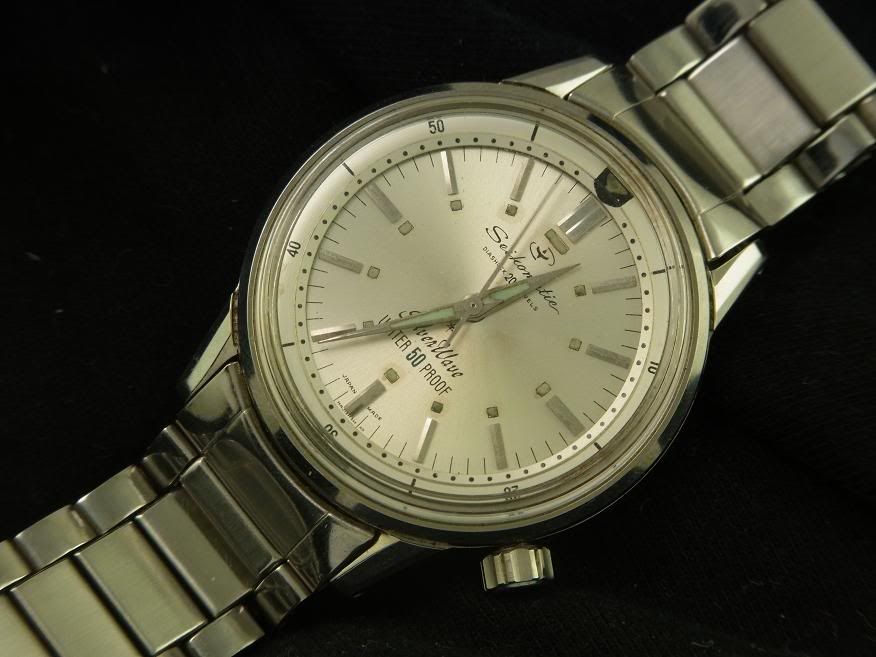
(credit kumakun / Seikoholics)

(credit Zonda / Seikoholics)
The watch was not cheap though: around 11.000 yens, mainly because of its Seikomatic 20 jewels caliber (62SW)
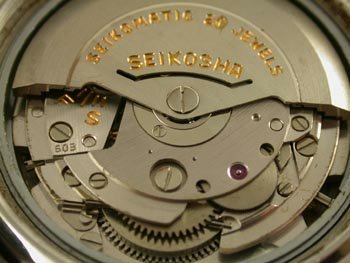
(credit google)
It works that way: turn the crown and you rotate the bezel, pull it and you set the time.... but impossible to wind it manually.
Sportmatic SilverWave, 1965


... and once again ...

From 1964, Seiko started to sell this "cheaper" Sportmatic version (8200 yens) with its 66SW serial 17 jewels caliber.
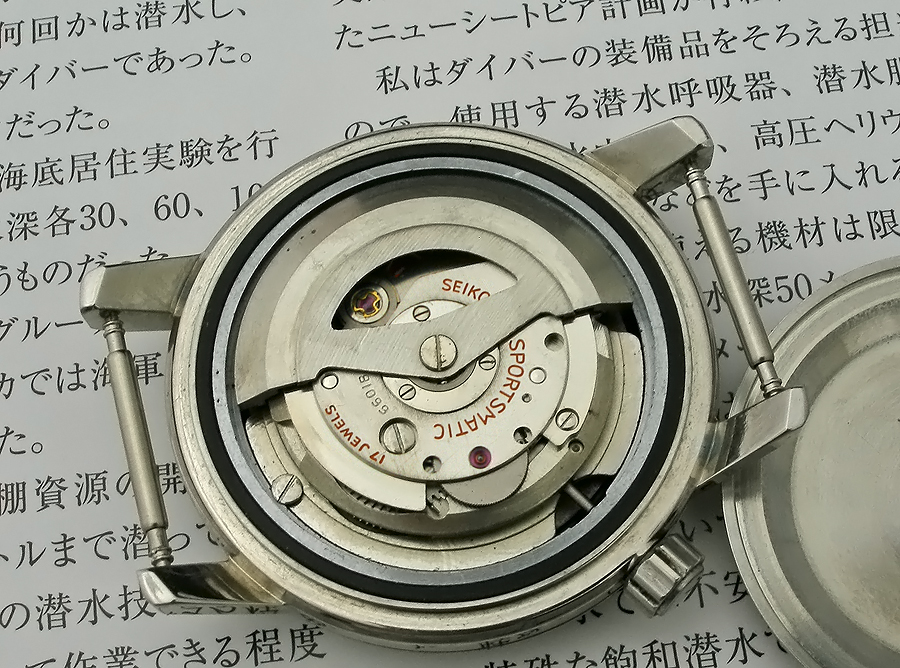
(credit google)
The watch is not the same class as the previous model: the dial does not have the same lustre of the 50M versions; other lesser features are only having a snap case back, 30m waterproof, the rotating bezel is made of plastic instead of bakelite (like the later 1968+ Sports 70m watches) and obviously the 17 jewel movement
Same dial and ring coulour variations as above:

(credit myself)
Funny copper patina... :

(credit Cannop / TZ-UK)

(credit google)
etc...
Underestimated, and far undervalued, these watches are absolutly legit for any diver fan collector nonetheless... IMHO of course 

Best regards
Fred
This message has been edited by Ludi on 2012-02-15 03:26:26i'm a bit of a Seiko fan myself, i like their in-house calibres, i like their designs, i like their dating system which makes it easier for me to find the correct year (1964) for me. this review shows that they were innovative with their dive watches. the inner rotating bezel uses the single crown and not a second crown as in the super compressors. you've also shown me that there is another Seiko for me to look out for to add to my 64 theme.(i have several including their 1 button chrono from th
Ludi, Thank you very much for the introduction to another Seiko that I didn't know. The one with the black bezel is a wonder! I feel sorry that here where I live, the most common vintage Seiko is always a chronograph. Cheers, Nilo
There's no limit to the interesting things we find in the watch universe. Thanks for taking the effort to assemble this overview. Mike aka Cazalea
... for your kind answers I'm not a big Seiko fan myself but I found this particular model interesting enough to focus more on this brand. The result is I'm tracking down a nice single button 5719 chronograph from 1964 (don't like the 5717 though)... No result so far, partly because they don't come often for sale, and no more replacement part so it has too be near pristine ( am I too greedy ?), but I'm quite confident anyway. The SilverWave are quote rare as well but I was fortunate enough to co
it has the plastic bezel and is in excellent condition apart from the bezel which shows wear, but what can we expect after 48 years. there is one Seiko chronograph that i'm looking at and have wanted for a while even though it doesnt fit into any of my collecting themes. its the 7016 which is a true flyback with bi axial hour/minute chrono subdial. one of the first bi axial chronograph movements i believe even though patek and others now use a double counting subdial. its also an auto with day/d
... whatsoever obviously Graham ... even if I have no idea about the question you're making reference to ? You are very lucky to own a 5719. Is it a white or black bezel ? I have myself an early 6139 from sept 1969. Its only interest, to my eyes, is being one of the first automatic chronograph ever produced, considering Seiko issued this movement on april 1969, same time as the El Primero and/or cal 11 (no debate on about who was the first to come ) . Seiko made a huge amount of various watch th
This thread is active on the Horological Meandering forum with 12 replies. Share your knowledge with fellow collectors.
Join the Discussion →