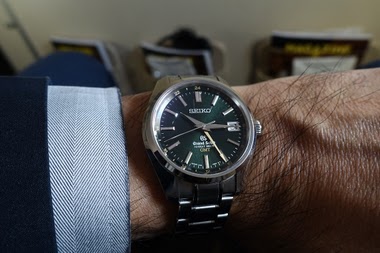
KMII's exploration of the 1971 Seiko 3823-7000 VFA Quartz offers a fascinating look into a pivotal moment in horological history. This article delves into the 'Very Fine Adjusted' quartz technology that challenged mechanical watch accuracy standards of its era. KMII highlights how this early quartz VFA, despite its groundbreaking precision for the time, paved the way for future innovations like the modern Grand Seiko 9F movement.
The three letters VFA - Very Fine Adjusted - usually conjure up sweaty palms and excitement amongst Seiko enthusiasts. They have historically stood for the most accurate time pieces, beating the standards of the day. The Grand Seiko hand wound and automatic watches with the VFA label managed a guaranteed 30 seconds +/- deviation per month in the late 1960s - something truly extraordinary (here:
www.watchprosite.com
for an overview of the classical model lines).
At the same time Seiko launched a revolution with its 1969 Astron 35Q (to be followed by 35SQW shortly afterwards) - their first quartz watch. Shortly after the launch the Suwa designed Cal. 3500 movement was further refined into the thermally compensated Cal. 3800, which was furthermore adjusted to 6 positions.
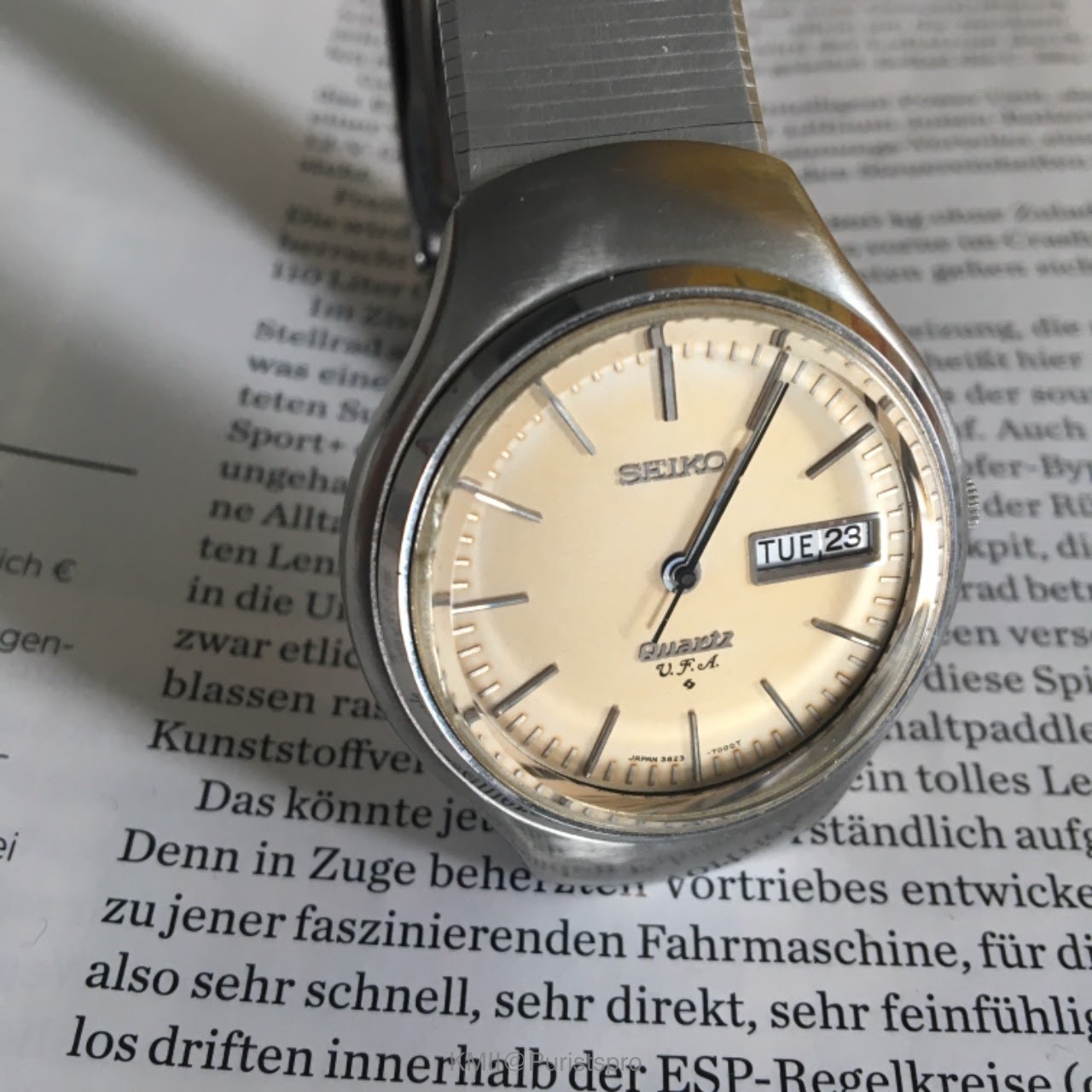
This movement is the heart of my recently arrived 1971 Seiko 3823-7000 VFA Quartz. The VFA version promised a heady +/-5 seconds a month deviation - something completely unheard of in the day. It had a price to match - 150.000 yen or the equivalent of a Toyota Camry - at the time (about 50% more than a mechanical GS VFA in steel if I got my figures right).
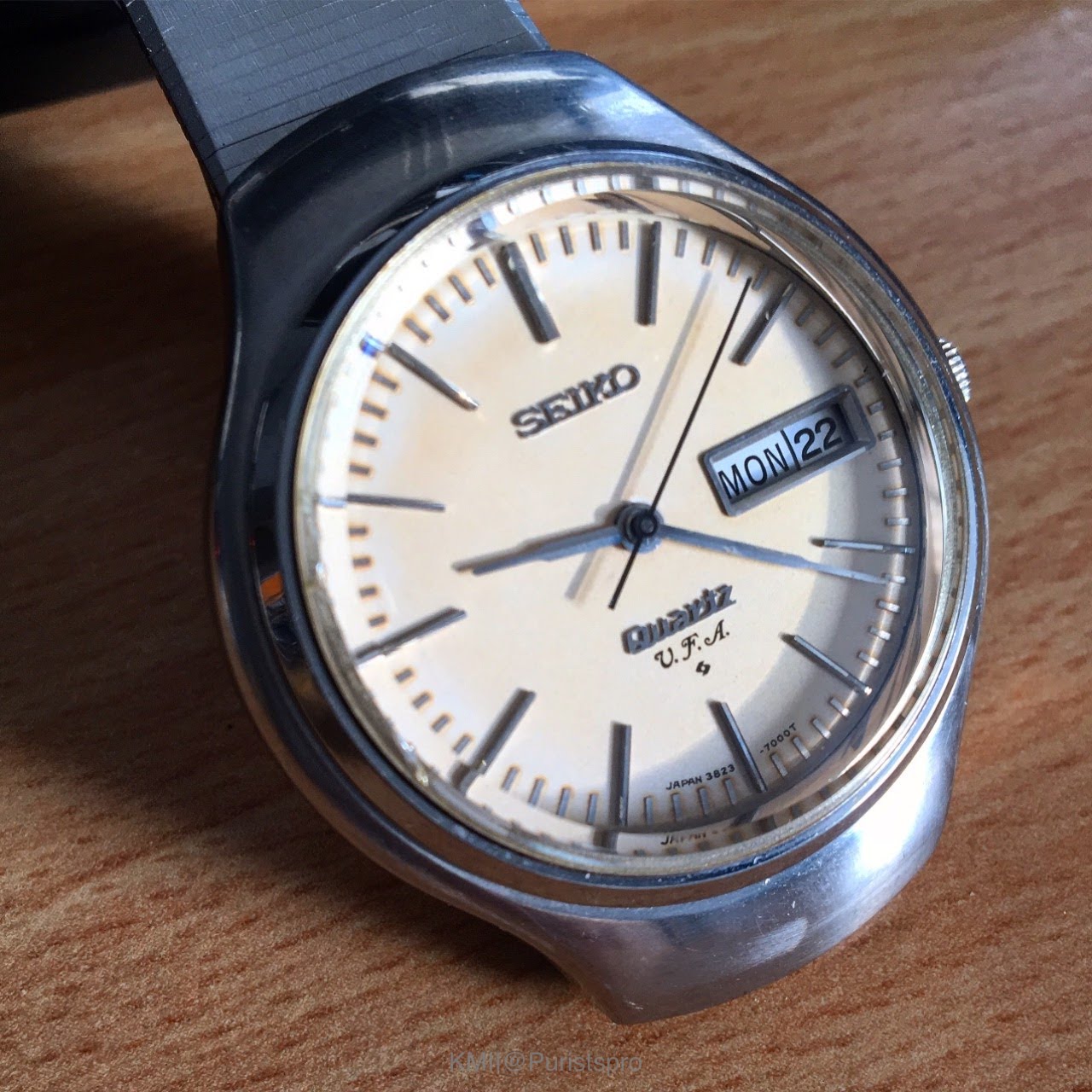
Mine comes in the 7000 case, which is suitably ‘spacy’ and fits the era. It also has a wonderfully patinated dial, which turned from white to a fairly uniform cream and a day date complication (both discs are white still).
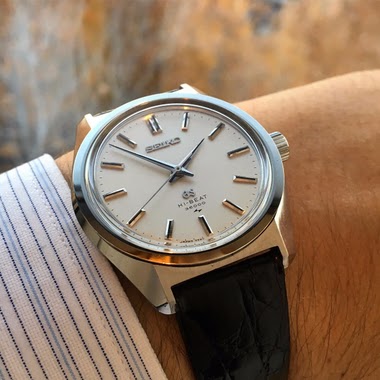
The 3823 model also featured a dial variant that would later lead to the famous SBGA11 Snowflake (the 3823-7040, I believe).
Not only the hour but also the minute markers are applied. The finish is perhaps not quite GS grade but then the watch was more a showcase for the then novel quartz technology than for Zaratsu polishing.
The hour and minute hands somewhat resemble the current dauphine fusee shape used by Chopard in its LUC line but the ‘thick part’ is longer here. The seconds hand is black.
The watch is topped by a fairly thick and slightly protruding crystal that does interesting things in terms of distortion of the dial edge, when looked through at an angle.
I have to admit that even the VFA Standard from 1971 cannot quite match the atom clock accuracy of a modern Grand Seiko 9F quartz movement but the watch definitely is fun - and a historical curiosity - nevertheless.
Thanks for reading!