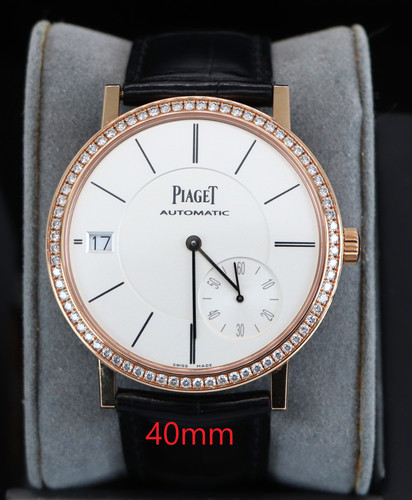
As announced a few weeks back, I was the lucky winner of the Piaget Altiplano Skeleton Contest. Learning of my success was exciting and also a humbling moment for me. As you all know, the community here possesses vast knowledge about watches, watchmaking, calibers and so on. Even so, the contest quiz questions were not easy. But of course there are more than a few of us here who relish a great challenge, and I knew that the contest would be "up for grabs" by any number of knowledgeable and passionate individuals. Coming out as the winner of such a contest, it was with great honor and respect of the PuristS community that I accepted the grand prize: a 2-day trip to visit Piaget in Geneva and La Cote Aux Fees.
And now that the requisite approvals from Piaget have been given, I share now my photo essay, along with various bits of commentary. I hope you enjoy.
***
The trip began with a long flight -- Denver to Geneva, via London.
Almost wheels-down, but first a quick cup of tea. Need to adjust my watch to the proper timezone, too!
It was snowy and beautiful -- there was a great moment as my plane descended through the cloud ceiling and suddenly Lake Geneva became visible.
The first evening, I met fellow (and famous) Purist "MTF" at the hotel where we enjoyed a nice Lebanese meal while getting to know each other a bit. That was a real treat -- the first fellow Purist I have met in person.
We dined on traditional Lebanese courses and desserts
And even Lebanese wine!
DAY 1 - We arrived at the Piaget headquarters in Plan-les-Ouates, only 15 minutes or so from our hotel in central Geneva (sorry, this is a stock photo -- I did not get a good exterior photo of my own).
Our tour consisted of a very thorough and personal tour of the entire manufacture, by a wonderful guide, she knew everything we had to ask. We walked through almost every section seen here in the facility map.
The main hallway had wonderful color sketches of many of Piaget's famous calibers. Here, for example is one, the Piaget Caliber 12P1. Would love to have a few of these for my walls!
The architecture of the Plan-les-Outes manufacture was open with high openworked ceilings, lots of natural light and minimally finished lumber. At ground level -- machinery everywhere!
Here is the treasure trove of raw precious metal rods. Most all you see here would be "sliced" and turned into links for Piaget's bracelets. Even a short rod, 18K gold, maybe 18-20 inches long -- heavy!!! Not a surprise for me as I have handled precious metals before, but if you have not handled gold before, well it is heavier than you might think!
This is a CNC machine at work -- it is producing bracelet links.
Here is the output of that CNC machine:
A sample of the links are quality-checked against original design schematics. Pieces which do not meet the required specification will require that the CNC machine gets a slight re-calibration so as to meet Piaget's high standards for precision. You can sense the magnitude of the magnification by simply observing that the actual piece is hardly visible on the glass plate below!
Here a Piaget craftsman works on bracelet pieces.
Now --- This was very interesting to me -- any guesses what this piece is? Go ahead, take a guess and then below I will tell you:
The piece above is what is known a tap (I'm not sure if that's what Piaget calls it, but that is essentially what it is). Of course it is shown magnified by probably 100x-200x. The actual piece was perhaps slightly larger than the diameter of a pencil lead. The shaped tip you see was almost imperceptible to the naked eye. If you are not familiar with taps, they are what is used to create threading in a bore so that it is thus able to receive a screw. Taps are perhaps more commonly heard as "tap and die" -- with taps used to create the female threading, dies used to create the male threaded piece (think nuts (requiring a tap), and bolts (requiring a die)). So for me it was fascinating to see this basic technology of machining at a relatively microscopic level. Practially speaking, it makes perfect sense -- the screw holes in a mainplate need threaded somehow!
One other quick note here while I talking watch tools. This is a good example of the high degree of vertical integration at Piaget, which was impressed upon us at various times throughout our tours. All of their tools are made in-house. For each new watch, a new set of specialized tools is required. Approximately 50 new tools are created specifically for each new watch that Piaget produces.
Next we moved to case/bezel/crown production. Here is a pile of freshly made watch crowns, some polished, some brushed. The "P" as seen on many of the crowns is done one-by-one (by machine, I believe).
Here you see a Piaget artisan decorating the inside of a caseback. While the technique looks like perlage, I was told by Piaget that perlage is a term which applies specifically to decoration of movements. When applied to a case, there is a different term. And darn if I did not get the term into my notes! But just know that it is not perlage.
"Before and After" of an engraved caseback. The tool above the casebacks gets credit for the work.
Bezel "blank" and machined bezel side-by-side. As you can see, this bezel is missing a few dozen pieces -- it is ready to be diamond-set (more on this in a moment):
Next up, bracelet assembly and fitting. This was to me one of the two most interesting aspects of the visit. Piaget makes some amazing bracelets, unlike any other. The have a wealth of knowledge and technique for making luxurious bracelets -- some of it resident solely within a couple of their talented artisans. Which is why they are also trying to transfer this knowledge to others so that some of these techniques do not become things of the past. Piaget has eighteen people who focus on just bracelets -- shows you how important this is to the manufacture.
Bracelet pieces awaiting assembly:
Special thanks to MTF, hand-model, in the photo below. Is that a Piaget on Melvyn's wrist?

More bracelet's. Gorgeous. Feminine. Piaget through-and-through.
These ladies bracelets were wonderful. So soft and smooth and flexible.
This last photo you will also find interesting. In this instance, Piaget was attending to a client who had a watch on a white gold bracelet -- but the original braclet was designed such that its length was not adjustable. But the client wanted a longer bracelet. So Piaget was in the process of extending this bracelet. They crafted and attached an extension on to the bracelet. But of course it did not match the design of the original. So a Piaget engraver was going through this extension, millimeter by millimeter and hand-engraving it such that it matches the original. Amazing! And again a good example of the fine skills and talented people who help make Piaget as esteemed as it is today.

The other most impressive aspect of the tour for me: the stone-setting department. Piaget has eighteen (yes 18!) stone-setters. Bezels, cases, bracelets even calibers! -- you name it, Piaget can put a diamond into it. Truly this is one of the distinguishing attributes of the brand. Remarkable talent and skill and experience is required for work like this and a good case can be made that no one does it better than Piaget.
Baguettes ready for setting.
Just one more thing I will point out here. The color-coded page just below the TV screen is what the "map" for the stone-setter. Each color represents a different stone or stone size. The engraver follows this color coded map to know precisely what type and size of stone to place where. He works under a high powered microscope. It is attached to this video screen, which made it easier for us to observe his work. A bit of science added to the art, if you will.
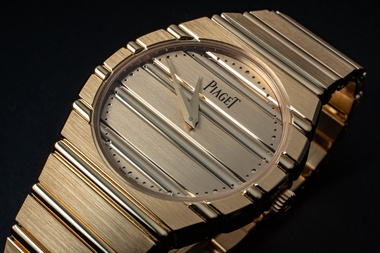
This was a fun piece to try on. Just happened to be out when we were there. A full diamond Polo. Fit me perfectly!!!! Although it does not suit my tastes. Or my bank account. Piaget will make 1, maybe 2, of these pieces on an annual basis. And yes they do sell.
Lastly on Day 1, we reached the assembly department for whole watches. Show here, the Altiplano Skeleton with ultra-thin Caliber 1200S. An amazing watch, perhaps my favorite reference of all from Piaget right now. This is the front and back of a near-finished piece.
This is a near-finished Altiplano Ref G0A37217. A limited, numbered edition of 235 pieces with ultra-thin Caliber 1200P, rose gold case and chocolate dial. Not also some modest guilloche on the outer dial. Beautiful.
We then met with a representative of marketing and sales. He passed around several of the 2013 novelties and we had a nice conversation for an hour or so.
Below, a 38mm Rose gold Altiplano. Piaget Cal 430P hand-wound. Simple and elegant. Or "Extreme simplicity" as I believe it was described by Piaget.
Day 1 ended with a beers and burgers at the hotel bar.
DAY 2 - La Côte-aux-Fées
A 60-90 minute drive into the mountains of Switzerland. We arrive at La Côte-aux-Fées. A quiet and small mountain town at 1038 meters, replete with its own small ski hill right out the back door of the manufacture. I live at about 2300 meters, so it was nice to feel at home away from home in the mountains
The relatively nondescript Piaget building is shown above.
All of the Piaget calibers are made here. About 100 watchmakers in-residence. There is also a machine shop where various tools are made.
Unfortunately I do not have photos from La Cote aux Fees for you, but I
can tell you that as at Plan les Ouates, we were provided a very up close and
intimate tour of the manufacture, which was very much appreciated.
Our host at La Cote Aux Feex was wonderful. He has been with Piaget for decades and his knowledge was immeasurable. It was a pleasure to spend the day with him.
I did manage to get a photo of a tray of famous Piaget Calibers:
here is a closeup of the 1050P from 1993 (note: slightly out of scale because my finger was approximately 1/2 inch closer than the caliber):
The last part of Day 2 was a real treat -- Piaget organized a watchmaking session for us. We each had our own work station and a 73-component Unitas hand wound caliber to disassemble and re-assemble. Led by a 2nd generation Piaget master watchmaker. Great fun! And newfound appreciation for talented watchmakers!!! Yes I lost a spring! I really enjoyed this experience, however difficult it was.
We finished day two at the hotel with a superb dinner in the other restaurant -- classic French cuisine.
***
As you can see, Piaget could not have been a more gracious host. Special thanks Vincent B. of Piaget for his wonderful job organizing the trip, and everyone else at Piaget who took time to share insights and guide us, and all of the artisans who were kind to move a shoulder such that we might get our cameras through for a quick pic.
And finally thanks to the PuristS community for the contest opportunity. And to MTF for joining me on the visit. As I say I was humbled to be the winner and it was an honor to represent in Geneva.
I welcome you comments and any questions.
Kyle/KWS
This message has been edited by MTF on 2013-03-11 08:54:24