Foversta provides a hands-on review of the Piaget Altiplano Chronograph in white gold, a watch that presents a fascinating paradox. He delves into its design choices and movement architecture, questioning initial impressions while ultimately finding its unique charm. This article explores why a watch with perceived flaws can still captivate a collector.
Piaget, as the specialist of the ultra-thin watches, presented at the SIHH 2015 the Altiplano Chronograph which distinguished by two records for a handwind chronograph: one for the thinnest caliber (4,65mm) and one for the thinnest case (8, 24mm). In this context, Piaget took the opportunity to unveil a new movement, the 883P deriving from the 880P.
This watch has been until now only available in rose gold in its configuration without set gems but a new version in white gold has just been unveiled during the last SIHH. It gives me the opportunity to come back to this very paradoxical watch.
In fact, this Altiplano Chronograph is a kind of enigma for me. When I analyze it soberly, I find in it several issues or question marks. Taken one by one, they could be perceived as prohibitive. Or, and this is surely the magic that comes from Piaget, once put on the wrist, it exudes an undeniable charm and a certain originality. But what are exactly these issues?
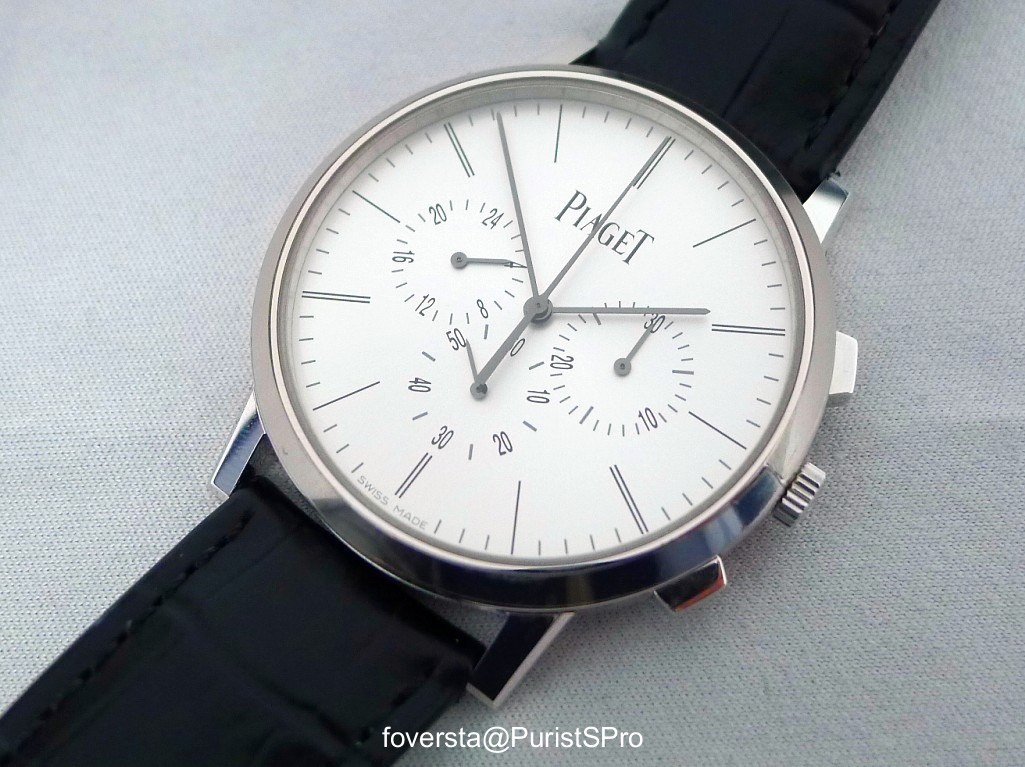
First of all, I was far from imagining that the chronograph would have been the first real complication joining the Altiplano line. Of course a date window (at 9 o'clock) had previously initiated this will from Piaget to provide complications in the context of its ultra thin and elegant line. But with a chronograph, we change the complexity dimension, the watchmaking level and this complication did not seem the most logic at least for my point of view. After all, the chronograph gives a very masculine side even a sportive one to watches and it almost seemed at odds with the Altiplano spirit.
Then, by making the choice of a handwubd movement, Piaget developed the caliber 883P from the 880P one. The problem is that the movement is relatively disappointing visually speaking despite the great care in the finishes: it doesn't hide its "automatic" origines and its architecture is unquestionably that of a movement which lost its winding mass.
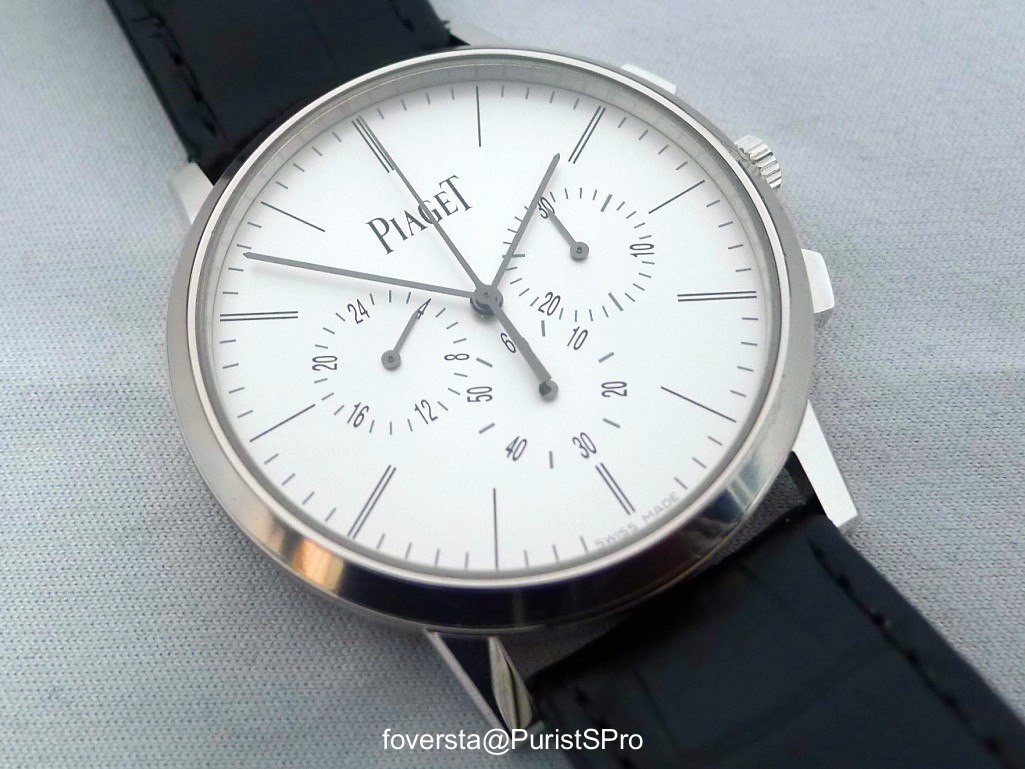
Moreover, the diameter of this movement remains small for a chronograph caliber (27mm) and by putting it inside a 41mm case, Piaget has complicated the designers' job dial side. The subdials then seem too close to the center and and the watch appears unbalanced. The graduation scales of the chronograph counters are only suggested and the dial doesn't use any applied element. It is the reason why it can be perceiced as extremely flat.
Finally, in its strong will to make the style of the watch as pure and sober as possible, Piaget didn't put any intermediary mark between the second marks of the peripheral scale that is followed by the chronograph second hand. Therefore, it doesn't display the 1 / 8th of second of the chronograph while the 4hz frequency of the movement (for a power reserve of 50 hours) would have allowed it.
Unbalanced, aesthetically oversimplified and powered by a movement whose lay-out is not fully convincing, the Altiplano Chronograph seems at first affected by significant flaws. But after all, we don't analyse a watch only step by step: it has to be considered first as a whole. And it is on this point that Piaget restored the situation like a cat land on their feet.
It took me a long time to understand if I like (or not) this Altiplano Chronograph, hesitating between the dark vision described before and a much more positive perception. I finally chose the second option. The reason is very simple: when I put it on the wrist, the Altiplano Chronograph becomes attractive and I even want to say that its flaws become assets. The additional complication brings more a dose of energy and character to the Altiplano context than a true complementary function even if, obviously, the chronograph is fully operational. The purity of the dial, the very sober subdials, the peripheral scale reduced to its simplest expression then explain and eventually strengthen the consistency of the watch. After all, the peripheral scale is also simplified on the Gouverneur or Polo which use the caliber 880P.
The 883P movement in the context of the pink gold version:
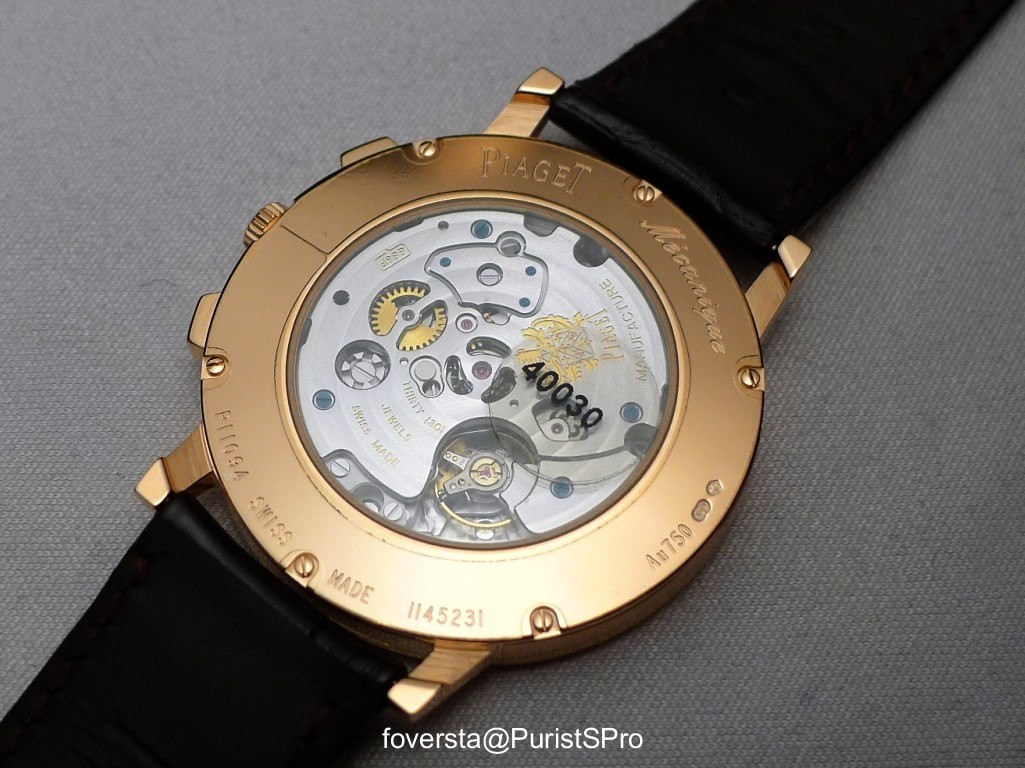
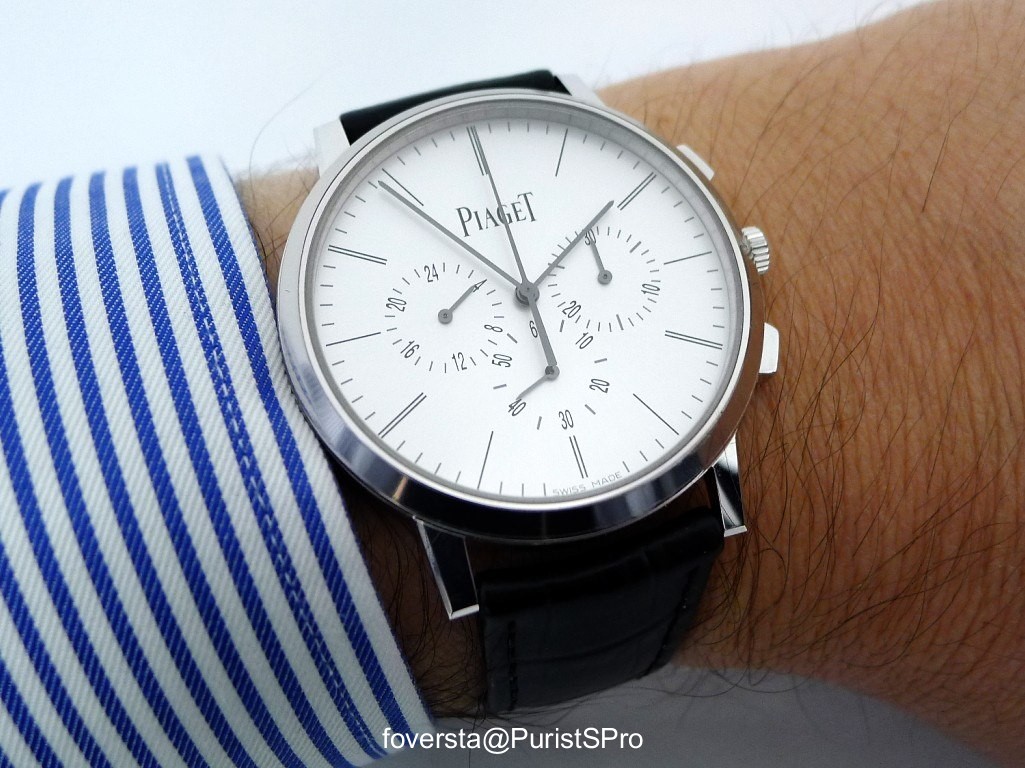
The counters too close to the center even find grace to my eyes. If the real purpose of this watch was to be a chronograph instrument, such a situation would disturb me a lot. Once put on the wrist, the Altiplano Chronograph seduces with its presence, its extremely slender style (the diameter to thickness ratio is very high) and this concentration around the center appears more than an originality than a concern. The discreet pushers and the fact that all the hands have the same color also support the idea that the complication should fade into the watch.
This presence (the perceived size is also larger than the 41mm diameter) can be seen as paradoxical for a dress and elegant watch. This opposition also explains the special nature of the Altiplano Chronograph that behind a very quiet appearance does not hesitate to break the usual codes and rules.
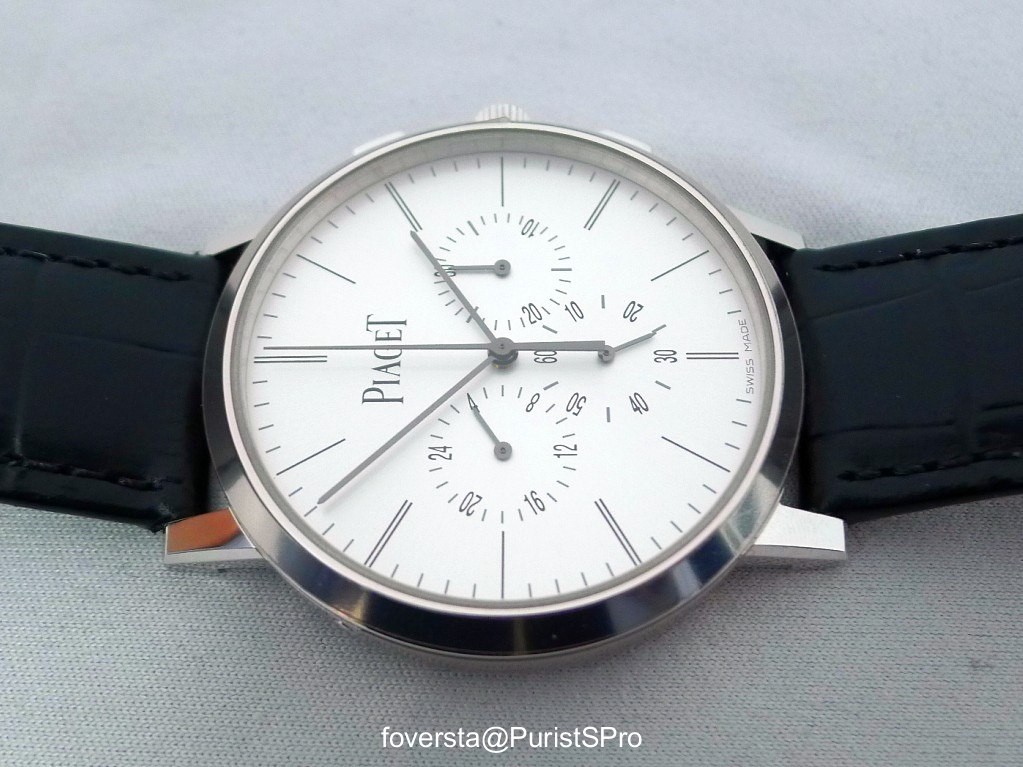
The white gold version of this year is of course more discreet than its predecessor in rose gold. The latter remains my favorite, but I like the monochrome rendering of the watch presented at the SIHH 2016. It is perhaps more versatile considering its neutral colors but I lack the warmth of the pink gold case.
The Altiplano Chronograph is in conclusion a watch that it is imperative to try to forge a reliable opinion. The pictures, the technical features do not give justice to its charm and only the test on the wrist can validate our own perception. Paradoxical, enigmatic, with a strong character despite its sober dial, the Altiplano Chronograph doesn't leave us indifferent what is an excellent point. It takes time to be appreciated and it is why we must not stay with our first feelings and spend more time with it to catch its interest.
Thanks a lot to the Piaget team for its warm welcome at the SIHH 2016.
Pros:
+ A watch that has much more character than we can imagine at first glance
+ The simple and neat finishes of the movement
+ The elegance that emanates from its pure style
+ The presence on the wrist
+ the stylistic versatility of the white gold version
Cons:
- The architecture of the movement which can't hide its "automatic" origins
- The movement is too small for the case and a solid caseback would have been better
- A paradoxical watch, its flaws for some can be seen as points of interest for others (like the counters too close to the center)
Fx
This message has been edited by foversta on 2016-02-01 14:40:55