quattro's meticulous overview of the Patek Philippe 'Padellone' case, specifically the Ref. 3448 and its related references, offers an invaluable resource for collectors. This deep dive into one of Patek Philippe's most iconic and historically significant perpetual calendars highlights its design evolution and rare variants. Understanding the 'Padellone' case is crucial for appreciating Patek Philippe's pioneering role in self-winding perpetual calendar movements.
Designed in 1962 by the Antoine Gerlach manufacture, the case of the ref. 3448 (the very first self-winding perpetual calendar made by Patek Philippe) was nicknamed the "Padellone", Italian word for "frying pan".
It can be found, with minor modifications, in three other references, which I happen to like quite a lot: 3450 (which I like a little less to be honest), 5235 & 5236.
Here's an overview: enjoy!
A/ Ref. 3448 (cal. 27-460, 37.5mm case)
1/ Yellow gold


credit: amsterdam vintage watches

 Alan Banbery’s unique ref. 3448J ‘No Moon Phase’ with Phototype Leap Year Indication
 (credit: christie’s)
2/ Rose gold (this is the only known rose gold example, which comes with a unique "double P" crown)
3/ White gold


credit: hodinkee

 Only known ref. 3448 with Leap Year Indicator, a specificity of the ref. 3450. White gold.
 (credit: hodinkee)
 Ref. 3448 ”Senza Luna": one of six known pieces without a moon phase
 (credit: William Massena on TimeZone)
4/ Platinum (there was originally no platinum 3448, but, in 1997, Philippe Stern approved the assembly of two 3448s in platinum cases, using previously cased movements from the 1960s)
 Property of Jean-Claude Biver
 (credit: hodinkee)

 Ref. 3448/100 from 1973 with sapphire-set indexes (cased in platinum in 1997). It was sold at a 2021 Hong-Kong Auction
 (credit: phillips)
(cal. 27-460QB, 37.5mm case, leap year indicator between 3 and 4 o'clock)


credit: christie’s

credit: reddit


credit: the keystone

Variant with Roman numerals & needle hands (credit: WatchTime)
C/ Ref. 5235 Annual calendar regulator (cal.31-260 REG QA, 40.5mm case)
1/ White gold ref. 5235G-001


credit: the keystone

credit: Sjx


credit: a collected man
About the Patek Philippe Perpetual Calendar Ref. 3448
The Patek Philippe Reference 3448 is notable as the brand's first self-winding perpetual calendar wristwatch. Introduced in 1962, it marked a significant technical advancement for Patek Philippe, combining the convenience of an automatic movement with the intricate perpetual calendar complication. This reference established a new standard for complicated wristwatches and laid the groundwork for subsequent automatic perpetual calendar models. It was produced for over two decades, demonstrating its enduring appeal and technical success.
The watch features an 18k yellow gold case with a diameter of 37.5 mm, housing the automatic caliber 27-460 Q. This movement provides a power reserve of approximately 40 hours. The dial is champagne in color, protected by a sapphire crystal, and the watch offers a water resistance of 30 meters. The bezel is polished, complementing the overall classic design of the timepiece.
Reference 3448 is highly regarded by collectors for its historical significance as Patek Philippe's inaugural automatic perpetual calendar. It appeals to those who appreciate the blend of traditional watchmaking with technical innovation. The model was primarily produced in yellow gold, with very few examples in white gold, rose gold, or platinum, making those variants particularly rare. Its production run concluded in 1985, solidifying its place as a key reference in the history of complicated Patek Philippe wristwatches.
Specifications
- Caliber
- 27-460 Q
- Case
- 18k Yellow Gold
- Diameter
- 37.5 mm
- Dial
- Champagne
- Water Resist.
- 30m
- Crystal
- Sapphire
About the Patek Philippe Grand Complications Ref. 3450
The Patek Philippe Reference 3450 is a perpetual calendar wristwatch with a moon phase display, notable for its unique leap year indicator. This reference succeeded the 3448 and introduced a new mechanism for displaying the leap year cycle, distinguishing it from earlier perpetual calendar models. It represents a significant evolution in Patek Philippe's perpetual calendar lineage, bridging the gap between vintage and more modern interpretations of the complication.
This reference features a 38mm case, typically crafted from 18k white gold, housing an automatic movement. The watch is fitted with a sapphire crystal, protecting a silver dial. The movement, caliber GP3100, provides a power reserve of 42 hours and incorporates the perpetual calendar and moon phase functions. The case design is characterized by its balanced proportions and refined finish.
For collectors, the Reference 3450 is particularly appealing due to its limited production and the innovative leap year display. It is considered a transitional reference, offering a blend of traditional Patek Philippe aesthetics with a technical advancement. The rarity of this reference, especially in certain case materials, contributes to its desirability among enthusiasts of complicated vintage timepieces.
Specifications
- Caliber
- GP3100
- Case
- 18k white gold
- Diameter
- 38mm
- Dial
- Silver
- Water Resist.
- 30m
- Crystal
- Sapphire
About the Patek Philippe Annual Calendar Regulator Ref. 5235
The Patek Philippe reference 5235 Annual Calendar Regulator introduced a distinctive display format to the brand's annual calendar complication. This model features a regulator-style dial, separating the hours, minutes, and seconds into distinct subdials. The central hand indicates minutes, while the hours are displayed in a subdial at 12 o'clock and the running seconds in a subdial at 6 o'clock. This layout provides a clear, uncluttered presentation of time and calendar information, distinguishing it from other annual calendar offerings.
The watch is housed in an 18k white gold case measuring 40.5 mm in diameter and 10 mm in thickness. It is powered by the self-winding caliber 31-260 REG QA, a movement specifically developed for this regulator display. This movement provides a power reserve ranging from 38 to 48 hours. The watch is fitted with a sapphire crystal on both the front and an exhibition case back, offering a view of the movement. It is water resistant to 30 meters.
First appearing in 2011, the 5235 appeals to collectors seeking a Patek Philippe annual calendar with a unique aesthetic. The regulator display, while historically rooted, offers a contemporary interpretation within the brand's complicated watch lineup. Its production run has seen it offered primarily in this white gold configuration, making it a consistent and recognizable piece for those who appreciate its specific technical and design characteristics.
Specifications
- Caliber
- 31-260 REG QA
- Case
- 18k White Gold
- Diameter
- 40.5 mm
- Dial
- Opaline silvery
- Water Resist.
- 30m
- Crystal
- Sapphire
About the Patek Philippe Complications Ref. 5236
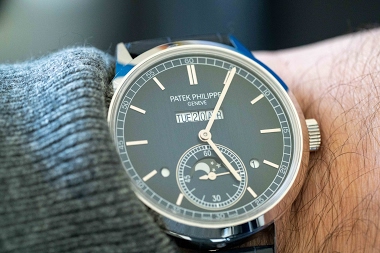
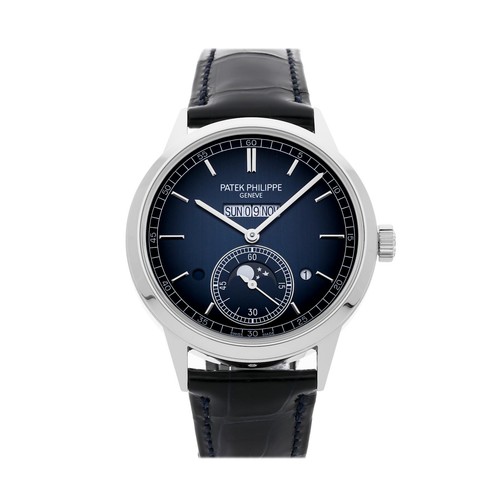
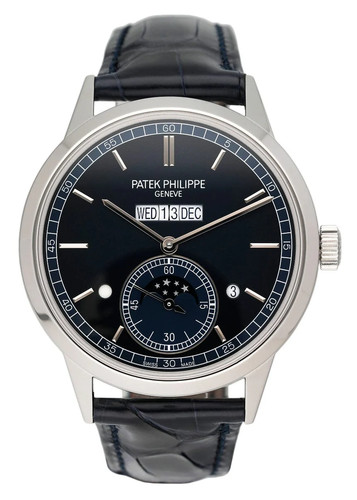
The Complications reference 5236P-001, introduced in 2021, is notable for its in-line perpetual calendar display. This configuration presents all calendar indications – day, date, month, and leap year – in a single, elongated aperture below 12 o'clock. This design choice offers a distinct aesthetic and legibility compared to traditional perpetual calendars with multiple subdials or apertures. The reference was a significant addition to Patek Philippe's Complications collection, showcasing a novel approach to a classic grand complication. Its platinum case and blue dial further underscore its position within the brand's high-end offerings.
The watch is housed in a platinum case measuring 41.3mm in diameter, with a thickness of 11.07mm. It is powered by the self-winding caliber 31-260 PS QL, a movement specifically developed for this in-line perpetual calendar display. This movement incorporates several technical advancements to achieve its unique calendar presentation and offers a power reserve of 38 to 48 hours. The watch features a sapphire crystal on both the front and the case back, allowing for a view of the meticulously finished movement.
As a relatively recent introduction that was subsequently discontinued, the 5236P-001 holds particular interest for collectors who appreciate innovative calendar displays and limited production periods. Its technical sophistication and unique aesthetic appeal to those seeking a distinct perpetual calendar from Patek Philippe. The discontinuation of a model introduced in 2021, while not uncommon for certain high-end references, adds to its potential collectibility, distinguishing it from longer-running production pieces.
Specifications
- Caliber
- Caliber 31-260 PS QL
- Case
- Platinum
- Diameter
- 41.3mm
- Dial
- Blue
- Water Resist.
- 30m
- Crystal
- Sapphire
About the Patek Philippe Complications Ref. 5236P
The Complications reference 5236P is notable for its in-line perpetual calendar display, a distinctive arrangement that presents the day, date, and month in a single aperture at 12 o'clock. This design choice offers a clean and highly legible presentation of complex calendar information, differentiating it from other perpetual calendar models that typically use multiple subdials. Introduced in 2021, this reference quickly became a point of interest for collectors seeking innovative calendar displays within a classic Patek Philippe framework.
Crafted in platinum, the case of the 5236P measures 41.3mm in diameter and houses the self-winding caliber 31-260 PS QL. This movement is equipped with a platinum micro-rotor and operates at a frequency of 4 Hz, providing a power reserve of approximately 38 to 48 hours. The watch features a sapphire crystal on both the front and the exhibition case back, allowing for a view of the meticulously finished movement.
This reference appeals to collectors who appreciate technical innovation combined with traditional watchmaking artistry. Its unique in-line perpetual calendar display represents a significant development in the brand's perpetual calendar offerings. The 5236P fits into the Complications collection as a sophisticated and technically advanced timepiece, appealing to those who value both mechanical ingenuity and refined aesthetics.
Specifications
- Caliber
- 31-260 PS QL
- Case
- Platinum
- Diameter
- 41.3mm
- Dial
- Blue-black
- Water Resist.
- 30m
- Crystal
- Sapphire