Omega Chronometers 1905-1974 Overview
Vintage

Omega Chronometers 1905-1974 Overview

By Bill Sohne · Nov 9, 2008 · 27 replies
Bill Sohne
WPS member · Omega forum
27 replies9868 views28 photos
f 𝕏 in 💬 🔗

Bill Sohne presents a comprehensive overview of Omega chronometer-grade watches, spanning from 1905 to 1974. This detailed presentation delves into the technical evolution and distinguishing characteristics of Omega's precision timekeeping, offering invaluable insights for collectors and enthusiasts interested in the brand's historical commitment to chronometry.

27 collectors discussing this on the WatchProSite forumJoin the Conversation →
Hi everyone ....

This is a presentation on Chronometre grade Omegas from 1905 to 1974.. i hope you enjoy it as much as I enjoyed writing it.


The above is first generation case ref CK 2254. Its a stunning 35 mm in diameter steel screwback case. The early examples ( Pre 1943) used a 30T2Sc chronometer grade movement. The 30T2SCRg was introduced in 1943. The example above is from aprox 1945. . Omega called the regulation system in the 30T2Rg the "Omega System". If you were to take a loupe to a Rg movement, the wheels have a high finish quality, the parts also hand finish and high polished in comparion to the standard 30 mm movement.


On a side note, in collecting 30 mm chronometrea. The example above has had click wheel swapped out with a non chronometre grade part. Notice the flat finishing in comparison to the watch in the previous foil. Sad to say that standard Omega 30 mm parts will fit and work on a 30 T2Rg movement . This is one of the pitfalls many newer collectors fall into when buying a 30 mm chronometre.


Omega first introduced bumper automatic movements in their anniversary watch "Jubilee" or Centenary model , the movements had fancy finished wheels like the Rgs but lacked the "Omega System" regulation assembly. Omega corrected that with the introduction of the 352 ( sweep seconds 28.10 mm in diameter ) , 333 ( sub seconds 30.10 mm in diameter) and the 342 ( sub seconds 28.10 mm in diameter) . In the above foil you see an example of the Omega 352 ( Sweep sec example). Omega referred to the 352, 333, 343 as deluxe execution chronometrer grade movements in comparison to the later caliber 354 that using a swan neck regulation and standard finish wheels.


Here we see an uncommon example of a Steel Seamaster bumper chronometre SUB SECONDS powered by a caliber 343. Even thought it does not say Seamaster on the dial, is this an early Seamaster chronometre. The caliber 343 found in 34 mm and smaller chronometre watches. and 333 normally found in the jumbo 36 mm cases including the Jumbo 36 mm Seamaster chronometrres of the time. The 343 and the 333 were never offered in a Constellation ( Omega never offered a Constellation with Subseconds to the best of my knowledge).


Omega also had one run of caliber 501 19j that was also chronometre grade. They also introduced the first Calendar chronometrre grade movement aka caliber 504 at this time as well..


The next generation of chronometre grade movements was the 551 no date and the 561 date chronometre. They later introduced the calbier 564 with quickset. The last of feature "day" display was introduced with the caliber 751.


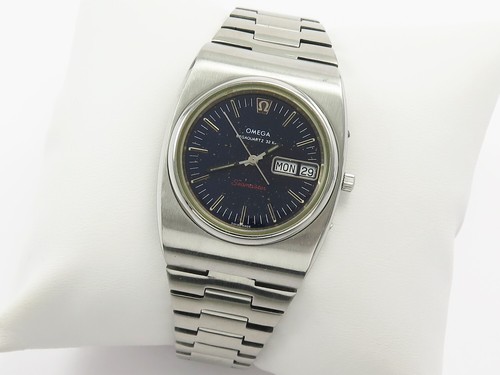
Omega was so excited by the Beta 21 that they designed the watches with the crown at 9 o'clock. This is to show that the crown was no longer a thing you needed to use on a daily basis. Hate to sound like Ron Popel "You just set it and forget it !"


The Speedmaster 125. This was the FIRST Automatic triple register chronograph , date that was certified as a chronometre ! At the time the mineral crystal was the largest that current manufacturing was able to produce.


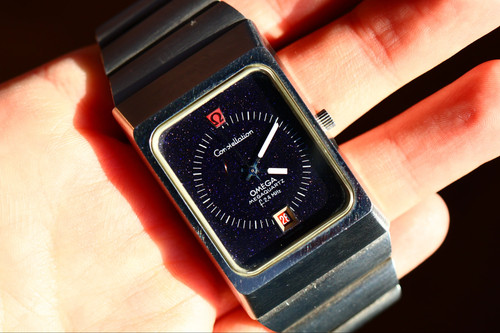
The Omega Marine chronometer Megaquartz 2.4 Mhz First certified Navigational Time keeper for the wrist !! The list price of the Marine chronometrer (MC) in the USA was 1850, compare that to a all steel non marine chronometer at 495$ . I know the MC is two tone but at just under 4 times the price Omega put a BIG price premium on the the MC. On another note there was an issue that Omega could not find a Swiss observatory to do the certification ( something about it being QUARTZ) . So all the 1511 and 1516 were certified at a French Observatory. Also pictuered above in the lower left is the late Eric Tabarly, French sailor. From Wikipedia " A former officer in the French navy who is often considered the father of French yachting," You see him with a sextant and his trusty Marine chronometer "Strapped" to his wrist ...


The above are photos i took at the Omega musem back in 1999. The watch on the upper left is a 2.4 mhz prototype. On the left you see the non marine chronometre grade 2.4Mhz in solid steel and a solid gold example.


I know I will get some emails saying I skipped a movement or what about f3oos .. All i can say is that this is a living document and I will be updating it as I get more info and photos.


Good Hunting and enjoy collecting Omegas !!

Bill Sohne

About the Omega Speedmaster Ref. Speedmaster125

The Omega Speedmaster 125, introduced in 1973 to commemorate Omega's 125th anniversary, was the world's first chronometer-certified automatic chronograph. This substantial timepiece was produced in a limited series of 2000 pieces, making it a notable, albeit less common, variant within the Speedmaster family. Its distinctive tonneau-shaped case and integrated bracelet set it apart from the more traditional Professional models, reflecting the design trends of the era.

Powering the Speedmaster 125 is the Omega Caliber 1041, an automatic chronograph movement based on the Lemania 1340, further enhanced with chronometer certification. This movement features a central minute and second chronograph hand, a 24-hour indicator, and a date display. The robust stainless steel case typically measures around 42mm in width, with an integrated bracelet designed for a seamless fit. The dial usually features a black finish with contrasting sub-dials and luminous markers.

For collectors, the Speedmaster 125 is significant for its technical innovation as the first chronometer-certified automatic chronograph and its unique aesthetic. Its limited production run contributes to its collectibility, particularly for examples in original, well-preserved condition. The Caliber 1041 is also highly regarded for its robust construction and functionality, representing a key development in Omega's chronograph history.

Specifications

Caliber
1041
Case
Stainless steel
Diameter
42mm
Dial
Black
Water Resist.
30 meters
Crystal
Mineral glass

Key Points from the Discussion

Advertisement
The Discussion
AM
amanico
Nov 9, 2008
Thanks a lot, Bill, for your work, my friend!

I think it's impossible to not skip some models, if you prepare this kind of review... I love the Accuracy tolerance of this era..." 30 sec per day is ok "... And if you think about it, 30 sec per day, without computer, without any of our modern tools, it 's fantastic! Was wondering if I'd see anything about the Pilot watch from 1938, the one which was re edited by Omea ( not the Chrono ), but you answered at the end..Impossible to not skip..LOL Best, and thanks for your great work and nice pres

WY
Wytnucls
Nov 10, 2008
MC certification

Hi Bill, nice presentation. Some nitpicking about the Marine Chronometer f2.4MHz: The prototype was actually certified as such by the Neuchatel Observatory after 63 days of testing. Its average daily drift was less than 2/1000 second per day. or 0.73 second per year. (Marco Richon) The movement physical dimensions also had to conform with the Neuchatel Observatory standards for a marine chronometer worn on the wrist. (Marco Richon) I read that the decision to send the commercial MC watches to th

BI
Bill Sohne
Nov 12, 2008
I dont know...

Hi Thierry The comments do not make much sense to me... Where were Marco comments published ? Journey Thru Time ? The comment that "I read that the decision to send the commercial MC watches to the Besancon observatory for certification was taken because the Swiss observatories were operating at full capacity at the time." In 1973 or so ...I cant imagine that they were busy ( Swiss observatories ) it was a pretty dark time for the watch industry with the onset of quartz and the flooding of the m

SA
SamJH
Nov 10, 2008
Nice job, Bill

I see it has come along some more since I saw it last, improving on what was already impressive and the photos are outstanding . . . . The only thing I would be interested in seeing added would be more "perspective". You commented that rather than creating slides, you would give the perspective orally at the presentation (and you are probably correct in that judgment): how Omega watches were perceived and performed versus their competition at each time period, what portion of Omega's watches wer

TO
tony p
Nov 12, 2008
Bill, I assume this is lifted from a PowerPoint presentation.

In which case, you should most certainly not add any more "perspective" to the actual slides. PP is a wonderful tool in the right hands, but it should always be designed as an adjunct to an oral presentation. There is nothing more boring (and difficult to absorb - as has been proven by psychological testing) than someone just reading word-for-word off a set of PP slides without adding anything. This looks like a great presentation - well laid out, with just the right amount of essential detail i

BI
Bill Sohne
Nov 13, 2008
hahahahaha good point....

Hi Tony I created the foils and gave this presentation. The additional text I added to the later foils I thought was necessary . Due to the nature of the photos and content. When I do give this presentation live the material really jumps out at you ! I am about 6 ft 3 inches and about 280 lbs. I originally wanted to create a sound track but just having audio commentary for about an hour would be sleepy as well . My next thought was to actually do a presentation with a live audience and then stre

Available on the marketplace

Continue the conversation

This thread is active on the Omega forum with 27 replies. Share your knowledge with fellow collectors.

Join the Discussion →