Manufacture
Tick Talk's winning entry in the Purists TimeWriter II Chronographe Bi-Fréquence 1000 contest earned him an exclusive trip to the Montblanc Manufacture in Villeret. This article chronicles his journey, offering a rare glimpse into the heart of Montblanc's fine watchmaking and the historic Minerva factory. His detailed account provides invaluable insights into the brand's commitment to traditional craftsmanship and the unique philosophy behind its Villeret timepieces.
This June, my wife and I were guests of the Montblanc Manufacture in Villeret. This dream trip was the result of my good fortune in winning the Purists TimeWriter II Chronographe Bi-Fréquence 1000 contest last November. I’ve already posted a few photos of our flight and arrival in Geneva, so the story will continue with our next stop in Neuchâtel where we stayed at the Hôtel Palafitte, literally on Lac de Neuchâtel!


Montblanc was kind enough to provide us with a driver and girl-Friday, Ursula. She was great fun and helped us navigate safely through this new land and culture.

Montblanc laid on a busy schedule, but not too onerous. The first stop following our arrival was the Musée International d'Horlogerie in nearby La Chaux-de-Fonds. Although a guide was provided, it became apparent that more time was needed to appreciate the full scope of this amazing collection so a mental note was made to return later in our holiday.


That evening, we enjoyed a quiet dinner at the Hôtel Palafitte’s very capable restaurant, Le Colvert.


Bright and early the next morning Ursula arrived in her chariot, a glossy black Mercedes-Benz sedan, to whisk us up to the lovely town of Villeret in the valley of Saint-Imier.
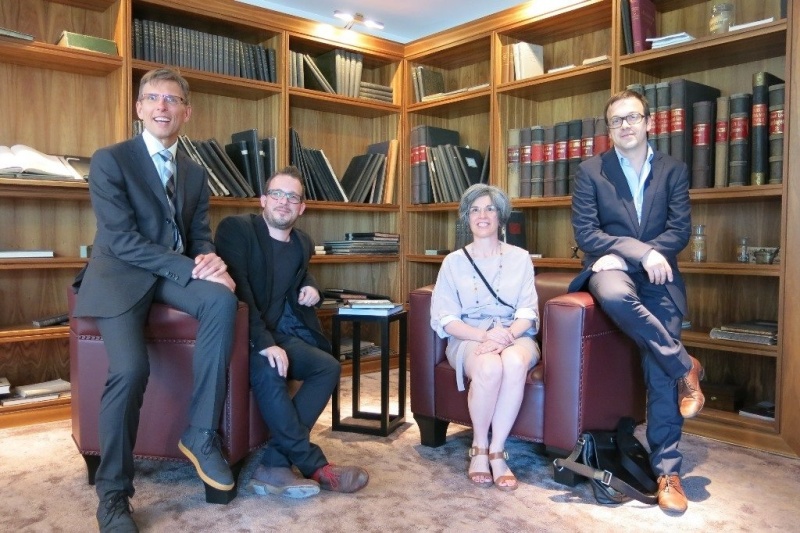
Here the fun really began for me! After meeting watchmaker and Project Manager Florian Brossard, we quickly found the Chronographe Bi-Fréquence 1000 designer, Bartomeu Gomila Sintes. Our little group of four began to tour the ex-Minerva Manufacture, room-by-room. It is a cosy structure with parts dating from 1902; located across the road from the original Minerva chateau constructed in 1858.


Smells of steel and oil permeated rooms filled with racks of metal stock, ancient trip-hammers and vintage manually-operated equipment, interspersed with high-tech computer-guided machinery, a spacious and busy CAD-design room, and a cosy customer delivery salon.
Barto Gomila

Florian Brossard


Watching the technicians at work was a clear reminder that, at Montblanc Villeret, everything is still very much a hands-on labor of love.


I was transfixed observing a young reglèur demonstrating her techniques for setting-up the balance assembly.

The Villeret facility remains a Manufacture in the Swiss sense; prototype development and construction occurs within its walls, along with movement construction and assembly. They remain one of the few facilities able to create their own hairsprings, a fact which Florian credits for their ability to develop working prototypes in short order. Habillage; the ancillary parts such as production cases, dials and hands, are provided by trusted outside suppliers.

When Richemont acquired Minerva in 2006, there was a period of internal contemplation before this asset was assigned to Montblanc. It seems the fit has been a brilliant success. There is an appreciable atmosphere of reverence for the past and eager excitement for the future. I was really energized by my encounter with Florian and Barto. As Barto has a background in vintage watch restorations (perhaps I’m understating, but more on Mr. Gomila’s qualifications later) we immediately connected when discussing the merger of classic and modern movement design and construction.
Mr. Gomila at his workbench

The naming of this historic facility as the Institut Minerva de Recherche en Haute Horlogerie is but one example of Montblanc Villeret’s ethical integration of the old and new. Their boardroom retains the historic documents and watches from Minerva’s legacy, now alongside this new chapter as Montblanc’s high-end atelier.


We closed the tour with a catered lunch where we were joined by Master Watchmaker Demetrio Cabiddu.

The respect, even reverence, accorded Mr. Cabiddu was apparent. His roots with Lemania and collaborations with Gerald Genta and Daniel Roth are well known and he is the acknowledged guiding force behind the Villeret Manufacture. Florian acted as interpreter and I was sometimes mystified when Mr. Cabiddu’s longer responses were pared down to just a few sentences. Once I threw in a few words from my limited French vocabulary, Mr. Cabiddu began to address me directly and I felt the conversation open up. Still, it was apparent that Cabiddu also viewed this interaction as an opportunity to mentor his protégés on the PR side of the business, although I hope it was eventually made clear that I wasn’t a “blogger”.


Florian, what new model are you working on?

I hinted earlier at some news regarding the TimeWriter III. Montblanc created the TimeWriter project upon acquiring Minerva to continue the development of fine watchmaking in Villeret. The idea was to assist young and promising independent movement designers by sponsoring a new project every two years. The TimeWriter I Metamorphosis came out in 2010, followed by the TimeWriter II Chronographe Bi-Fréquence 1000 in 2012.
While there were very little hard facts to be gleaned from the inscrutable Mr. Cabiddu, he did confirm the two year schedule has been abandoned. A TimeWriter III is in the works; just don’t expect it by SIHH 2014.
Our conversation rambled on about future models, TimeWriter series or otherwise, and I observed a great deal of interest in minute repeaters by all three watchmakers. It was a privilege to be present in the room when these talented individuals threw around ideas, with Mr. Cabiddu pointing out the various challenges that would have to be met. It was this idea-bashing, problem-solving dynamic that Barto credited for the success of his Chronographe Bi-Fréquence design.

The subject of chronometry brought forth some interesting perspectives. Mr. Cabiddu felt it redundant to consider the Villeret calibers separate from their chronometric qualities. What purpose are COSC’s minimum standards when the highest levels of chronometry are instilled in their very DNA? Still, I urged, could they not reawaken the Observatory standards of nearby Neuchâtel or participate in the nascent Concours International de Chronométrie which seems to be suffering from a lack of interest? On this matter we could reach no conclusion.
Observatoire de Neuchâtel

I expected some annoyance when we moved to the topic of quality control, given the occasional carping directed at perceived flaws in movement finish. Surprisingly, Cabiddu confronted the issue with a story; it seems that a customer was examining some expensive timepieces with intentions to purchase. His comments revealed that he wished for changes to this and that, more like another brand. Mr. Cabiddu, perhaps un-diplomatically, suggested these Villeret watches were not for him. “We make watches for humans”, he recalled telling the frustrated client. “Machines can give you perfect angles and finishes, but people give character and nuance to their work. No, it’s not perfect, it’s for humans!” My heart instantly bonded with Mr. Cabiddu upon hearing his summation of the Montblanc Villeret ethos.
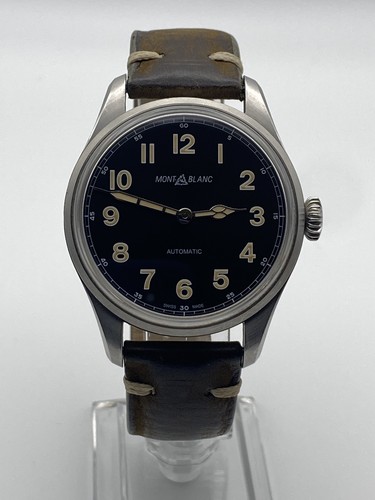
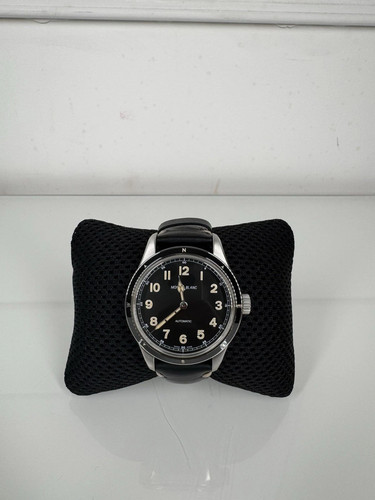
Following lunch and Mr. Cabiddu’s departure, we were treated to a presentation of the complete Montblanc Villeret 1858 collection. I had the opportunity to try on every piece and was surprised at the weight differences until it was revealed that some cases were the prototype’s plated steel versions. Please forgive my clumsy photography but I hope I managed to capture most of them adequately.


The presentation culminated with Mr. Gomila’s Chronographe Bi-Fréquence 1000. His pride was evident, and rightly so.

As a family man, watch designer, and vintage restorer, Bartomeu Gomila reflects the renaissance qualities required of haute horlogerie “for humans”. He shared an engaging story with my wife about how he discovered a love of watchmaking as a young child, sick in bed. His grandmother brought him a broken clock for amusement and he proceeded to disassemble and fix the mechanism. He found a great deal of comfort in this activity, which he has noted in his own daughter’s response to hearing the relaxing, rhythmic tick-tock of old pocket watches at home.

Following previous experience with Rolex after-sales service, Barto’s connection with Montblanc began as their manager of technical services in Spain. In 2008, he succeeded in obtaining one of two positions offered at WOSTEP Switzerland for the Restoration and Complicated Watches course. Upon graduation, he opened his own restorations service, Taller del Temps, in Menorca. His connections with Montblanc remained strong and the happy result was an invitation to participate in the TimeWriter program.

We returned to our hotel for a brief rest before joining Florian and Montblanc Communications manager Gaëlle Jeanrenaud for dinner at La Ferme des Brandt, situated in a 17th century farmhouse just outside La Chaux-de-Fonds. Gaëlle was the person I communicated with most frequently in arranging this stellar trip and we were eager to finally meet and present her with a Canadian teddy bear. Florian was his best impish self, entertaining us with stories and gossip. The evening was enjoyed with great food and local wines.


Regrettably, the following day was to be our last in the company of Montblanc Villeret. In the morning we enjoyed a guided walking tour of Neuchâtel’s old city.


The historic quarter was saved from irrevocable damage when, after years of debate over costs, it was decided the freeway would tunnel underneath rather than create a scar through the middle of the city.

Following the tour, Ursula took us to the village of Auvernier and its namesake vineyard, Château d’Auvernier, for a wine-tasting. Our host was a charming lady who filled us in on the micro-wineries of the area. We discovered a great fondness for two of their products; a young Oiel de Perdrix, their signature wine, and a lightly-oaked Chardonnay from 2011. Needless to say, our luggage was increased with the addition of a few bottles.


Onward to lunch a short walk away at Le Poisson, then back to the Palafitte for our final night.


We moved on the next day to La Chaux-de-Fonds and the second part of our Swiss holiday. Please forgive me if I delay posting that adventure for a couple of weeks but summer is calling…

The Rolex Bubble Back, reference 1858, represents an early example of Rolex's self-winding waterproof wristwatches. This reference is part of the broader Bubble Back family, characterized by its distinctive domed case back designed to accommodate the thicker automatic movement of the era. It showcases Rolex's foundational efforts in developing robust and reliable automatic timepieces for everyday wear, laying groundwork for future Oyster Perpetual models.
This particular reference features an 18k white gold case, measuring 38mm in diameter. It is fitted with a sapphire crystal, protecting a silver dial. The watch is powered by an automatic movement, specifically the Boucheron 1858 caliber, offering a power reserve of 42 hours. The fixed bezel and leather strap complete the watch's classic presentation.
For collectors, the reference 1858 holds interest as an early and relatively rare iteration within the Bubble Back series, especially in white gold. Its larger case size for the period also makes it appealing to modern tastes. The presence of a date complication adds to its functionality, distinguishing it from simpler time-only Bubble Back models and highlighting Rolex's early integration of practical features.
Hello tick-talk Really enjoyed seeing the workshops. Thanks for sharing your visit. Kind Regards Anthony
If price were no issue, which Villeret piece would you want to own and have on your wrist? :) Cheers, Anthony
I noticed Mr. Cabiddu was wearing a 40mm "small" model and I would also seek this, being of similar build. The black dial Monopusher Chronographe is stunning and I feel drawn to it most.
What a pleasure to (re)discover the links between the Past and the Present, the richness of the Minerva collection. Did you happen to see Florian's Chronograph? Since I saw it, I had and still have no rest before i find one! ;) Superb place, too. Thank you so much for these nice pictures. All the best, Nicolas.
the one without a watch! Sorry to say that I don't know what his timepiece is. Florian, if you are lurking please post a picture ;-)
Is my memory correct, Florian? ;) All the best to both of you. Nicolas 5 who met you in Vegas, Florian. )
This thread is active on the Montblanc forum with 34 replies. Share your knowledge with fellow collectors.
Join the Discussion →