Complications
Dje's 2008 post introduces the A. Lange & Söhne Richard Lange Pour le Mérite, highlighting its fascinating duality of classical aesthetics and complex inner workings. This article provides an early look at a significant timepiece, emphasizing its technical achievements and the brand's commitment to horological excellence.


This watch is
no longer a secret, but you are certainly many waiting and hoping to see it and
know more !
As you already
know, Amanico, Foversta and myself had the pleasure to attend a presentation of
the new for 2009 A. Lange & Söhne Richard Lange Pour le Merite.
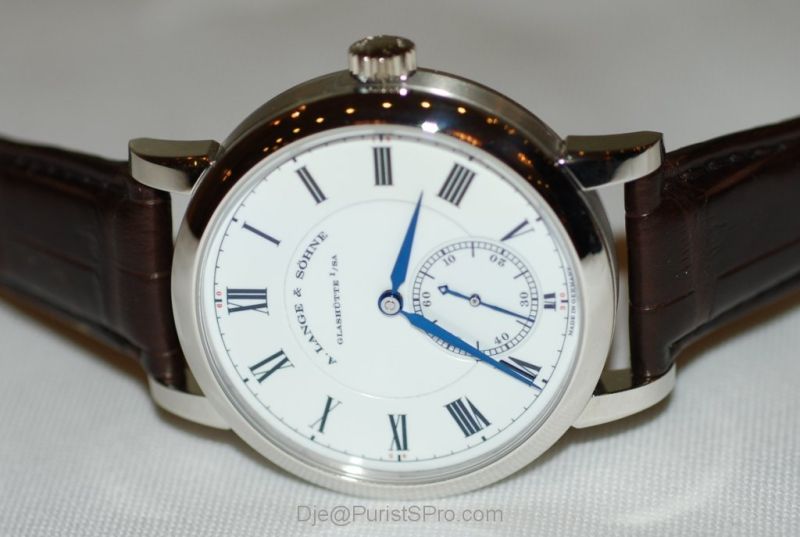
A. Lange & Söhne Richard Lange Pour le Merite in platinum with enamel dial
The duality of
this watch is really fascinating. Its outer face is quite classical and sober
and totally and efficiently hides the complex reality of its inner works. In
fact some journalists from outside the horological press were surprised to be
invited for the presentation of such a simple watch!
You can see
below that our own Amanico and Foversta were a bit more convinced right from
the start by the interest of the new born!

Amanico and Foversta at work
The name
« Pour le Merite » is in itself a good reason to look further below
the beautiful enamel dial of this watch. The "Ordre du Merite" was
created in 1842 by the famous explorator Alexander von Humboldt to celebrate
deserving scientists and artists. A. Lange & Söhne has chosen the name
"Pour le Merite" for its uncommon complications and specially its
fusee-and-chain transmission models, the new one being the third after the
Tourbillon "Pour le Merite" and the Tourbograph.
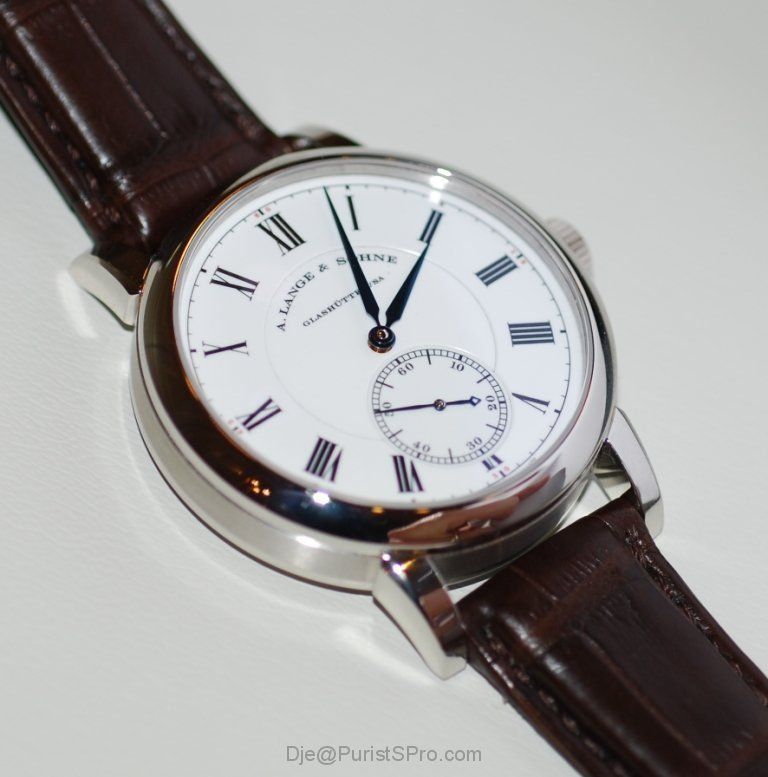
Simple, simpler watch
The Richard
Lange original model is now becoming a piece in a limited range of precision
watches, reminding us the pocket chronometers of the past that Lange produced
in very low numbers, around thirty pieces, and the inventor Richard Lange,
older son of the original Lange company founder and creator of special alloys
for balance springs.
The new Richard
Lange "Pour le Merite" is the second chapter of the family, pushing
even further the quest for precision of rate.
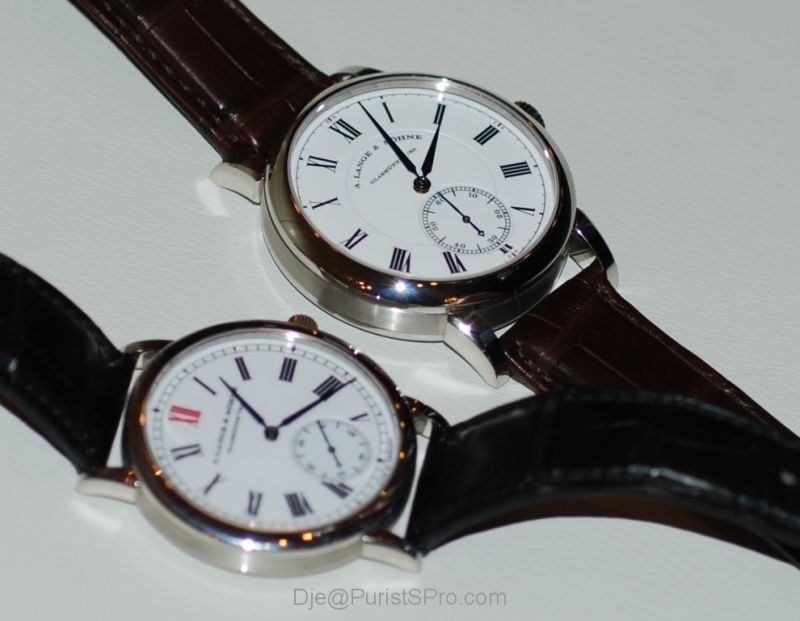
The second enamel dial modern Lange watch with the Anniversary model
To some extent
a fusee-and-chain transmission could seem to be a rather simple and easy
solution to fit in a watch, but you should remember that it is not a chain saw
that you look at, but a 40.5mm large watch. Considering the 636 components of
the chain alone, and adding the 279 other pieces of the completed calibre,
that's 915 pieces assembled in a calibre measuring 31.6 mm by 6mm of
thickness!
So there is
first the complexity of the building, finish and assembly. Then you should not
forget that precision is the objective and the use of a chain in itself is not
enough but has to be integrated with several mechanisms to reach the goal.
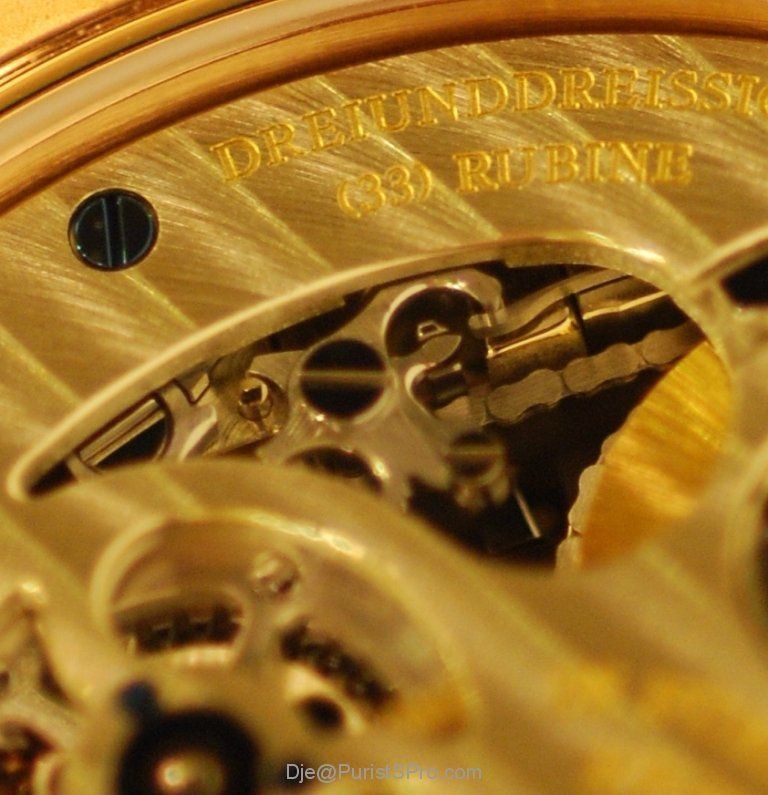
The chain transmission
You can see
below the fusee-and-chain and the barrel mechanism. The fusee is exploded in
the left and the mainspring barrel is on the right.
The principle
is simple, the implementation is another thing!
First the
principle: the main spring wound inside the barrel powers the wheel train to
the escapement. When the mainspring is fully wound the torque is maximum and
this torque decreases as long as the main spring unwinds itself. If this main
spring is geared directly to the wheel train, this decrease of torque means a
decreasing amplitude of the balance and consequently a loss in precision.
To
counter-effect this decrease of torque the fusee-and-chain mechanism offers an
increasing lever effect when the main spring unwinds.
At full winding
the chain is rolled around the fusee which is a stepped cone. When the main
spring begins to unwind it pulls the chain from the fusee to roll it on the
barrel.
At the
beginning the torque of the main spring is maximum obviously and the chain is
pulled from the thinner extremity of the cone, so the lever effect in minimum.
As long as the
chain rolls itself on the barrel the torque of the main spring decreases but
this decrease is compensated by the increasing of the lever effect brought by
the fact that the chain pulled is more and more pulled from the thicker
extremity of the cone of the fusee, i.e. farther from the axis of the fusee!
Did you get
it? 
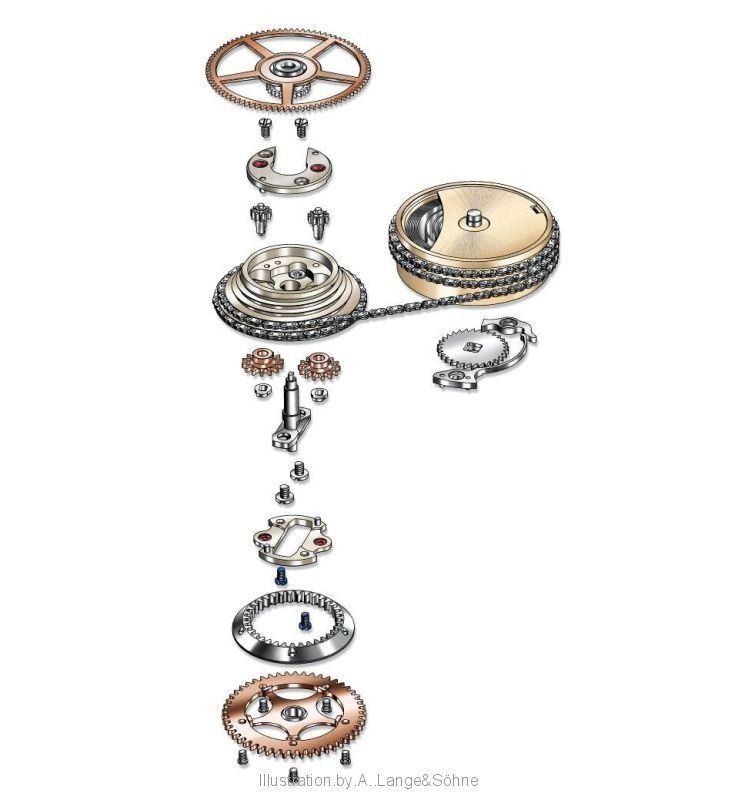
The fusee-and-chain and barrel mechanism
Below you can
see the calibre in the watch, with the barrel at 4:30, linked by the chain to
the fusee at 1:30, then the wheel train at the center of the calibre and at
7:30 towards the escapement at 10!
This is the way
followed by the energy to power the calibre, in this case hopefully with
constant torque in the wheel train and consequently with constant amplitude of
the balance.
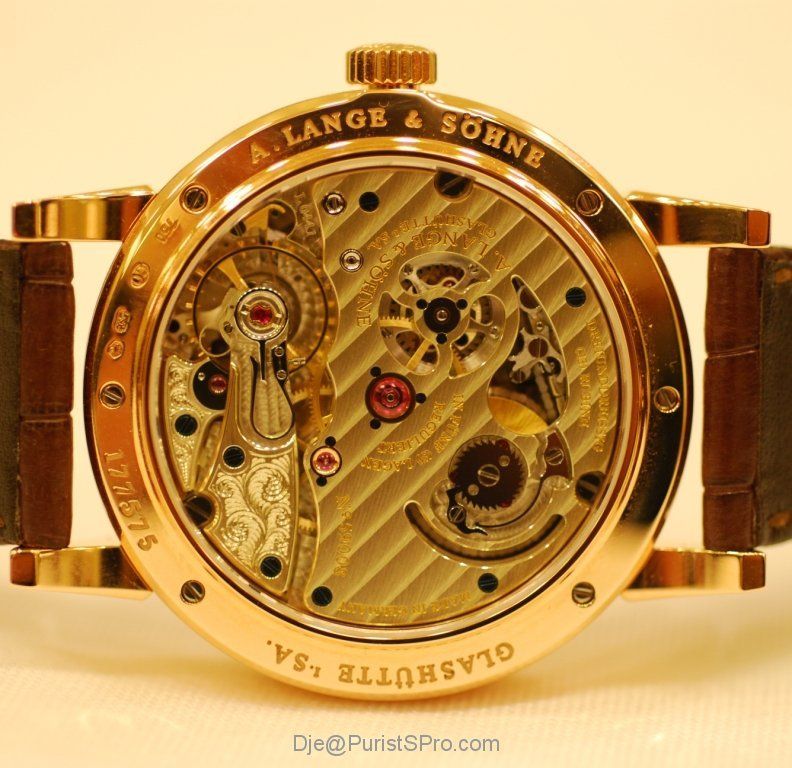
Three quarter open plate for valid reasons
Obviously this
fusee-and-chain principle needs the conception of other refinements to be effective
when implemented.
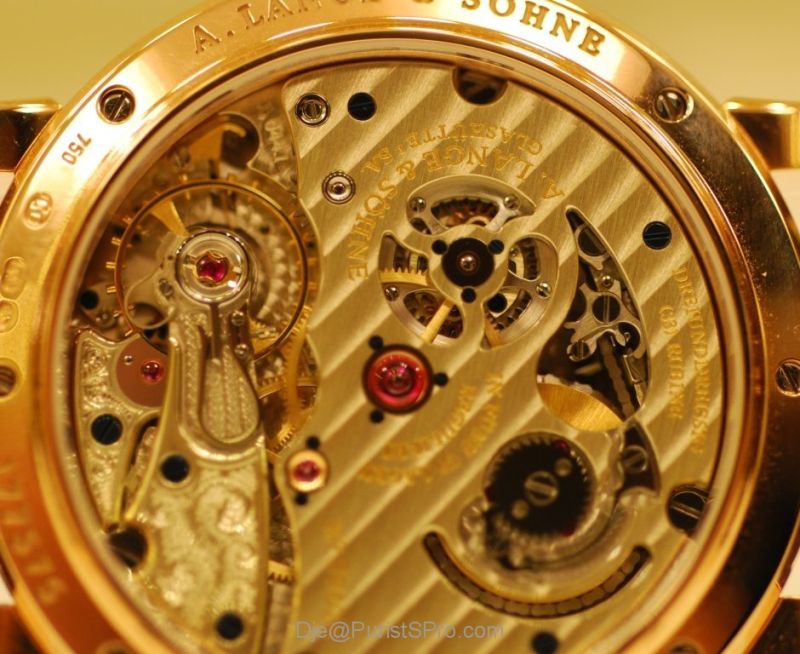
Fascinating mechanics
The first trick
has a security purpose. The specific construction of the fusee-and-chain
transmission means that the chain is fixed on both extremities on the barrel on
one side and on the fusee on the other side. If the chain is pulled to be
rolled excessively on one side or the other of its course beyond what is
scheduled, the tension on the opposite (un-rolling) side may result in a
breaking of the chain. The risk is particularly to overwind the main spring and
pull excessively on the chain attachment on the fusee.
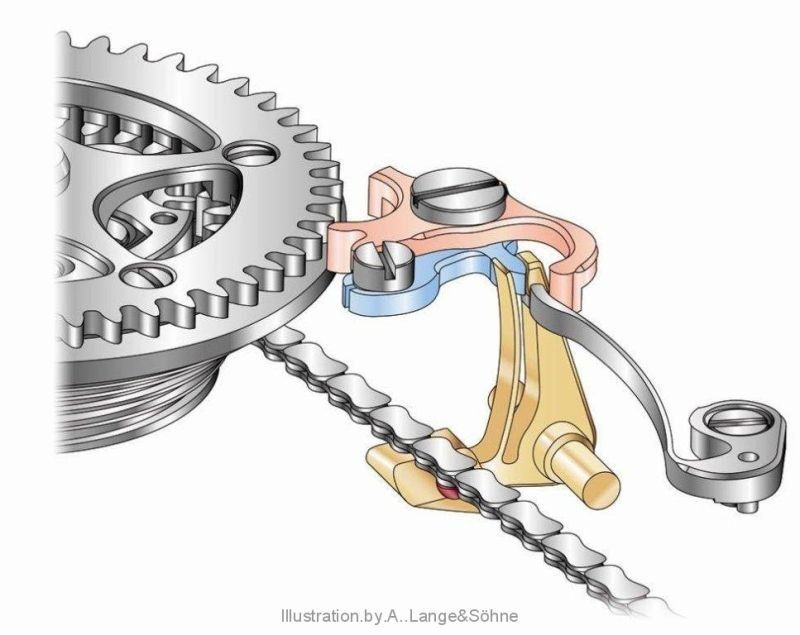
The full winding locking lever
Consequently
the winding process is stopped and blocked by a lever before over winding.
When the chain
is rolled enough around the barrel, the chain arriving to the thinner extremity
of the fusee pushes a cantilever towards the dial side (light brown above),
whose lever itself pushes a blocking lever (blue) that rotates a blocking
ratchet (in pink) inside the teeth of the ratchet wheel above the fusee.
The full
blocking is completed by a little rivet fixed on the chain that is stopped by
the lever and consequently further block the chain.
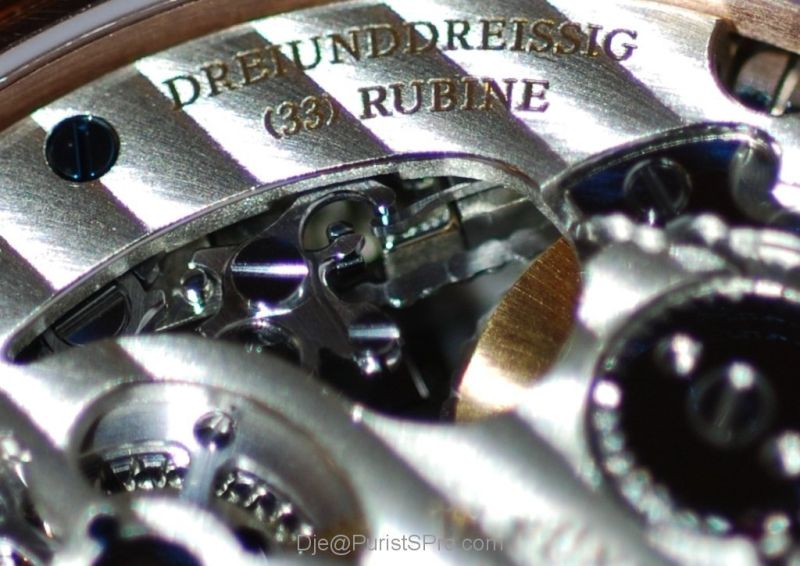
The same lever pictured from above
This mechanism
avoiding over winding is not enough to understand the full complexity of the
mechanical marvel!
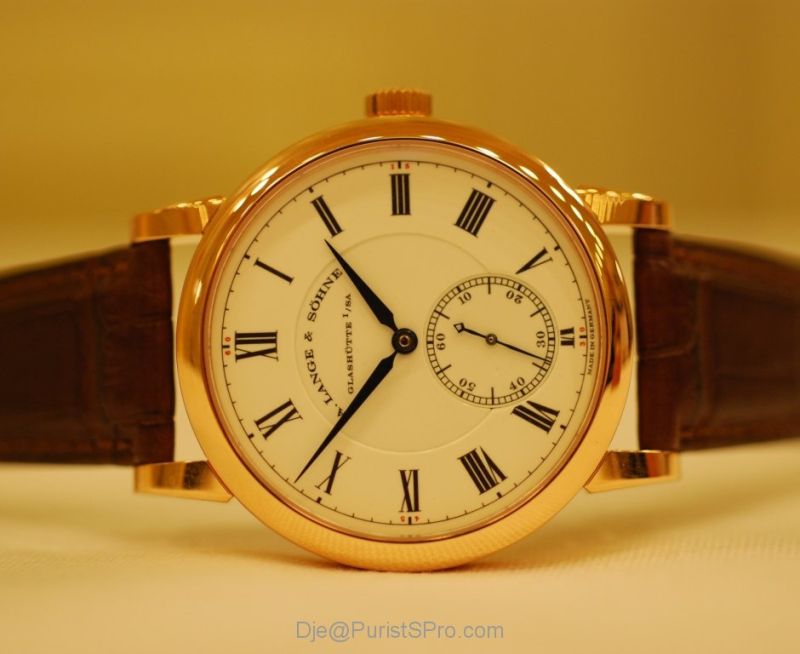
Beauty outside beast inside
Again as
precision is the aim, the range of action of the increasing lever effect of the
chain-and-fusee transmission must be precisely opposed to the inverted torque
curb of the barrel. For that matter the power reserve has been voluntarily
limited to 36 hours, this power reserve being evaluated as the longest power
reserve to achieve a satisfying result on the precision.
That results in
a locking device that stops the watch when the 36 hours of power reserve have
elapsed from full winding. So the power reserve wheel at noon below makes one
turn in 36 hours. At the end of the 36 hours of power reserve one extremity of
a blocking lever (light blue) falls inside a recess in the power reserve wheel (brown).
When the lever
falls in that recess, its other extremity engages on the way of a finger fixed
on the 4th wheel arbour (brown at three). When the seconds hand arrives at 0 the
rotating finger is blocked by the extremity of the blocking lever and the wheel
train stops, the seconds hand remaining vertically at 0! Magic isn't
it?
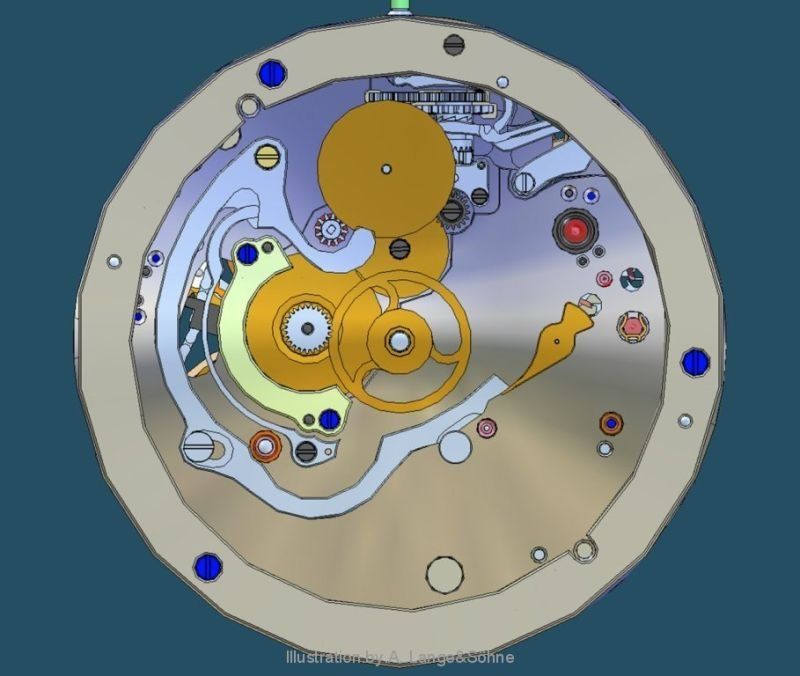
The low winding locking device
So now you know
that you can't overwind the mainspring. You know also that the power
reserve is voluntarily limited at 36 hours.
The lever
effect of the chain-and-fusee transmission is calculated so that the lever
effect must compensate the decrease of torque during 36 hours.
Obviously the
final touch is to adjust the 36 hours working range of the main spring when its torque is regularly decreasing so that it matches the counter effect of the chain-and –fusee.
This adjustment can be made through a pretensioning ratchet located on top of
the barrel.
This can be
done by a watchmaker with a Lange proprietary tool and the setting is locked
then with a pawl. The mechanism located above the three-quarter plate is easily
accessible.
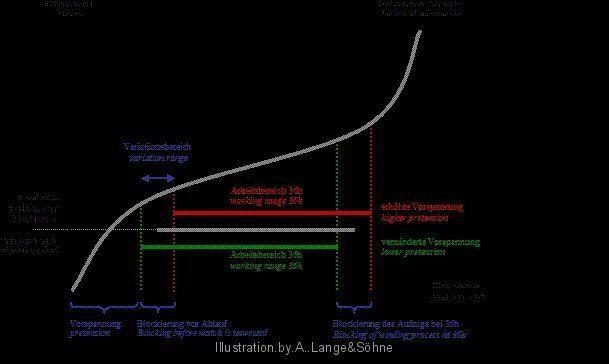
Adjustment of the working range
In the drawing
above the ideal 36 hours range is in grey (line) and must be positioned between the
green and red ranges, so that the lever effect can counter perfectly the
decrease of torque (grey curb).
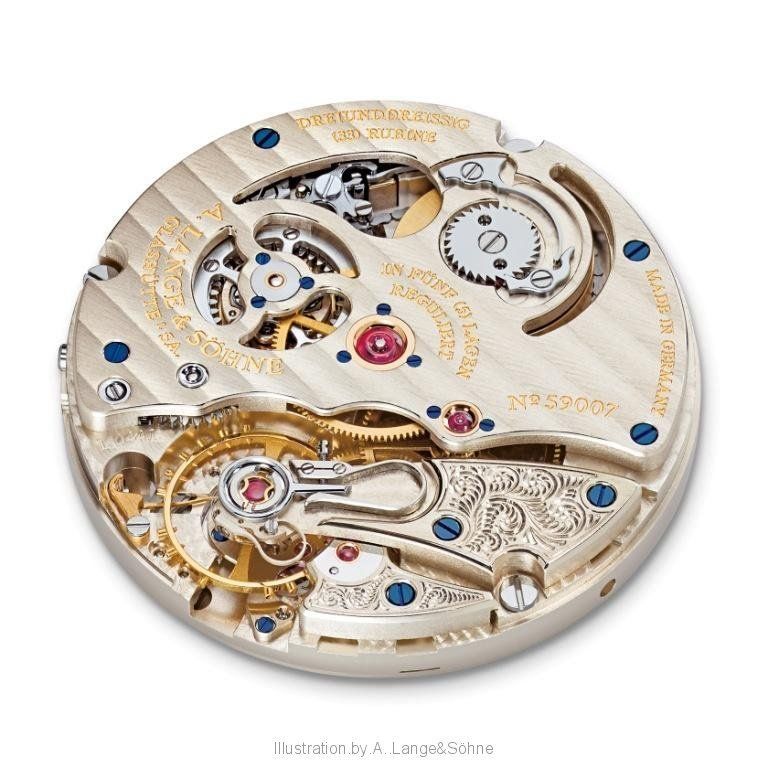
Lange calibre L044.1
So the
apparently simple calibre L044.1 above is indeed a beast of chronometry, made
for precision!
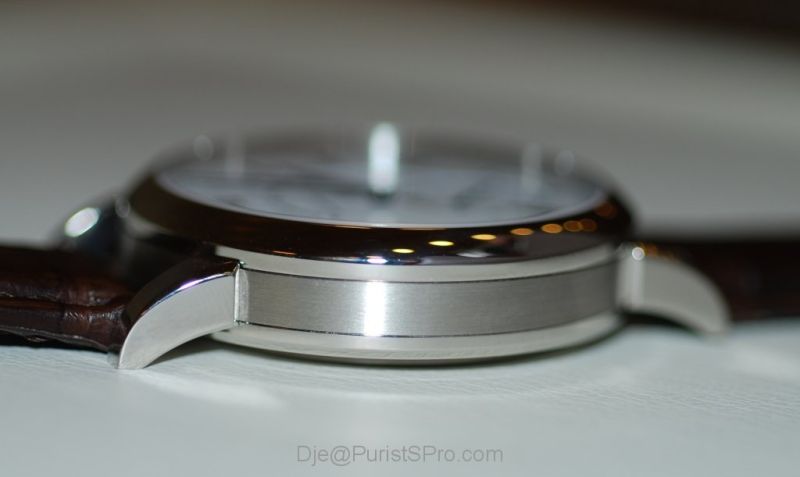
Brushed platinum
The watch
remains perfectly wearable, very close to the volume of the
"standard" Richard Lange.
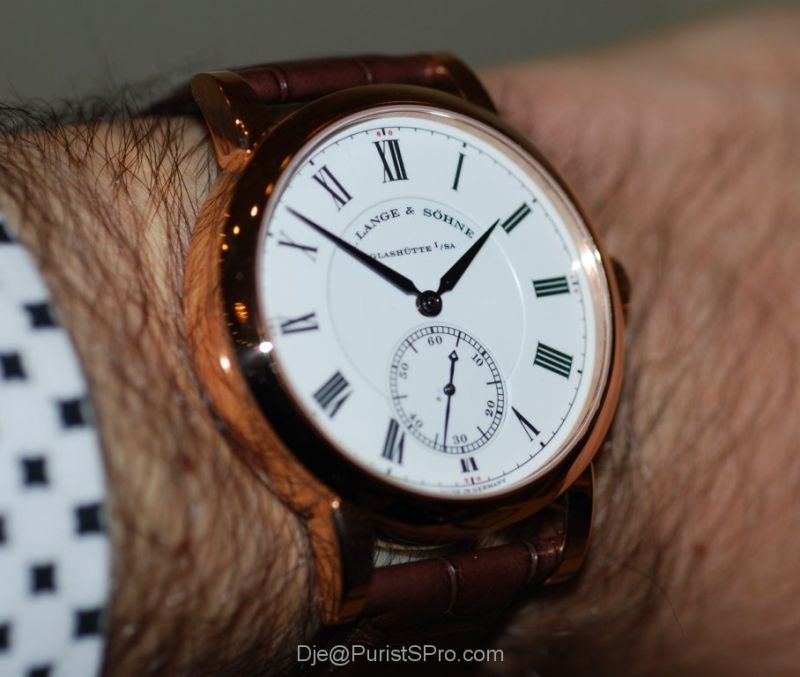
White and pink
There is one
final interesting technical aspect inside the watch.
As the winding
is made through the fusee (we've seen that the ratchet wheel is on the
fusee), the fusee-and-chain construction needs a planetary gearing inside the
fusee so that the drive wheel (that transmits the energy to the wheel train) on
top of the dial side of the fusee can turn in one direction while the ratchet
wheel turns in the opposite direction on the other side of the fusee when the
watch is being wound.
Without this
planetary gearing the watch would stop while being wound and that would not be
ideal to maintain a long term precision, to say the least.
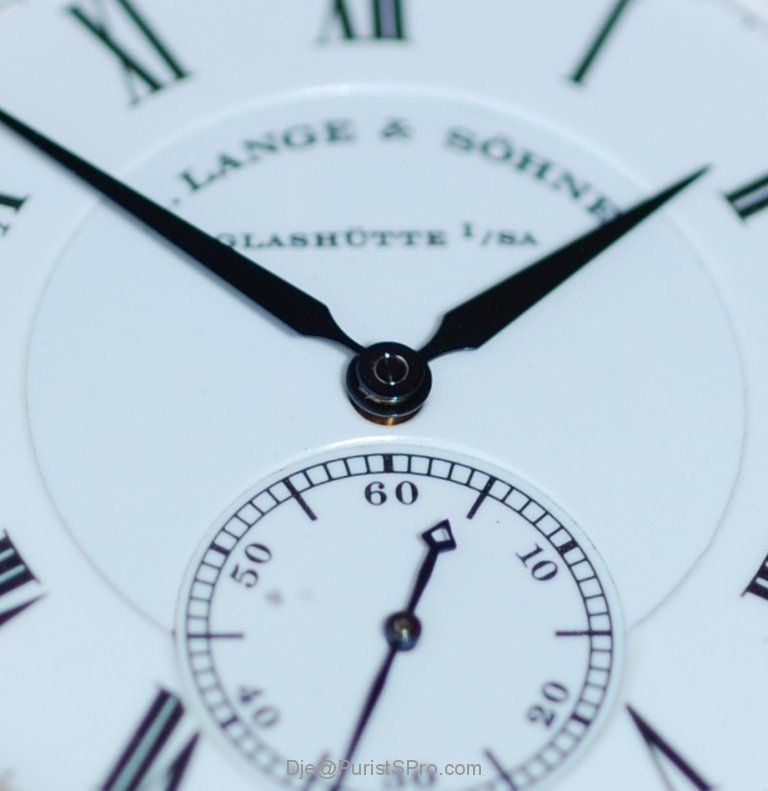
Three level enamel dial
I could say
also that the enamel dial is made in three different pieces so that it is three
dimensional, having three different plans! Obviously these three pieces have to
be made together to get the same colour.
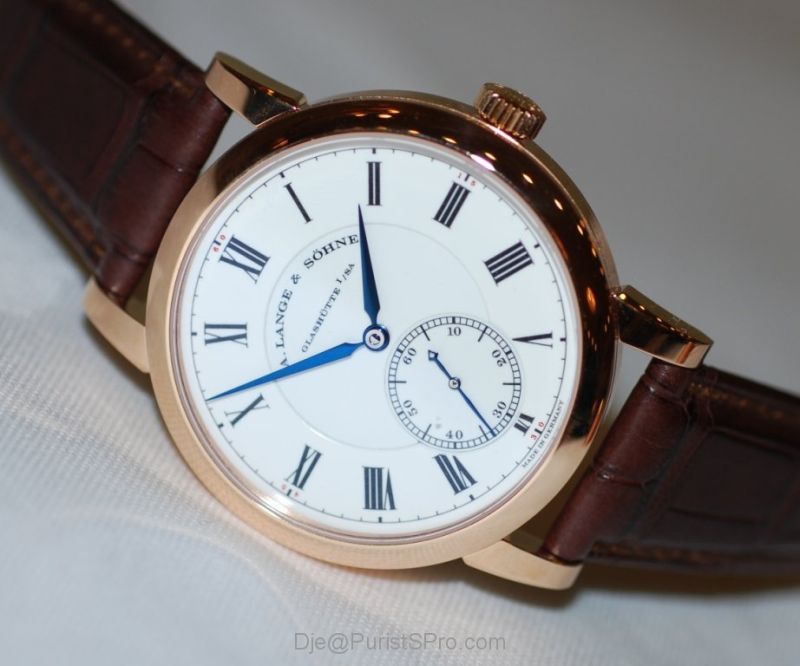
Maybe the first modern pink gold Lange with three blued hands
The picture
below will show you on the upper right corner the pretensioning ratchet on the
barrel that allows to adjust the 36 hours range to get the best effect of the
chain-and-fusee mechanism.
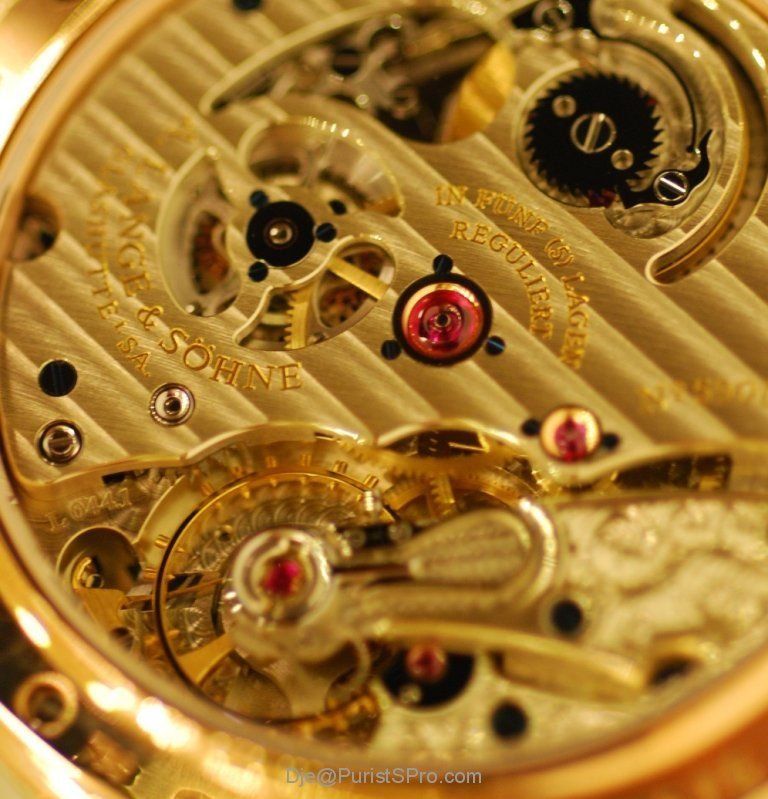
Coveted German silver
On the balance
side I can add that the balance spring is made in-house by Lange like for the
original Richard Lange and the balance is free-sprung. The escapement
oscillates at 21.600vph. The inertia of the balance is chosen to match the
constant torque delivered by the fusee-and-chain transmission.
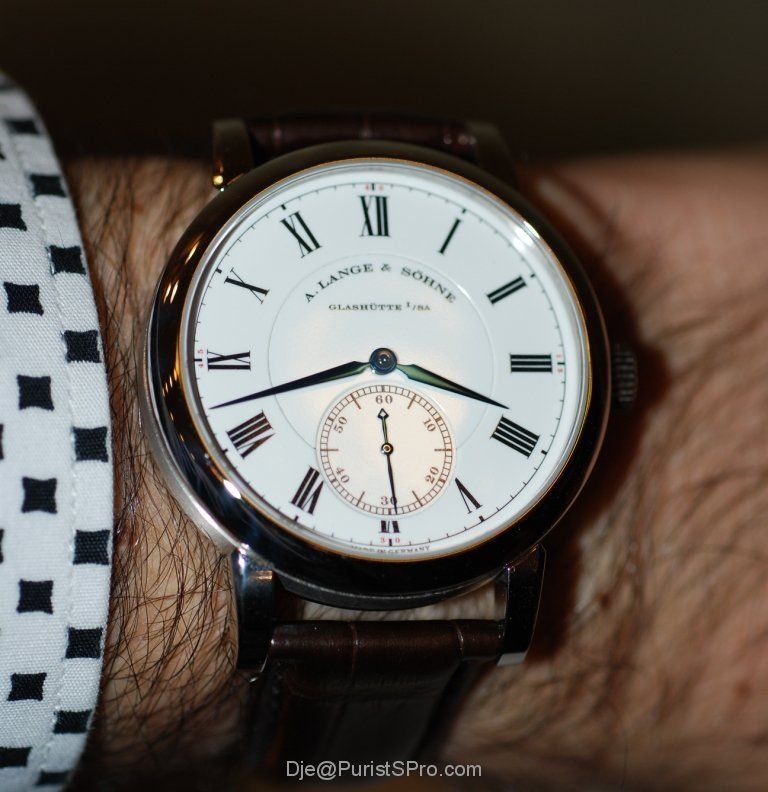
Perfect on the wrist
I hope you
enjoyed this reading and followed me so long!
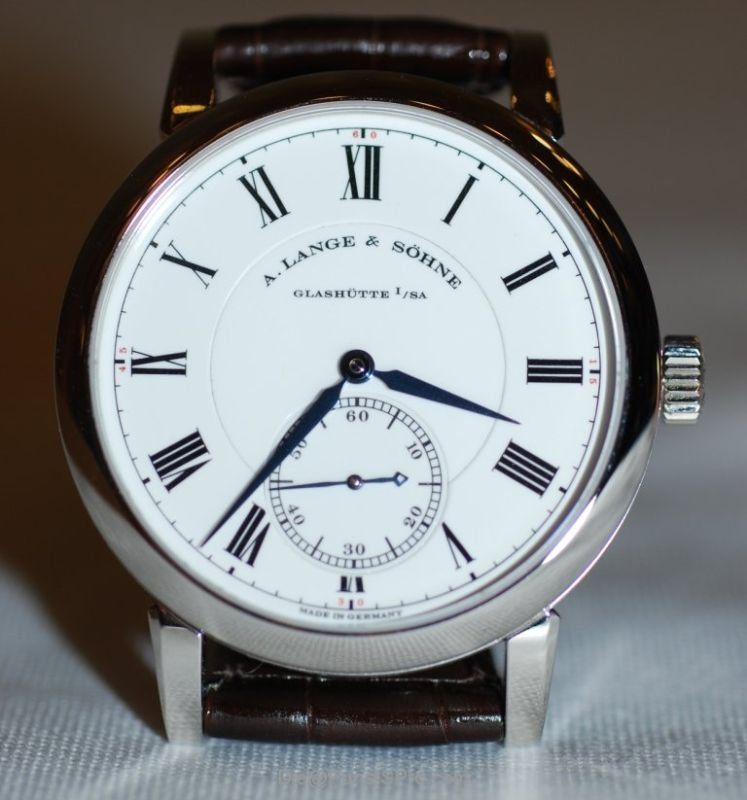
A milestone in simplicity
That's a
promising 2009 that comes with this Richard Lange "Pour le
Merite" !
Dje
You perfectly explained that beneath the simplicity of a 3 hands watch, there is a complex caliber full of technical features. Fr.Xavier
Can't wait to see what Lange will present in less than 3 weeks, now. This PLM was above my expectations, indeed. For its understated Beauty, and its mechanical sophistication. Thanks to you, now we better understand how interesting is this PLM, mechanically speaking. Best, my friend. Nicolas
thanks a lot, great report for a truly dream watch greetings from France
The more I read your posts the more this watch fascinates me.Congratulation guys for the wonderful reports.All the best.
Thank god this watch is not available yet, becuz with all the post we've read here and the beauty of this watch, it would have been very hard to resist K.
Now I need to spend some time with this beauty. Thanks again. Bill
This thread is active on the A. Lange & Söhne forum with 52 replies. Share your knowledge with fellow collectors.
Join the Discussion →