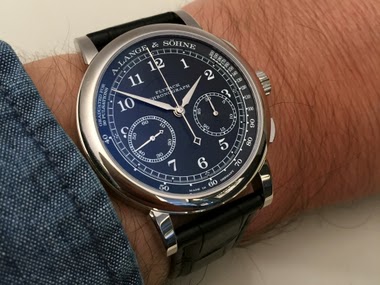
Complications
Skyeriding's detailed essay on column-wheel chronographs, particularly focusing on A. Lange & Söhne's L951 movements, remains a foundational resource for understanding this complex complication. This article, adapted from an original forum post, breaks down the mechanics of chronographs, including column wheels, clutch types, and flyback functions, making it accessible to enthusiasts. His work provides invaluable context for appreciating the intricate engineering behind high-horology chronographs.


Disclaimer: I am not a watchmaker. The following is an unprofessional, hobbyist, technical(in-depth?) essay including pictures of how a chronograph movement works – based on my own view/understanding and tidbits of info I've gathered/read from here and there. Specifically I'll be talking on the A. Lange & Söhne chronograph movements: the L951 series which is used in their 1815 Chronograph and Datographs. Any experts please feel free to correct any mistakes I made in the article!
I wrote this article on another website, now adapted for PuristSPro here. All photos do not belong to me, they are taken off various sources online (Hodinkee, TimeZone, Lange website, onthedash, …). Annotation done by myself. This article is written for non-profit purposes.
By the end of this (if you do, thank you for reading!), I hope I can cover:
• How does a chronograph work in general?
• Column wheel, whats that and why?
• Horizontal vs vertical clutch chronograph?
• A typical chronograph vs a monopusher, how are they different?
• What is a flyback?
+=+=+=+=+=+=+=+=+=+=+=+=+=+=+=+=+=+=+=+=+=+=+=+=+=+=+=+=+=+=
Lets cut to the chase. I love mechanisms and naturally, I grew a deep interest in watches and their movements. One of the most fascinating type of complication to me are chronographs - because they are an interactive feature you can play with. "Click" and the seconds hand moves. "click" again, it stops. "Click", reset! A mechanical stopwatch, in a watch on your wrist! That is simply fascinating. You're weird if you think otherwise.
Of course, at one point when one ventures into high-horology chronographs the Lange name will inevitably be mentioned. Flip over the watch, and whoa!
But then you ask yourself - what exactly am I looking it amidst the vast "city" of steel levers, Maillechort (i.e. German Silver) bridges, gold-chatoned rubies, brass gears and screws? What does this screw hold down, what does this spring do...its a mess! A real nightmare for the watchmaker too. Bear in mind, with the current convenience of the Internet you're probably viewing most watches and their movements through your computer monitor blown up fullscreen (or for the lucky you, down on your own wrist…). The real movement in this case is only 30mm in diameter (or for the Americans, just over an inch).
Let that sink in awhile. The entire picture, shrunk down to the size of a watch, sitting on your wrist. All those complex gears, levers, bridges - yes, they are *that* tiny!
Ok thats a long intro. Ready to venture into the actual movement and how it really works? Grab a coffee first before continuing...
+=+=+=+=+=+=+=+=+=+=+=+=+=+=+=+=+=+=+=+=+=+=+=+=+=+=+=+=+=+=
Lets begin with this picture as we are focusing on the movement.
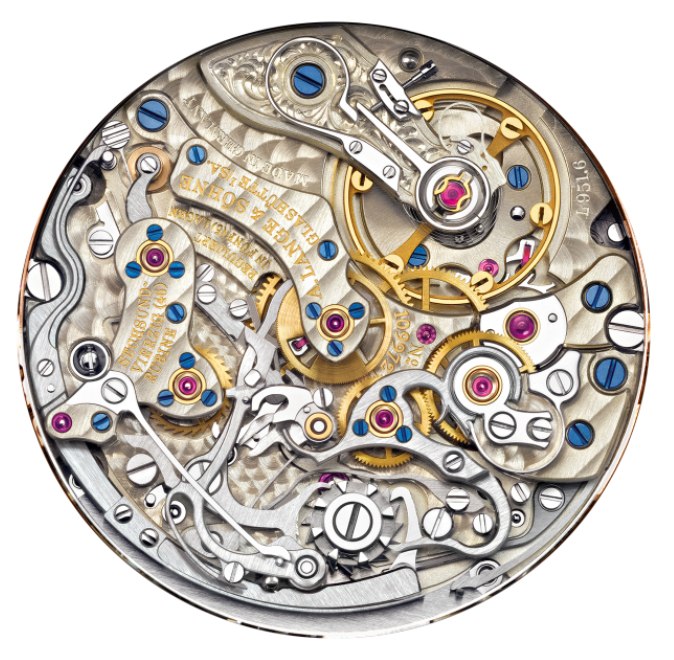
*Still* too complicated, all the bling is distracting! Okay, okay, one step at a time...
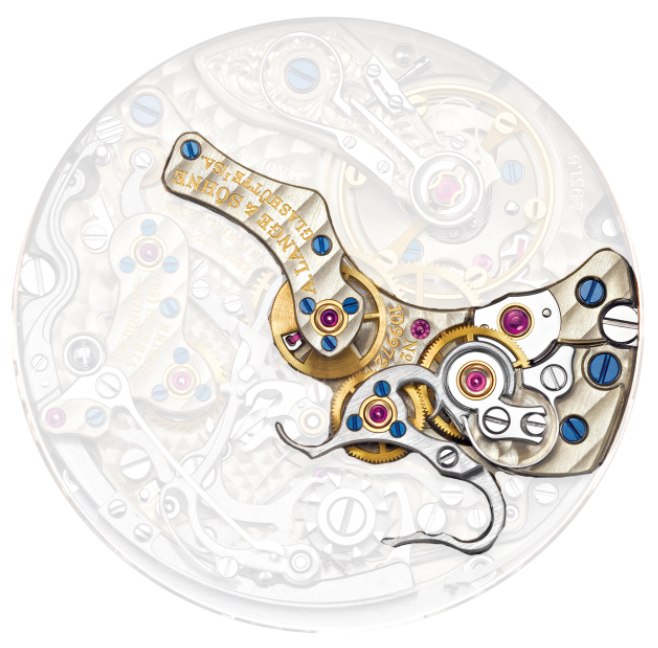
Now thats better.
What I am highlighting now is the heart of the chronograph. There are three important gears here that is what makes the chronograph..work
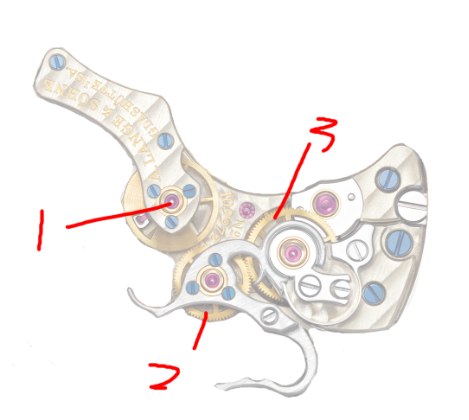
(1) is the gear connected to the chronograph seconds hand. This is the large sweeping hand that turns whenever you start the chrono. You can see how they are connected to the dial side here...
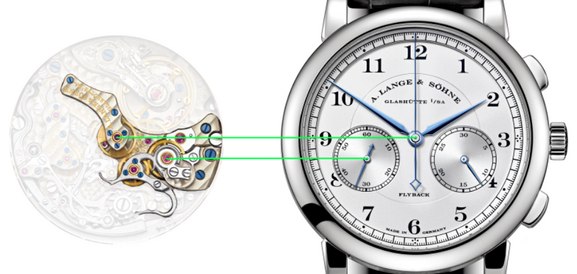
I want to start and stop this on demand with the push of a button. How do I do that? The natural answer: have another set of driving gears come closer and engage it upon that push of the button. In this case, (3) is the important gear. Guess what gear this is? Right - It is the continuously moving seconds hand of the watch! (2) is the intermediate gear that joins them together. (3) makes one revolution every 60 seconds. The gear ratio is 1:1, so (1) will also make that one revolution in 60 seconds.
Let's check out a couple other chronographs, for example - these Vacheron Constantin and Patek Philippes.
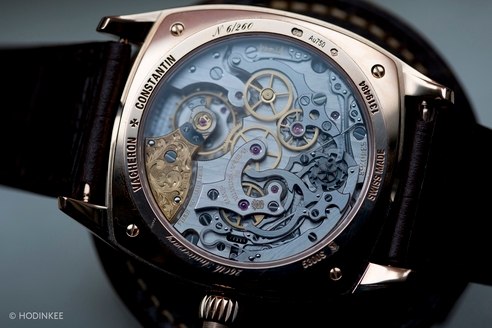
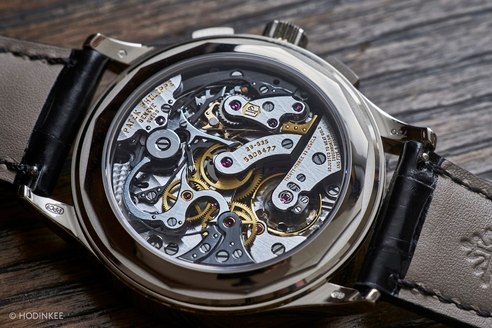
Notice the similarities? There is also the same set of gears (1) to (3), and the same dial layout on front where the seconds hand are.
If you still can't tell, here they are:
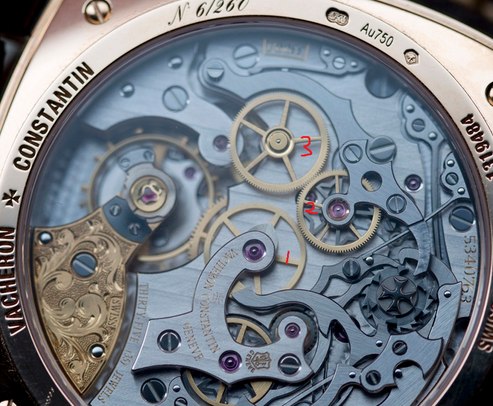
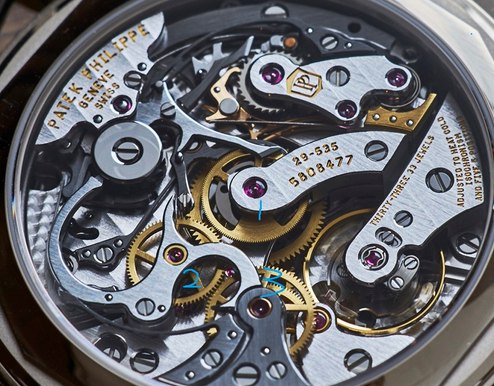
These chronographs fall into a family of a kind of chronograph mechanism called the horizontal clutch type. This means that, the gears (i.e. (1) ~ (3)) engage each other sideways; horizontally. These are the more common type of chronographs you'd find around. How do they engage exactly? Ok - see the bridge holding gears (2) and (3) with the gold chatons and blued screws? That is free to swing as shown in the direction of the green arrow.
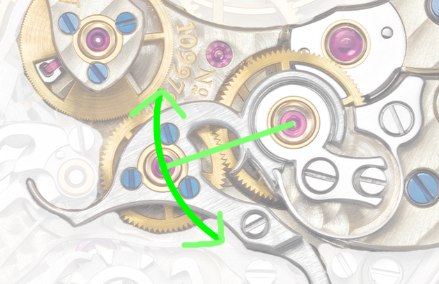
On the other hand, there is another variant called the vertical clutch. Instead of having (1) to (3) gears, the gears (1) and (3) are stacked on top of each other. To engage, they are "pushed" together and friction grips/drives them together. When released, they are separated and (1) stops moving again. An example is this Piguet movement used in a Blancpain chrono:
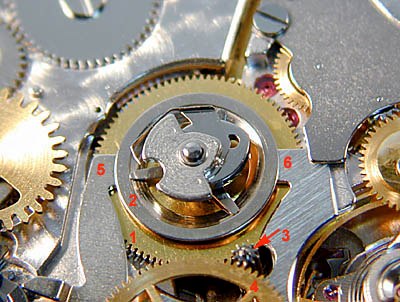
What's the difference? Horizontal clutch have a downside - imagine meshing teeth of the gears as they come into contact suddenly. If the teeth don't mesh properly, there will be a "knock" and a slip before properly engaging. You might see the chrono seconds hand "jump" when you start the chronograph. This would cause innacuracy and (possibly?) damage over repeated usage of the chrono. To solve this, the typical solution is to use fine teeth like in this Lange.
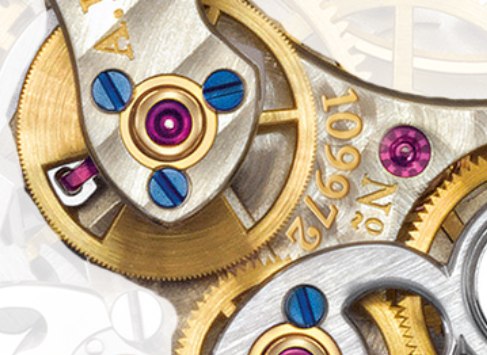
You can see that (1) has very fine teeth while (2) has large, spiky ones. The fine teeth makes it much easier for the large teeth to slide into the "gaps" between the teeth when engaging and avoid direct tooth collision. Another thing is, these sharp pointed teeth are not too efficient at power transmission versus the typical gear teeth used in the rest of the watch. These normal gear teeth are typically cycloidal type which are more durable and allows a smoother power transmission. This is also one reason why these chronographs are not recommended to be left running 24/7 - the chrono seconds geartrain (1) ~ (2) would theoretically wear out faster if left running compared to standard gears.
Vertical clutch chronographs do not suffer this problem as they are driven by friction - two wheels rub against each other without any teeth engaging, so it is a smooth start-stop. Therefore in theory, there is no harm in letting the chronograph run continuously day to day. However, my understanding is that they are more difficult to service; the two surfaces mating each other needs to be controlled properly with regards to friction and lubrication to work properly. Also, aesthetically I'd argue the horizontal clutch is more pleasing to the eye; you see more of the mechanism in action when running.
Back to the Lange and horizontal clutch....so wait, how do they engage again?
Lets highlight them...
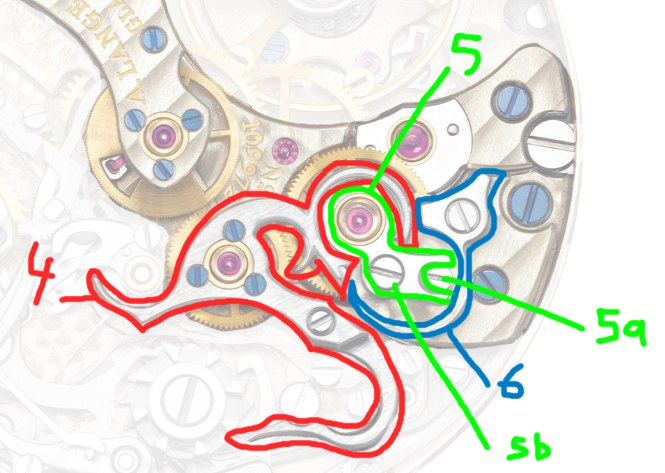
Yes, the entire (4) swings! It swings around (5), which holds 4 in place. Notice that (5) has two screws on it. Screw (5a) at the open end is used to adjust the position of (5), so that the entire system can be adjusted precisely to function smoothly. Again, left to the deft and capable hands of the watchmaker... Screw (5b) is used to hold down piece (5) firmly, so (4) and (5) doesn't just fall off...
Great, we now have a free swinging piece (4) that engages and disengages gears (1) and (2). The next big question - how do we control this piece with the push of a button? When we start the chrono, we want piece (4) to swing to engage the gears. Another push, stop the chrono by disengaging the gears. Notice piece 4 has a long tail at the bottom...and there is a curved spring (6). (6) has an important purpose to fulfill; it constantly applies rotational force to (4), always wanting to engage the gears. However, if I held the tail of (4) open, I'd stop the gears engaging till I release the tail. The spring will then force piece (4) to engage the gears again.
Why the tail at (4) though? Thats right - its a practical way to control the chrono by using a special component you might have heard of before.
+=+=+=+=+=+=+=+=+=+=+=+=+=+=+=+=+=+=+=+=+=+=+=+=+=+=+=+=+=+=
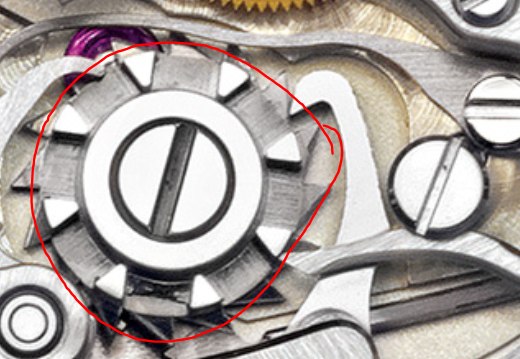
The column wheel.
So what's this mythical part that people always talk about when mentioning chronographs? "I like column-wheel chronographs" "oh, they are higher end than cam chronographs" "they feel nicer to use!" etc. etc. Well, this is the other key piece that makes chronographs work.
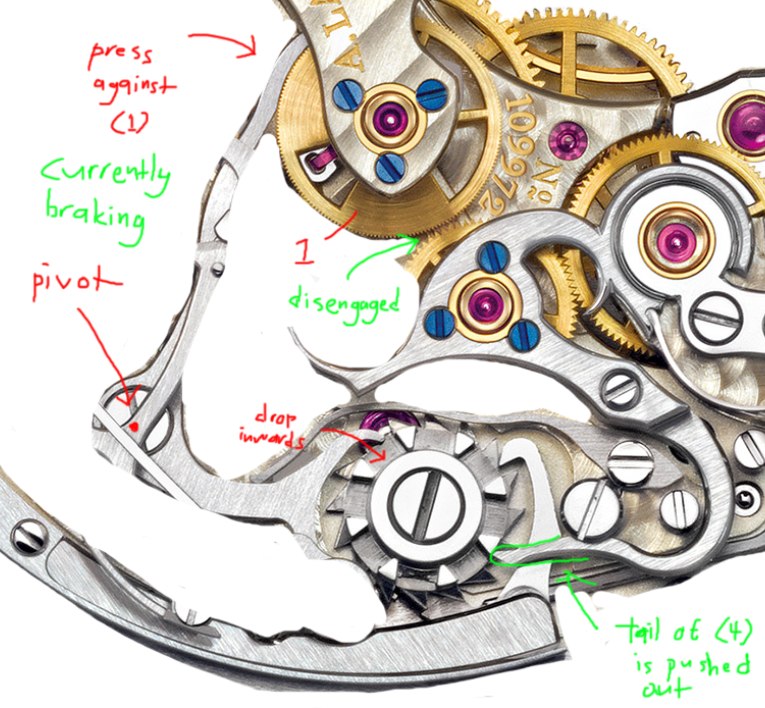
The column wheel looks like a medieval castle turret; with pillars along the rim. The column wheel spins when you press the chrono pusher start/stop button. As it spins, the pillars move and give way- allowing the tail of (4) to drop in between them, or on top of them. Remember that (4) is spring-loaded! The pillars are what hold (4) open. Case 1 is the tail dropped in between the pillars, Case 2 is when the column wheel spins and pushes tail (4) forcefully outwards.
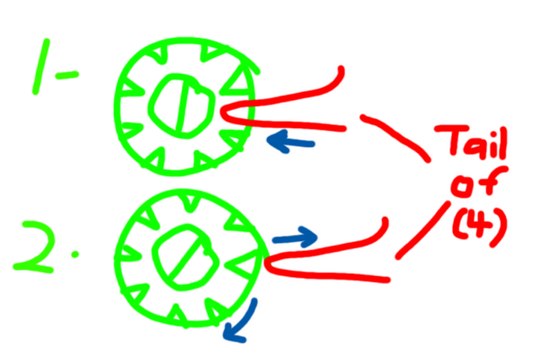
And there you have it. The very core of a column-wheel chronograph explained. One push of the button, the column wheel turns - dropping piece (4) in between the pillars, causing spring-loaded (4) to engage the gears (1) and (2). This starts the chronograph running. One more push of the button, the column wheel turns again - pushing piece (4) outwards outside the pillars. (4) is then pushed open and disengages the gears (1) and (2). Phew, what a mouthful!
We aren't done yet with the mechanisms, lets look at some other subtleties. Here's a pic of the full start/stop lever that actuates the column wheel. One key thing to note is that levers almost always have a spring attached to it. Levers are meant to be pushed - but they must find a way to return to its original state afterwards, so they all individually have a detent spring attached to them. This is visible at the top of the chrono lever for example.
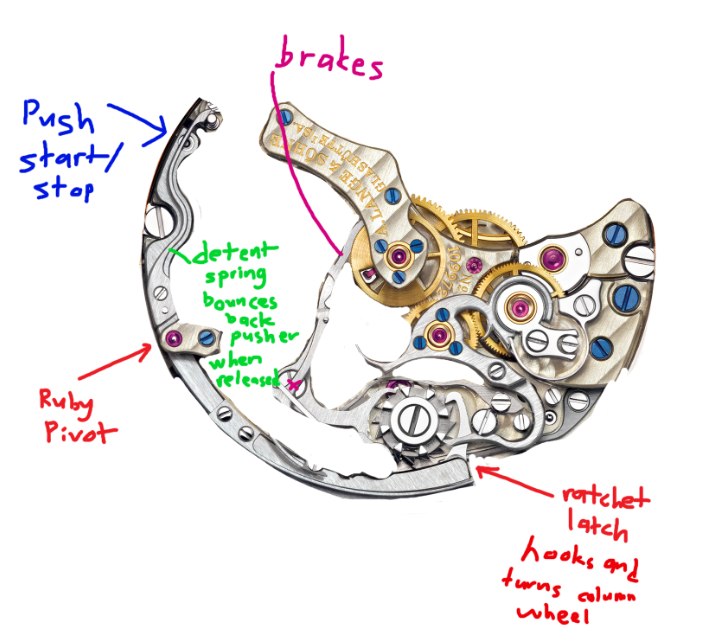
One nice touch is that the whole lever is pivoted on a ruby. Rubies are usually used for movement geartrains for less friction. Lange is trying to tell you "Ladies and gents, if you buy this chronograph from us we don't just want you to stare at it - we want you to use it! Just feel how buttery smooth pushing the chrono buttons are!".
The tip of the lever has a ratchet latch that is spring-loaded and catches onto the column wheel. Note the base of the column wheel has jagged teeth; this allows the ratchet to pull it clockwise but let the ratchet slide over counterclockwise when the lever is released and sprung back.
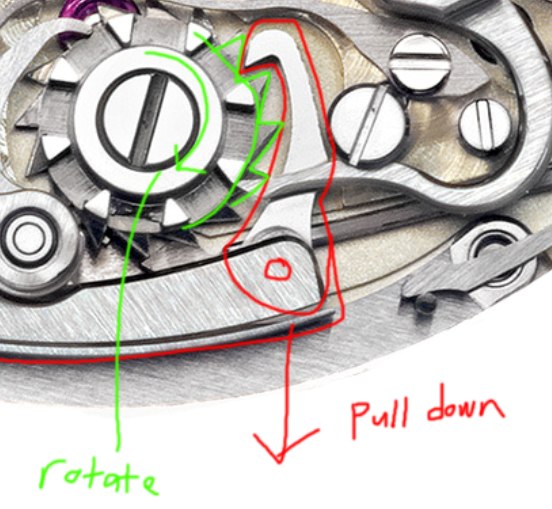
A nice thing about column wheels is that they have many sides; therefore, they can control many levers at once. The most important thing it controls is the main chrono bridge (4) as discussed before. However, there is also an extra lever required that controls braking of the chrono seconds. Otherwise, when the chrono seconds gear is disengaged, it’d a free spinning gear which is not a good idea! The column-wheel is the key component that controls the "timing" of these events. When (4) disengaged, brake the (1) wheel. When (4) engaged and chrono running, release brake of (1).
Now wait just a moment. All this mention of braking and such - what about the column wheel itself? It's meant to be a free spinning piece - how do we stop it from spinning and making sure it turns only when we press the button? Also, how do we ensure it turns the same amount each time we press the button? Sometimes we might press harder or softer, won't that affect the turning amount? There's one final key component that solves the puzzle: a detent spring holding the column wheel in place.
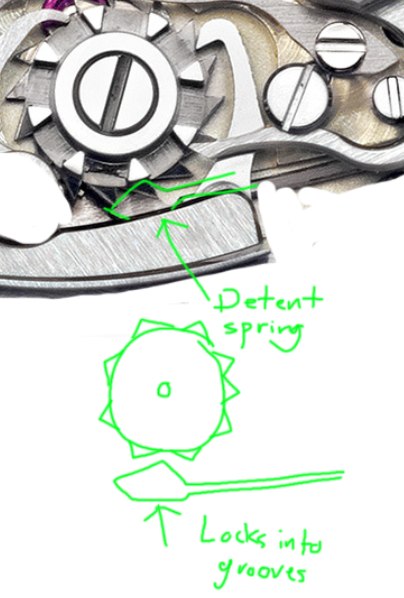
The detent spring has a triangular shaped tip that locks into jagged teeth under the column wheel. Remember the TV show "Wheel of Fortune"? There is a huge wheel with many spokes in it, and a little detent spring that points to wherever the wheel lands up. That spring works the same way here, just a little bigger/bulkier and holds the wheels firmly in fixed amounts of rotation each time (by the triangular tip).
A cam chronograph works almost the same way, except a cam chronograph works directly without a column wheel; a push of a button rotates a cam that moves a set of levers that power the chronograph. So the difference with a column wheel and cam chronograph is a little clearer: a column wheel has a nice firm "click" to it, due to the detent springs holding down the column wheel in fixed rotating increments. Also, the spring of the ratchet as you depress the pusher can be heard. A cam pusher however is a continuous movement, so in theory it would feel more "mushy" without as firm of a click to start/stop. A column wheel is more complicated to manufacture however – it’s a tiny crown wheel with a ratchet and pillars that need to be symmetrical, finely machined and finished to function properly and smoothly.
+=+=+=+=+=+=+=+=+=+=+=+=+=+=+=+=+=+=+=+=+=+=+=+=+=+=+=+=+=+=
Great, we now know how a chronograph starts and stop. But what about resetting it? Before we get into that...
Pop quiz time! Have a look at these two movements - One is a monopusher chronograph, the other is a typical two-pusher chronograph. Can you tell which is which?
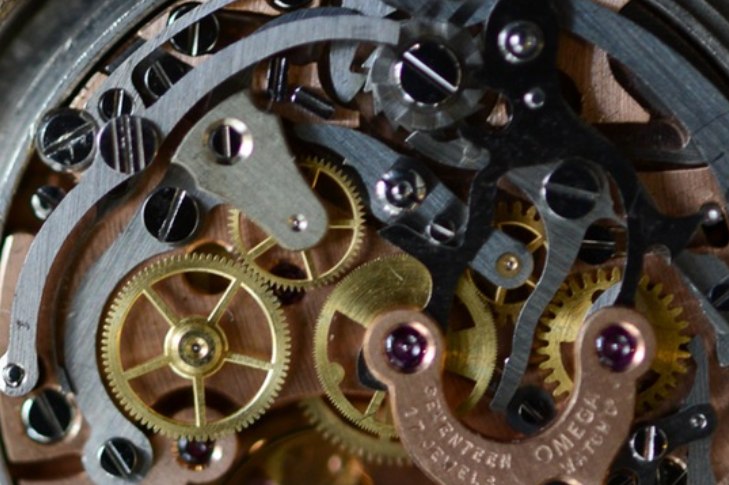
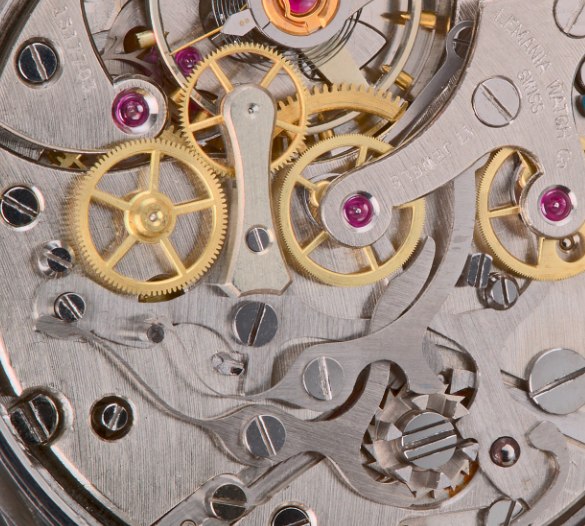
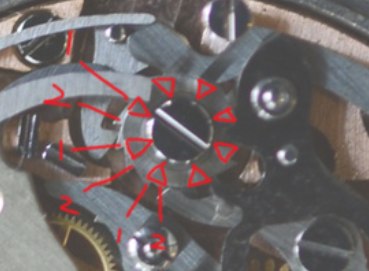
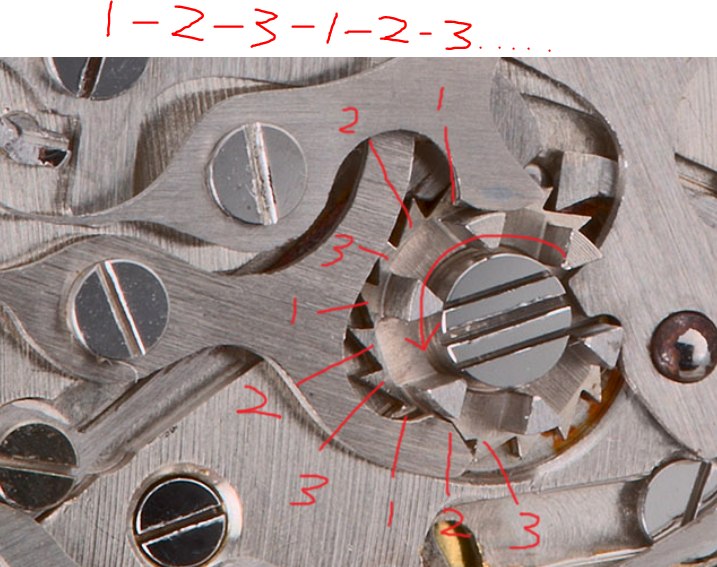
If you guess the second one as the monopusher, pat yourself on the back. How can we tell? Count the ratchet teeth of the column wheel between each "pillar". A two-pusher chronograph needs two per pillar, while a monopusher needs three. Why? Because a two-pusher chronograph button does a start-stop-start-stop-start-... cycle, when you keep pressing it. A monopusher chronograph does not have a reset button, therefore it does a start-stop-reset-start-stop-reset-... cycle.
Ok back to the Lange.
How do we reset chronographs? A key piece is called the heart-cam.
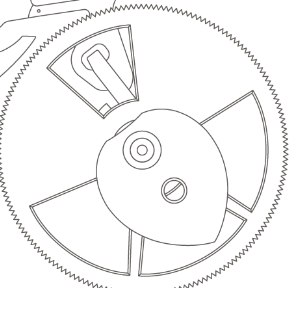
It literally looks like a heart; and its mounted on the shaft for the chrono seconds. Please note that this is not to be confused with cam-actuated chronographs; A heartcam is used for resetting a pinion, while the cam in a cam-chronograph is used for controlling the levers like a column-wheel would. The heart-shape is such that, if you press a flat surface against it, it will "slide"-rotate to the base of the heart due to its shape, to the minimum radius. The following Lange diagram shows it well: there is a hammer that slams into the heartcam to reset.
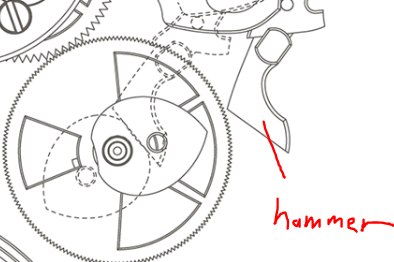
The heart then rotates as indicated in the dotted line to the reset position.
So now, we need another set of levers to activate this hammer. As in this marked-up diagram. Note that this setup is for a flyback chronograph and differs slightly for a non-flyback (as discussed later)
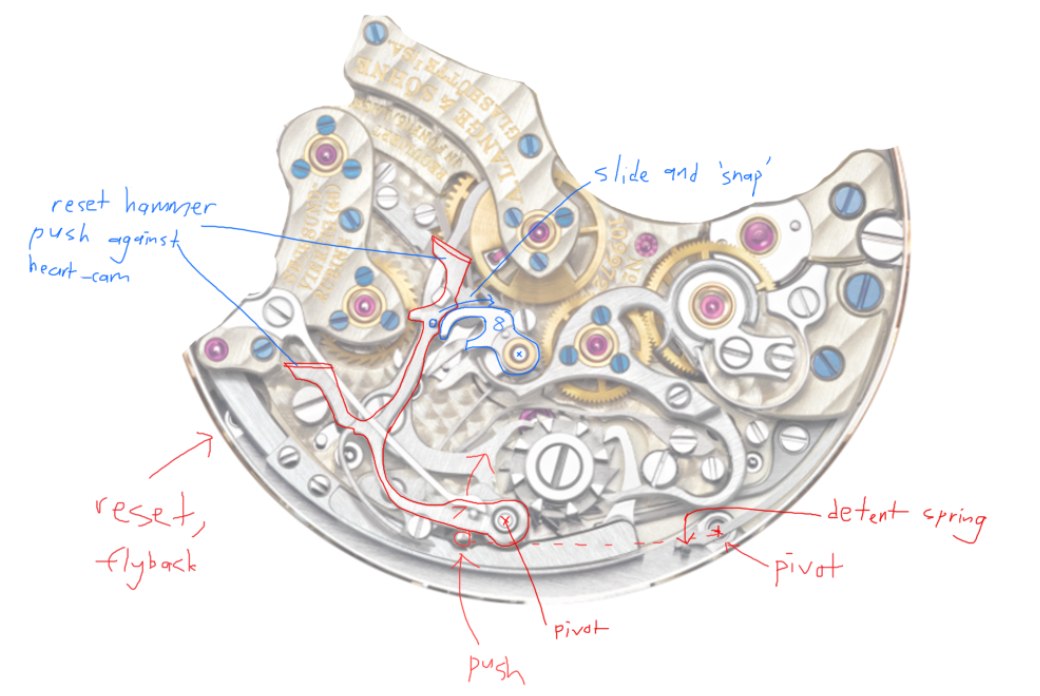
A long lever pushes against piece (7), which is the key lever used to reset both the seconds and minutes (you can see two reset hammers). Looking closer, piece (7) slides against a curved piece (8).
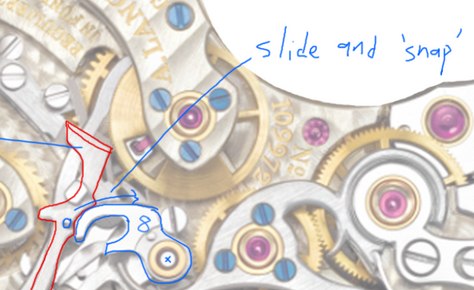
It starts as a sharp cliff (from the left) and then becomes a flat surface. This gives the "resistance" as you push the reset lever - there is plenty of resistance at first at the start which means you need to give a firm push. The shallow section afterwards then lets the lever glide freely; now strongly by the force of the push before which allows the hammer to slam into the heart-cams, resetting the chronograph properly. The heartcam then rotates into the zero-position, therefore the chrono seconds are now pointing back to 0.
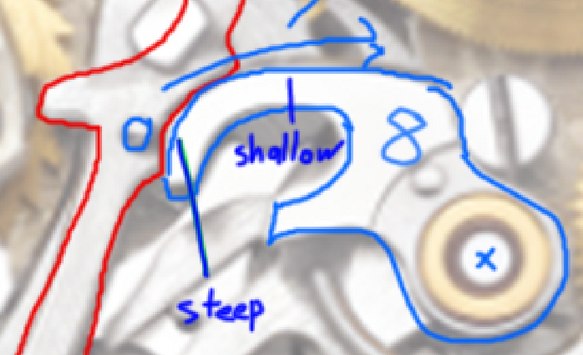
Neat! So we now know how the reset works. But, what exactly is piece (8) though? Why does it have a pivot? We now enter into the world of...flyback chronographs.
+=+=+=+=+=+=+=+=+=+=+=+=+=+=+=+=+=+=+=+=+=+=+=+=+=+=+=+=+=+=
What is a flyback chronograph? Simply put - when a chronograph is running, it would be really bad if I suddenly hit the heartcam of the chrono seconds as it is engaged with the gear train. Therefore, most chronographs can only be reset when it is not running or stopped. This is done by having the column wheel block the reset lever when the chrono is running via a tab.
This is why you should not forcefully push things on your watch if you feel resistance! If you forced the reset pusher while the chrono is running on a normal chronograph, -*snap*-! There it goes to the service centre, as you probably just broke off one of the column wheel pillars..
However, a flyback can be reset even when the chrono is running! Push the reset while the chronograph is running, the chrono seconds and minutes are reset to 0. When the reset is released, it then starts running again. Therefore the column wheel in this case never blocks the reset lever even while the chrono is activated. Brilliant! So how does it work?
The simplest way is to disengage the gear train at the same time when you press the reset lever. An example is here:
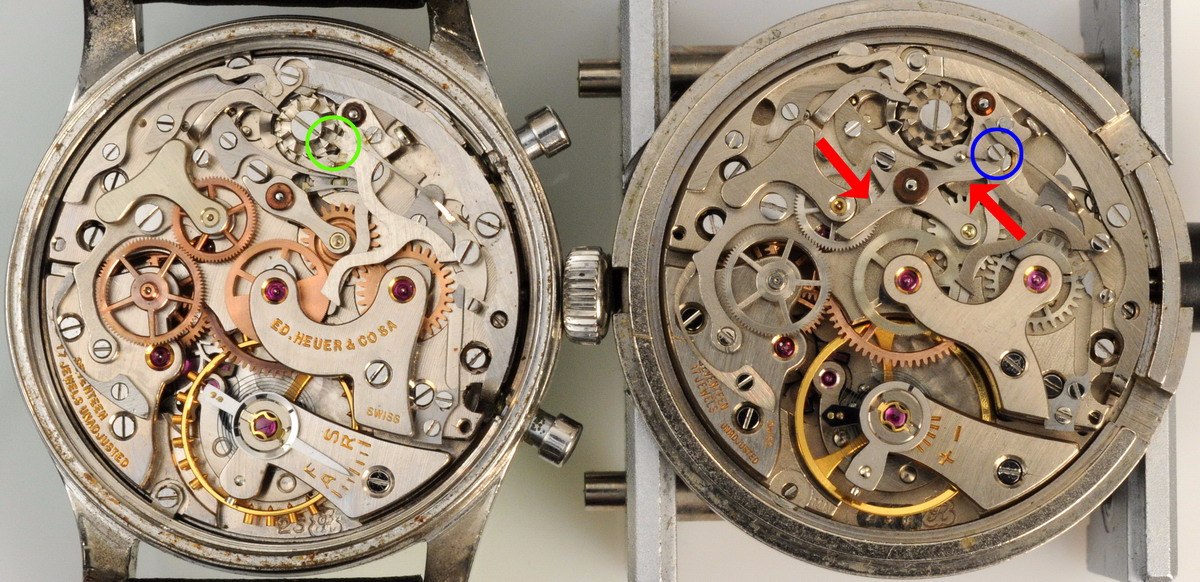
To the left is a movement of a typical chronograph without flyback. To the right, a similar movement but modified with a flyback mechanism. Notice that for the non-flyback, there is a tab on the reset lever that contacts the column wheel. Typically for a non-flyback (at least from what I believe, maybe there are other ways of doing it?), when the chronograph is started, the column wheel pushes against the tab, “cocking” the reset lever outwards and it clicks into place held by a pin. This tab also prevents a typical chronograph from being reset while running. When the chronograph is stopped and you press the reset pusher on a typical chronograph, it releases this pin – the lever spring then forces this reset lever inwards to slam into the heartcam which resets the chrono.
However, a flyback chronograph does it differently. This tab does not exist; so the chronograph can be resetted regardless of whatever position the column wheel is in (this is usually the quickest way to identify if a chronograph is a flyback from glancing at the movement). When you push the reset pusher on a flyback like the Lange, you are using the force of pushing the pusher to move the reset lever to slam into the heartcams. This setup is subtly different in tactile feel – in theory, start/stopping a flyback chronograph would need less force as the column wheel does not have the resistance of cocking the reset lever anymore. That work is now done by the reset pusher which conversely in theory may need more force on a flyback.
For a flyback, the geartrain has to be disengaged when you press the reset lever (otherwise, the hammer slamming into the heartcam will force the geartrain!). Therefore, there is an addition of a lever in the middle for decoupling the chrono bridge. When the reset button is pushed, the circled blue peg pushes against the lever (marked both ends with red arrows) which then pushes against the swinging chrono geartrain, disengaging the mesh of gear teeth. The hammers also slam into the heartcam at the same time, resetting the chronograph. When reset button is released, the blue peg is withdrawn and the lever is released. The spring then pushes back the swinging chrono geartrain to re-engage the chrono seconds.
This can also be seen in the case of the Lange movement.
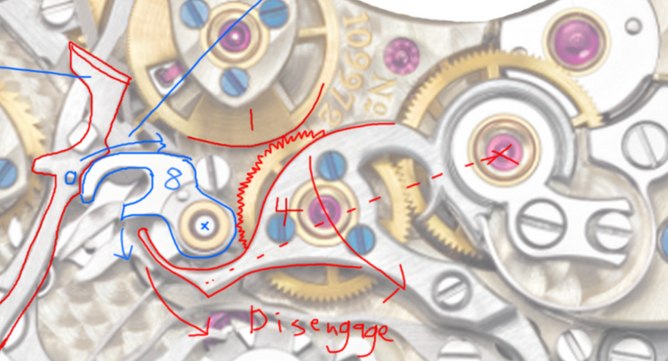
Piece (8) actually pivots; when reset button is pushed, it will force piece (8) to rotate downward - pushing against piece (4) from before. That will temporarily disengage the geartrain from the chrono seconds gear (1). Again, when reset button is released, spring of (4) makes it rotate back to re-engage gear (1) and the chrono starts again.
Note a weird looking piece (9) underneath that is actually also connected to (8).
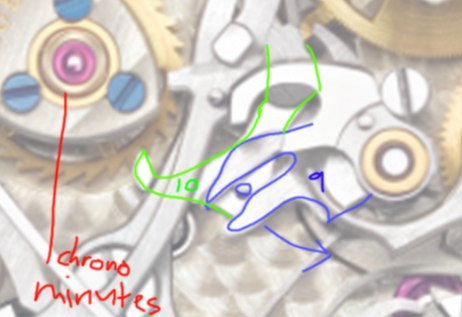
That does the same job of disengaging the chrono train; except this is for the chrono minutes. Speaking of that, this video demonstrates well how the jumping chrono minutes work ... Note at the very end, the chrono seconds/minutes are reset to 0. Piece (9) can be seen retracting the ratchet lever that moves the chrono minutes, while the heartcam is pushed back to 0 (hammers not shown in the video).
+=+=+=+=+=+=+=+=+=+=+=+=+=+=+=+=+=+=+=+=+=+=+=+=+=+=+=+=+=+=
That's about it from me for now. Thank you for reading if you made it through! Understanding how the L951 chronograph section works worked both ways to me: on the minus side, it removed most of the "mystery" surrounding all the little parts when you realise what each of them actually do and know how they work. However, gaining a deeper understanding of the movement makes me appreciate the fine engineering that goes into watches in general.
Again, remember they are small enough to fit on your wrist!
Regards,
skyeriding
Edit: Here's a nice vid of the Datograph. See if you can figure out everything after reading the above!
Edit2: If you can't tell by now, I love this movement. One day I'll own one...One fine day...
This message has been edited by skyeriding on 2015-12-15 11:57:57The 1815 Chronograph, reference 414.026, is a distinguished member of the 1815 collection, known for its focus on traditional watchmaking and classical design elements. This particular edition, often referred to as the "Boutique Edition," stands out with its white gold case and a black dial, offering a monochromatic aesthetic that enhances its legibility and understated sophistication. It represents a more contemporary interpretation within the 1815 chronograph lineage while maintaining the collection's core principles of precision and craftsmanship.
The watch features a 39.5 mm white gold case with a thickness of 11.4 mm, housing the manually wound caliber L951.5. This movement is visible through a sapphire crystal case back, allowing appreciation of its intricate finishing and traditional German silver components. The front crystal is also sapphire, ensuring durability and clarity. The movement provides a power reserve of 60 hours, indicative of its robust and reliable construction.
This reference appeals to collectors who appreciate a chronograph with a strong classical identity, executed with a high level of artisanal finish. Its white gold and black dial combination offers a versatile appeal, suitable for various occasions while remaining true to the brand's heritage. The 1815 Chronograph series is a cornerstone of the brand's offerings, providing a purist's approach to the chronograph complication.
I will read in depth when getting the time. Best, Kari
Thanks! Best, Kari
What a generous and wonderful contribution to the forum. I've done several searches on this topic and have not found an essay as thorough and clear as yours. I cheated on the pop quiz. I didn't think Omega ever made a monopusher so guessed based on the engraving on the bridge. The only thing I was wanting for was a picture of a cam. I'm still not clear what that actually looks like. This was clearly a time-consuming endeavour and I am grateful that you took the time to create it.
I overlooked the Omega engraving on the bridge haha. A cam would look like this , in a 7750. [1] would be the cam itself, with all the levers actuated by it. [4] and [5] would be the reset levers and hammers, 6 would be the chrono bridge that couples and decouples the chronograph. The cam rocks back and forth when activated, versus a column-wheel which rotates in one direction only. Regards, skyeriding
You've hit all the main operations - starting, stoping and reset - in one comprehensive post. Very much appreciated. That Lange is a beautiful movement too! You may wish to dissect the oscillating pinion and vertical coupling in a future post - the material available on the web is limited. No pressure! These traditional horizontal coupling movements are my favourite type regardless - easy on the eyes and easy to observe in action. Yet we still see interesting innovation every year. The Vacheron
This thread is active on the A. Lange & Söhne forum with 23 replies. Share your knowledge with fellow collectors.
Join the Discussion →