Reference Guide
Modernahab, a seasoned collector, offers a compelling comparative review of two horological titans: the Jaeger-LeCoultre Reverso Chronographe Rétrograde Ref. 270.2.69 and the contemporary Reverso Tribute Chronograph Ref. 216.8.S0. His personal journey with these timepieces provides a unique lens through which to explore the evolution of JLC's integrated chronograph movements and the distinct aesthetic philosophies behind these iconic Reverso references. This article delves into the nuances that define each watch, from movement architecture to dial design, offering invaluable insights for both long-time enthusiasts and new collectors.


 I should add that in neither of the two watches are the
verso sides exemplars of legibility, though the Tribute Chronograph does score
over its predecessor on this account. In addition to the minute track and
indices, black sectors on the chronograph minutes and seconds chapter rings and
corresponding white-painted segments on the chronograph hands result in less
squinting when reading elapsed times on the Tribute Chronograph. Operating the
two chronograph mechanisms also offers different tactile experiences, though I
don’t know how much of this is attributable to the greater age and history of use
attaching to my Chronographe Rétrograde. Whatever the cause, the Tribute Chronograph
pushers engage with a more distinct (and very audible) click, while the Chronographe
Rétrograde, though not without offering some tactile feedback, has a smoother, “buttery”
feel and is practically inaudible.
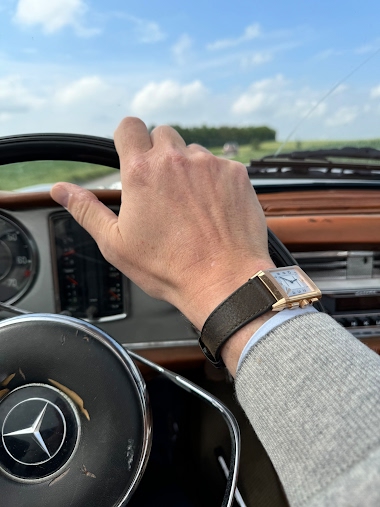
Finally, a word on the straps. Two quick-release straps are
supplied with the Tribute Chronograph, both courtesy of Casa Fagliano, and both
sharing a single stainless steel butterfly clasp. One is done in medium-blue denim-like
canvas with smooth, midnight-blue leather accents, the other is entirely in
midnight blue leather. The seen below, the all-leather strap dresses up the
watch significantly, though the dressier presentation strikes me as somewhat at
odds with the Tribute Chronograph’s large size. I look forward to trying some bespoke
ridged reptile or exotic leather straps, as I have used as alternatives to the
Fagliano straps on my other Reversos.
I should add that in neither of the two watches are the
verso sides exemplars of legibility, though the Tribute Chronograph does score
over its predecessor on this account. In addition to the minute track and
indices, black sectors on the chronograph minutes and seconds chapter rings and
corresponding white-painted segments on the chronograph hands result in less
squinting when reading elapsed times on the Tribute Chronograph. Operating the
two chronograph mechanisms also offers different tactile experiences, though I
don’t know how much of this is attributable to the greater age and history of use
attaching to my Chronographe Rétrograde. Whatever the cause, the Tribute Chronograph
pushers engage with a more distinct (and very audible) click, while the Chronographe
Rétrograde, though not without offering some tactile feedback, has a smoother, “buttery”
feel and is practically inaudible.
Finally, a word on the straps. Two quick-release straps are
supplied with the Tribute Chronograph, both courtesy of Casa Fagliano, and both
sharing a single stainless steel butterfly clasp. One is done in medium-blue denim-like
canvas with smooth, midnight-blue leather accents, the other is entirely in
midnight blue leather. The seen below, the all-leather strap dresses up the
watch significantly, though the dressier presentation strikes me as somewhat at
odds with the Tribute Chronograph’s large size. I look forward to trying some bespoke
ridged reptile or exotic leather straps, as I have used as alternatives to the
Fagliano straps on my other Reversos. 
The Reverso Grande Automatique reference 270.2.69 represents the larger automatic variant within Jaeger LeCoultre's Reverso collection. This reference belongs to the Grande series, positioning it as a substantial interpretation of the reversible case design with self-winding functionality.
The watch features a 46 x 29 mm stainless steel case housing an automatic movement. The silver dial sits beneath sapphire crystal, while the fixed bezel maintains clean proportions. Water resistance extends to 30 meters, suitable for basic daily exposure to moisture.
This reference appeals to collectors seeking an automatic Reverso in substantial proportions. The stainless steel construction and silver dial configuration offer accessibility within the Reverso lineup, while the 46 x 29 mm dimensions provide significant wrist presence. The automatic movement eliminates the need for manual winding, making this variant practical for regular wear among those drawn to the Reverso's distinctive reversible case concept.
On the original, my only doubt is about the date, which was not mandatory. I would have loved to see it existing in platinum, but well... As it is, it is a masterpiece. A milestone of elegance, and its case dimensions are playing a big part in the charm of this watch. Without forgetting the 14 Kt gold movement! The Tribute offers a dual time and a much bigger case. And a white metal version. An evolution of the original, with two issues for me, the case size, even if, in person, it doesn't look
The time on recto and verso are not individually adjustable, though several sources have described the Tribute as possessing that complication. (Too bad, it would have been cool.)
The rose gold chronograph is my personal preference here. Although I have to say, the crown looks a little too big in the proportions to the rest of the case. The Fagliano strap proportions don't look right on the rose gold Chronograph in my eyes; the "square" piece of leather is too square and should be more rectangular in my eyes. Which one will get more wrist time?
I have so many alternative straps for the Chrono Rétrograde, I could wear it for a week and have something different on it every day. ;-) Hence that Fagliano band is a sometimes thing. As for comparative wrist time, I've only had the Tribute for a short time, so I have no idea which I'll wind up wearing more often. (Though again, I hold a special fondness for the gold original.)
This thread is active on the Jaeger-LeCoultre forum with 22 replies. Share your knowledge with fellow collectors.
Join the Discussion →