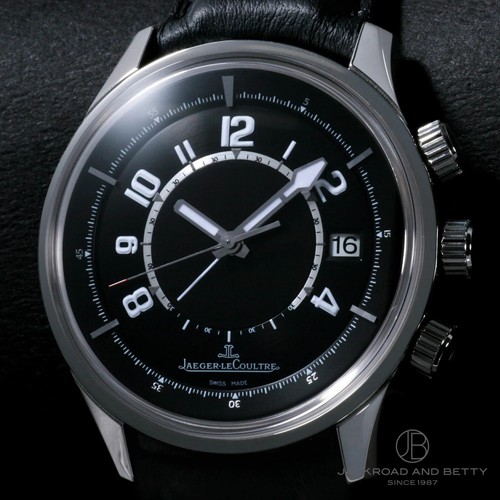
The Gyrotourbillon III is one of the first watch of the 2013 collection I introduced to you.
Here is the link to my previous article, dated from January 2013:
jlc.watchprosite.com
Jaeger-Lecoultre invited some journalists at the Manufacture for a in depth presentation of this new high end time piece.
A kind of making of, as you will see.
But first, let's remind what is the Gyrotourbillon III.
I/ The Gyrotourbillon III:

A High End piece which combinates a Flying Gytourbillon to an instant digital Chronograph, in an extra white 950 Platinum and 50 Palladium case whose diameter is 43, 5 mm and a 15, 5 mm height.
I take the opportunity here to share some observations, with you.
- This is the first time we see the Grande Maison using a Chronograph in a high end wristwatch.
Yes, you can try to check, the Gyrotourbillon I, II, the Triptyque, the Hybris Mechanica à Grande Sonnerie, the Extrem Lab One, well, none the whole family of the Hybris Mechanica collection offers a Chronograph.
Of course, Jaeger-Lecoultre released chronographs in not a so distant past: The Master Chronograph, in 2005, the Amvox II in 2006, the Duometre in 2007, and... The Extrem Lab II which also has instant digital minutes.
The Gyrotourbillon III Chronograph is even more sophisticated than the one of the Extrem Lab II, though.
You have a vertical clutch, and a column wheel, which is not the monopole of the Gyrotourbillon III, BUT, on this last one, you have a " hat " which covers the column wheel, which is located above the " 60 " of the Chronograph subdial and between 9 and 10 o' clock on the time subdial.

This " hat " was used in some pocket watches, as well as in a few modern chronographs, such as the Patek Philippe 5070.
Therefore, the second hand of the Chronograph directly works with the Gyrotourbillon, while the second barrel feeds the instant digital minutes, which take a lot of energy from the escapement.
One figure: 200 parts are dedicated to the instant digital minutes display...
The Extrem Lab II doesn't have a second barrel, to differenciate the 2 instant digital chronographs.
- The Spherical spiral is certainly one of the most complicated and sophisticated to make, compared to others such as, of course the flat spiral we most often see in the market, and the cylindric spiral we used to see in some Marine Chonometers, and most recently, the Gyrotourbillon II, as well as the Duometre à Spherotourbillon.
The spherical hairspring:

The spherical spiral is theorically and practically slightly more accurate than any others. JLC measured it, and I hope to be able, one day, to put the results on line.
This enhanced precision is due, from what I have been told, to the fact that the curve is shorter and closer to the axis.
The amplitude doesn't vary in different positions, with the multi axis flying Gyrtourbillon, since the cage does turn clockwise and anti clockwise.
The cages are made of aluminium, while the blue balance wheel is in 14 Ct gold, and Nivarox is used for the spiral.

The magic ballet lies in the fact that the external cage makes one rotation per minute, when the internal cage does it in 24 seconds, only.
- The day night indicator is not very useful, here, as it is not coupled to a date or to a second time zone, its presence being dictated by some aesthetical reasons, for the balance of the dial.

- The finishings are strongly inspired from pocket watches of the 19th century, maybe even earlier, especially the " Martellage " on the bridges, which are made of non treated german silver ( Maillechort ).

- Those who know and admire the Hybris Mechanica à Grande Sonnerie will appreciate to see that the Gyrotourbillon III borrows the same very technical buckle, allowing an adjustement to the millimeter, which is, obviously a plus when your comfort zone is between two holes.

100 components are required for the buckle only.
From the Bureau Technique Habillage to the Prototype Workshop, this is the journey I want to share with all of you, now.
II / The Making of:
From the virtual to reality, there are a lot of steps to measure the progression of a project.
- First of all, the idea of a new watch always takes form with a plastic case and a dial made of paper, as everybody needs to see if it works, or if it doesn't, which is a common point between watchmakers and us.
Words and drawings are not enough, we need some concrete details.
Here is the first prototype, in plastic and paper:

Did you notice the absence of the pusher at 2 o' clock?
- The designers and watchmakers work in close collaboration, which is easy to understand, as it is not worth working on something which is impossible to realize.
There is an essential department in the concretisation of any project, a department which we had the pleasure to visit for the very first time, the Bureau Technique Habillage.
The people working here are in charge to control that the solutions found by the designers and watchmakers work, that there is no issue.
For example, a movement which is too big for a case, or too thick, or that the water resistance is ok, that nobody didn't forget a detail which is essential to the watch, and so on...
This Bureau works with 3 D programs and inspect all the details.
For your eyes only...


If there is an issue, the watchmakers or the designers have to re adapt their ideas and solutions to the project.
- Step 2, the assembly of the balance wheel and the spherical hairspring.
First, you have to work on the balance wheel to reach the perfect balance, when it turns.
If it is not the case, you have to remove some material from the inside of the balance wheel, till you reach the expected outcome.
After, the spherical spiral is installed on the balance weel, which needs to be flawlessly centred.
Needless to say that these surgical operations are long, minutious and fastidious.
The technical drawing of the balance wheel and its spherical hairspring:

The outcome, magical:

- Then, the watch can go to step 3, the Adjustments and Testings Workshop ( Laboratoire Reglages et Essais ).
All is in the name of this workshop: The prototypes are tested, adjusted by the prototypist, for the best precision of work.
The prototypist plays another very important role: He will train the watchmaker of the Spécialités Horlogères Worhshop who will be in charge of the assemblies of the series, who will, in his turn, train his colleagues for the same workshop who will work with him on the movement... A chain of shared knowledge.
A close up of the Cal 176 through a Leica Binocular, taken with a Leica D Lux 4... The movement, not finished, of course:

A general view of the Cal 176, now:

The Group at work... Some well known faces:

- Once the movement is perfectly adjusted, the production of the components can start.
Some magic moments were lived during this stage.
Some examples: The undercutting of the tourbillon cage from its aluminium bar:

Sculptural Art:

As we are speaking about sculptural art, some nice anglages and perlages:

And... The famous " martellage " which is back on a modern watch.
The artist in action:


The outcome:

The movement, including this new finishing. You will notice that between the anglage and the martellage, Jaeger-Lecoultre added a zone, a kind of pavement, to have a cleaner visual aspect.
I was told that the " pavement " was indeed necessary before the anglage on a martellé part.
Very interesting:

Conclusion:
The Gyrotourbilllon III reaches some summits, in terms of finishings, price ( 453 000 Euros ) and sophistications ( the instant digital chronograph and the spherical hairspring ), with the now well known magic of the multi axis tourbillon.
Each Gyrotourbillon III requires 3 to 4 months to be fully finished, adujsted and assembled.
The only reserve I have is the choice of the day night indicator, which I don't find very consistent on a watch of this category, nor very useful, to say all, but its presence is purely aesthetic, and I must say that it is nicely decorated.
It is also exclusive because of its rarity, as it is limited to 75 pieces.
No doubt that the Gyrotourbillon III is another nice page of the Jaeger Lecoultre Hybris Mechanica book.
Looking forward to reading your comments and thoughts,
Best.
Nicolas
This message has been edited by amanico on 2013-05-01 00:09:55 This message has been edited by amanico on 2013-05-06 08:43:55