Complications
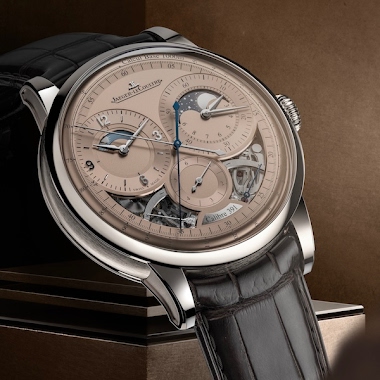
Dje's 2010 SIHH report delves into the Jaeger-LeCoultre Duomètre à Quantième Lunaire, a pivotal piece showcasing the brand's innovative dual-wing concept. This article provides a detailed look at its technical features and design, offering a valuable historical perspective on JLC's advancements in precision watchmaking.


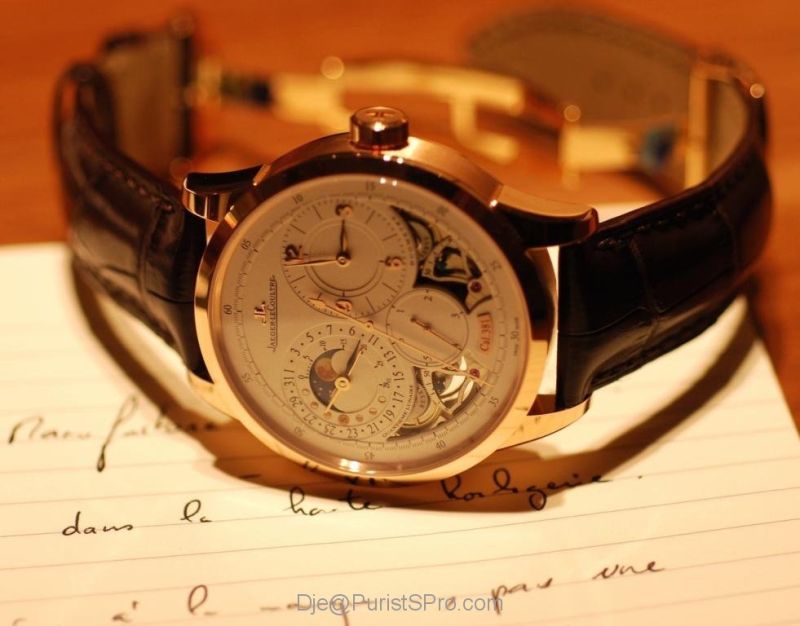


Nearly three
years have passed since Jaeger-LeCoultre presented the Duometre a Chronographe.
This extraordinary piece was the first of an expected series of interpretations
of horology devices powered by two parallel barrels. As you may know now the
two barrels power two separated wheel trains, each of them having its own
function.
In the Duometre
a Chronographe one barrel and wheel train was used for indicating the time
(hours, minutes and seconds) and the other was doubling the function on a
chronograph way. Obviously both wheels trains were regulated by the same
escapement. You may find more information about the way it works in this
article I wrote at that time to explain it: jlc.watchprosite.com
In the Duometre
a Grande Sonnerie, second Duometre and master piece of the Hybris Mechanica
presented in September 2009, one barrel powers the Grande Sonnerie while the
other powers the time indicators and the perpetual calendar.
This year
Jaeger-LeCoultre presents another smart use of the dual wing concept with this
calibre 381 of 369 parts. The Duometre a Quantieme Lunaire is a simpler watch
in a sense, dedicated to precision and showing a very beautiful finish like the
former Duometre.
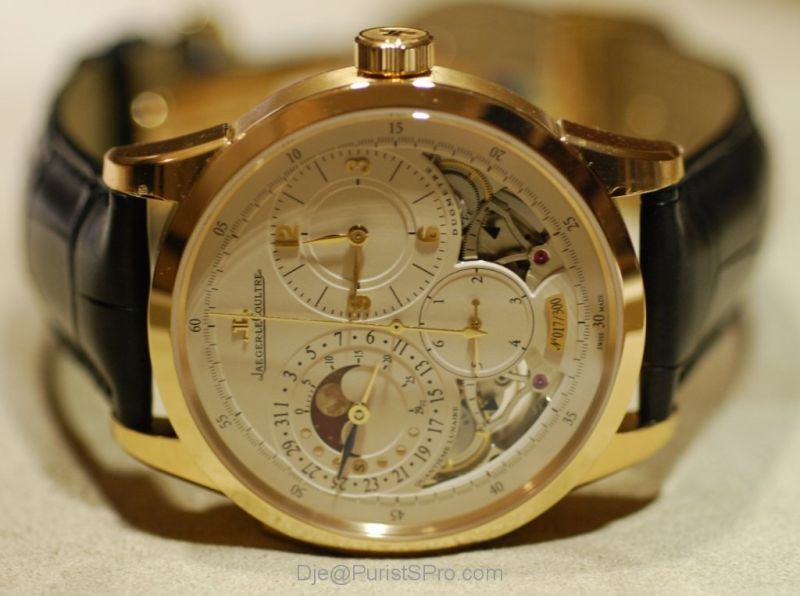
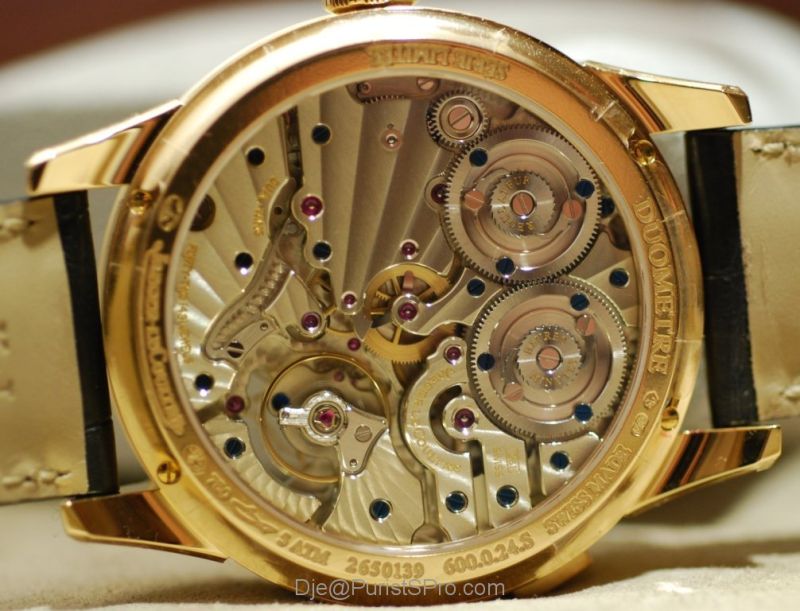
Jaeger-LeCoultre Duometre a Quantieme Lunaire in yellow gold
Don't
take me wrong ! I don't write "simple watch" meaning
that it is made simply.  This watch has a very well thought construction, quite
inventive in fact. It uses a complicated way of expressing indications
generally simple to realize, but for a good reason.
This watch has a very well thought construction, quite
inventive in fact. It uses a complicated way of expressing indications
generally simple to realize, but for a good reason.
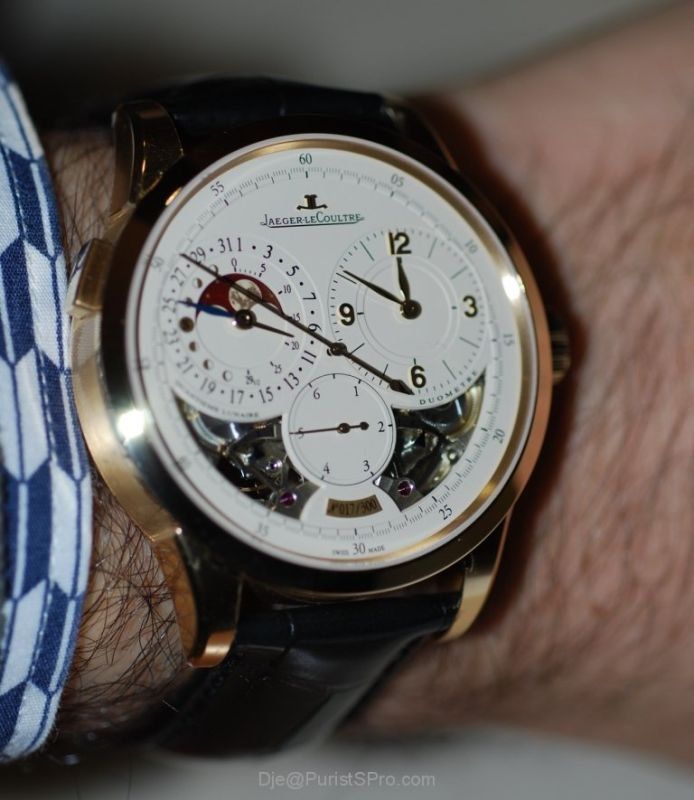
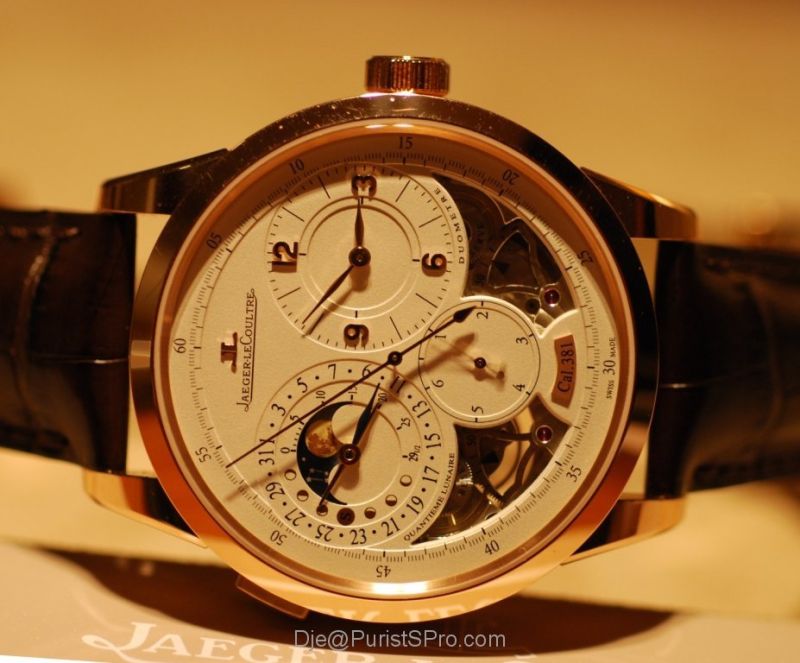
This watch
shows the hours and minutes in the upper right part, the seconds hand at the
centre, the sixth of a second at 6 and the date and moon phase and age at the
upper left.
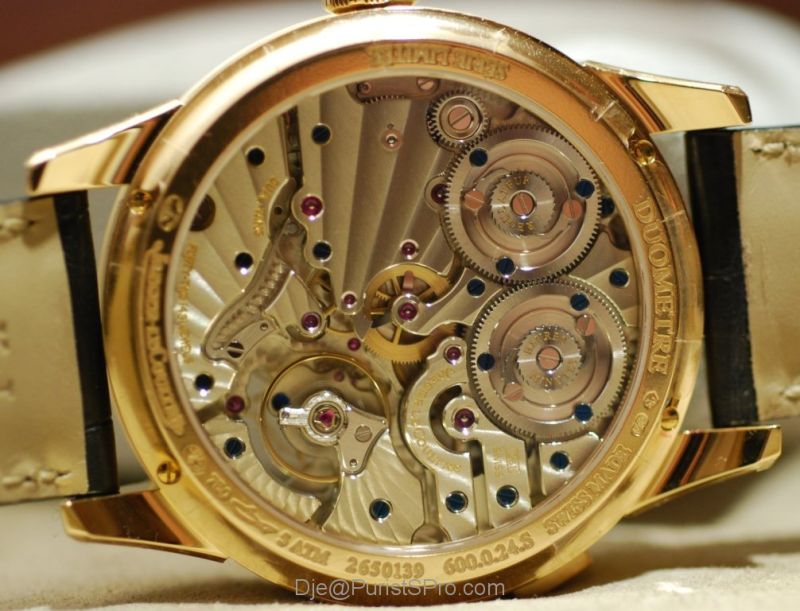
Dual barrels
You may wonder
which barrel powers each of these indications? Well in fact one barrel
powers them all!
Is there any
use for the second barrel? Yes, it powers the escapement. Why? Because if
one barrel powers only the escapement, its flow of energy is not perturbed by
the needed energy for the indicators like in other watches. This is the Duometre principle we already
know. It was the same basic principle with the Duometre a Chronographe: being
powered by another barrel, the use of the chronograph train had no interaction
with the precision of the time indication.
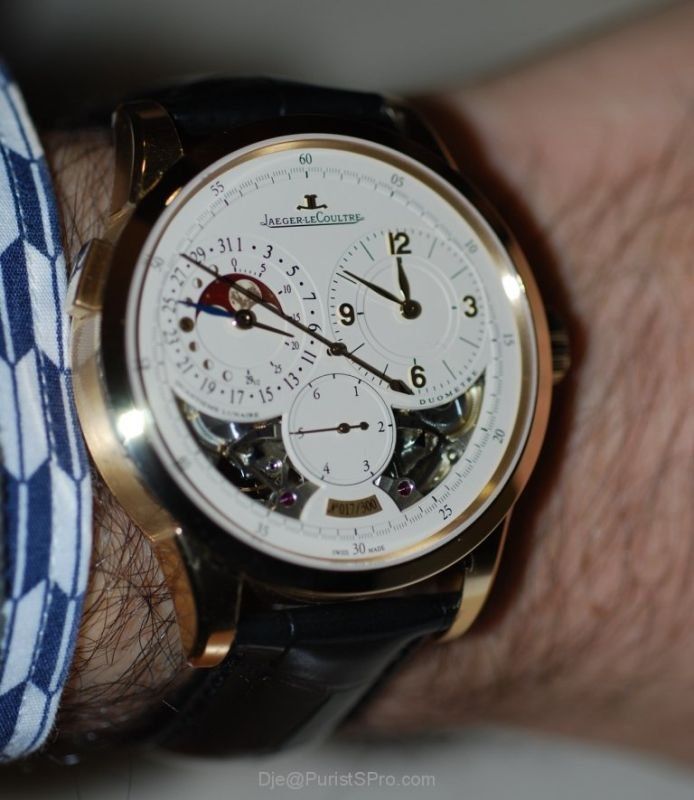
Permanent lightning second
In the Duometre
a Quantieme lunaire the energy needed to move the indicators of the hour, the
minute, the second, the sixth of a second, the date, and all the moon
indications, is not taken from the energy that powers the escapement.
Consequently the flow of energy at the escapement is directly depending of the
torque curb of the barrel. This is not a constant force escapement, but it is
an isolated escapement (isolated from the inertia of the indicators).
This is the
first positive aspect of this dual wing construction (and the difference from the Duometre a Chronographe).
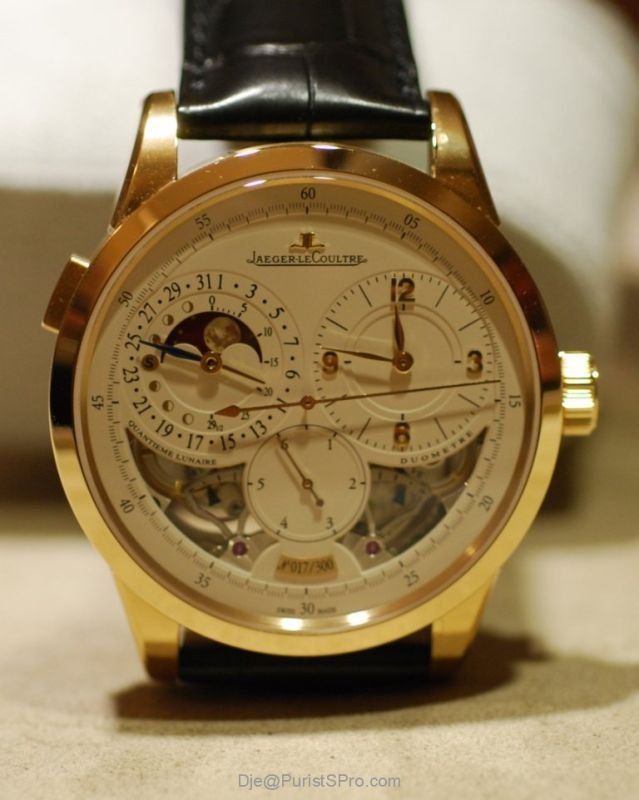
Precision is the aim
Precision
relies in the indication too. The clear and separated indicators help improving
the precision of reading.
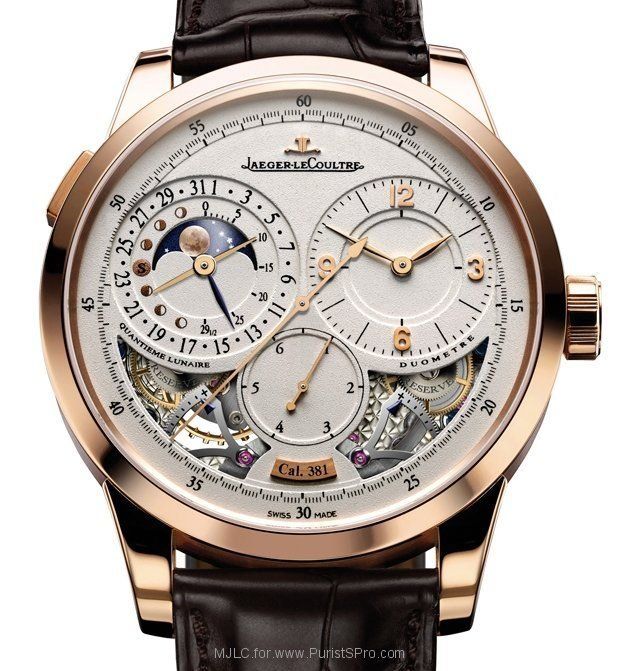
Open dial
The second main
positive outcome of this construction relies in one major aspect of all precise
watches: it hacks!
But contrarily
to traditional watches when the Duometre a Quantieme Lunaire hacks the balance
wheel is not stopped. All indicators are stopped but the escapement keeps
running perfectly and that way the use of the stop seconds function has no
interference on the balance amplitude and frequence. The precision of the
timing is totally preserved from interference from the setting of indicators.
The balance
wheel is 10mm large and has an inertia of 11.5 mg cm2. It beats at a frequency
of 3 Hz or 21 600 vph. I'm particularly fan of these large and heavy
balance wheels running at moderately fast speeds. Fast balance wheels have
their advantages too, but they are generally small and light to preserve the
power reserve. Here we have a sufficient power reserve of 50 hours. A manual
wind aimed at running at the best of its torque curb deserves a daily winding
in my opinion.
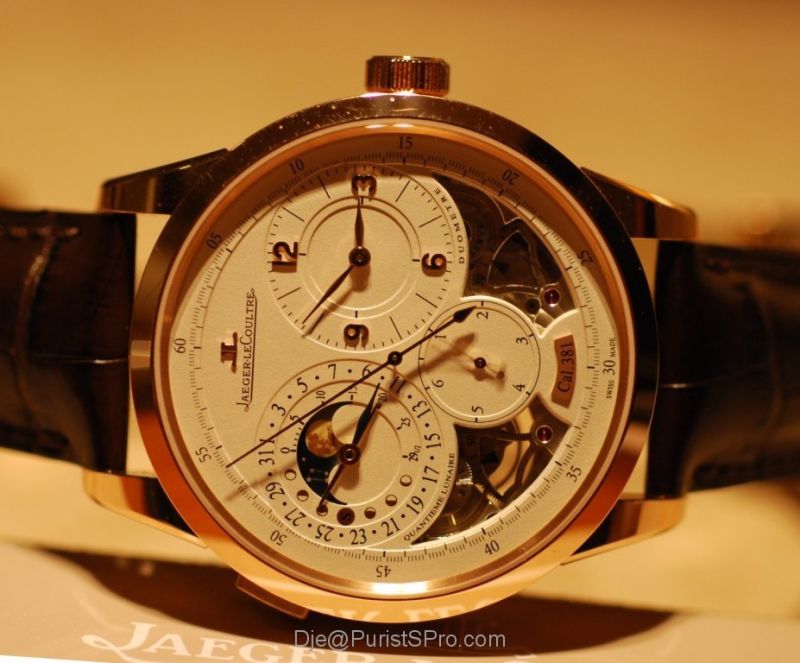
Pink gold is fashionable these days
To sum up we
can consider that if the escapement is properly regulated, the long term use of
the watch has no consequence on its precision: setting the indicators or
hacking the watch to synchronize the second doesn't act on the precision
of timing of the escapement. Only the torque curb of the escapement barrel can
influence the precision. Still it is known that a spring can have a range
of use with a pretty steady torque before the torque changes. You have to use that part of the spring for the best timing.
I still have to
ask and get from Jaeger-LeCoultre the information about the torque curb
principles of this calibre but I guess that the smart use of the power reserve
indicator can lead to a very precise watch. I also hope to get more information
about the precision tolerances of this watch. Of course the SIHH is just over
and we have to be patient but I'm sure it will come sooner or later.
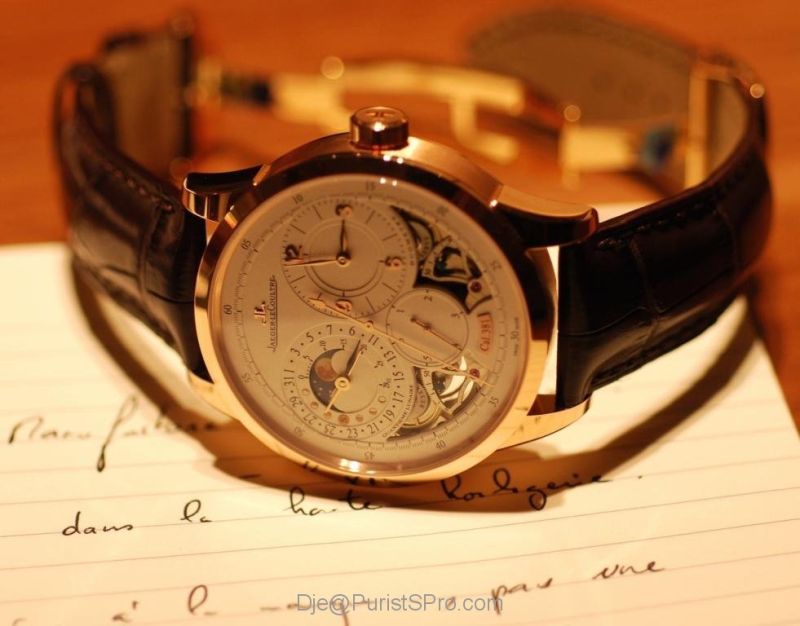
A complicated aspect for a simple watch
As I wrote
about hacking the watch, in fact I must explain. If you pull the crown it stops
the seconds hand immediately and the lighting seconds hand keeps running till
it stops at 0. The other indicators are stopped too but you obviously
can't notice it. If you pull again lightly the crown the central seconds hand
goes back to 0, pushed by a heart cam like those used for resetting chronograph
hands.
Once you push
back the crown at the desired moment the hands and all indicators begin running
again. At this precise time the escapement is still at full precision as it was
not stopped and is not interfered by the re-activation of the indicators.
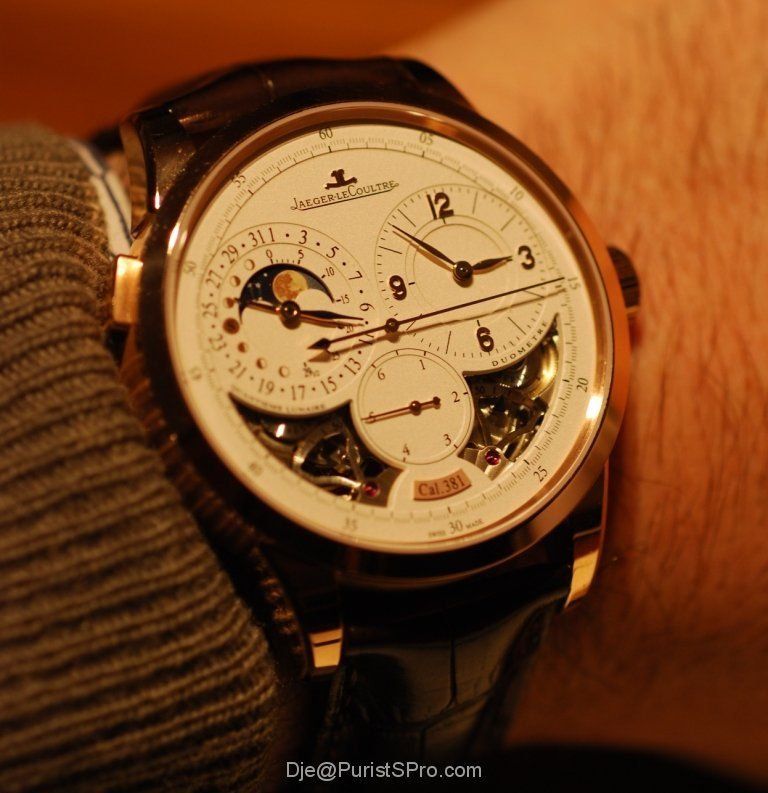
Perfect on my wrist
There is
another positive aspect of this watch construction. The lightning seconds hand
is permanently running (when it is not hacked of course) and this brings a very
pleasing animation to the dial. We can sometimes regret to look at some very
beautiful but "dead" dials of fantastic watches. This one is always
alive and you have nothing to do to keep it alive, except keep an eye from
time to time on the two power reserve indicators in the dial apertures.
Furthermore the
sixth second hand is a natural indication as the escapement runs at 21,600
vibrations per hour, i.e. 6 per second!
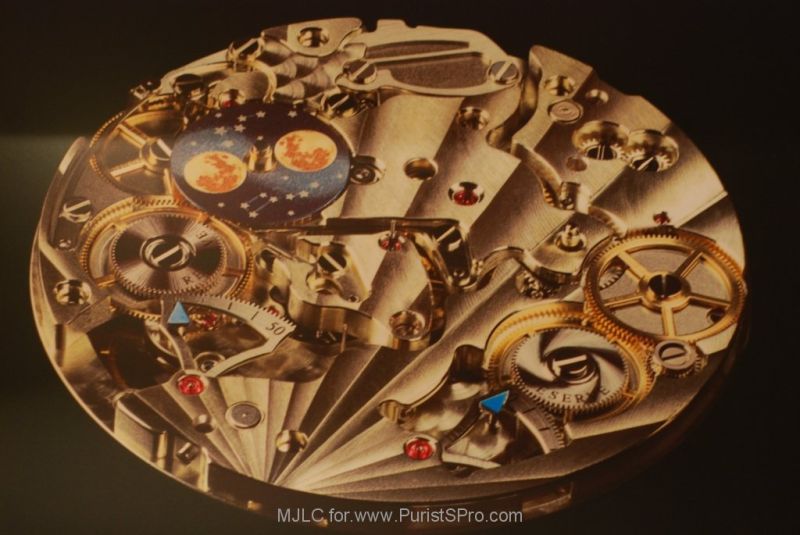
Dial side
At first sight
I regretted two things on this watch. I didn't like the apertures on the
dial. I generally don't like apertures showing the calibre. Honestly
I've been fast to get used to these ones. They are limited and show
interesting and nicely finished landscapes: the two power reserve indicators that appear on the
opposite of the barrels, what I find amazing, and the balance wheel on the
left, confirming that it doesn't stop while you hack and set the
indicators.
The other point
that I didn't like was the decoration of the moon disc. Don't worry
it is not the definitive one that is pictured here. Although it looks nice on
the two press pics, it was far from being as nice on the prototype watches
I've seen, and I can't wait to see the production piece. About the
moon indications I should precise that it relies on a classical 59 teeth wheel
and consequently the moon will require a one day setting every three years. The
moon is adjusted through a pusher at twelve while the date is corrected with
the button at 10.
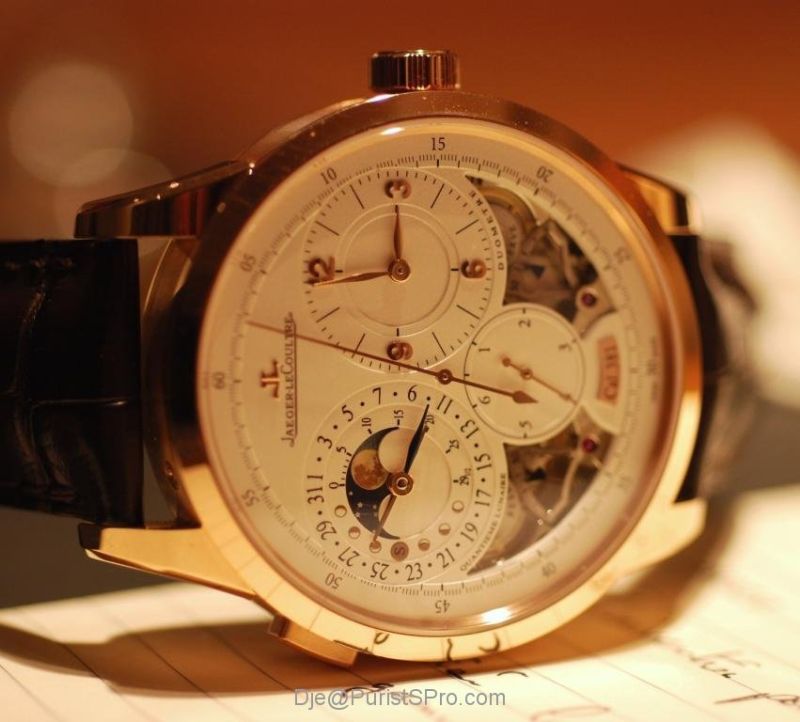
The face of the moon
This gorgeous
watch will have a limited production of 300 pieces in yellow gold (26 500
euros expected) and will be un-limited in pink gold (25 500 euros
expected), although production of Duometre models is not high enough to see one at every corner.
The case is 42 mm large, 13,5 mm thick and nicely
filled by the 33,7 mm
large and 7,5 mm
high calibre The watch is waterproof at 50 meters. I have no idea
of the waterproof capacity of the alligator strap though!
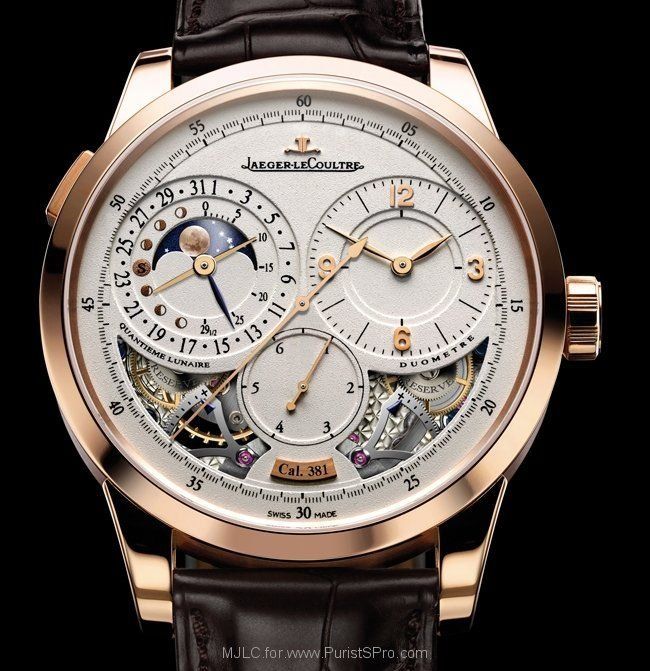
A totally new design
All in all this
watch is a very appealing new offer. It has a very beautiful case, a gorgeous
calibre, some very appealing chronometric virtues and promises (yet to be
confirmed of course by figures). The functions are simple and useful, but also
romantic with the moon and pressing with the lightning seconds hand! This watch
is alive and wants to keep your time best than ever! I'd like to lend her
mine, for sure!
Could that watch be my favourite current Jaeger-Lecoultre? Sure!
Cheers
Dje
I've also been conquered by the Duometre ! I appreciate your technical explanations my friend. Best Patrice
I fell under the charm of this watch... The dial is superb, and the small apertures are superb. I was a bit surprised at first sight, then I had a closer look and loved them. There is something nice to see through these apertures! It is smart from JLC to have moved the hour dial on the right part, at 3, as you will have an easier look at the time when you wear it under your sleeve. As always, the Duometre is a very well balanced watch, with this clear and neat separation of the complications. To
I think I got the principle now. Very nice. I am not sure I am over the little apertures yet but otherwise I love it! Andreas
First of all, a big thank to Jérôme for the impressive report and to Nicolas for the additional pics. The technical features, the finishings, well, everything is impressive. But I much prefer a moonphase watch in a simple context like the new DB25 from De Bethune (see below) or the 1815 Moonphase. They speak much more to me. I understood the coherence between the caliber structure of the Duometre "Chronograph" and the complication, I don't understand it here. The watch is too complex for its pur
Just too complicate for such a romantic "complication". Indeed a very cool watch, but not "pure" enough for my taste. Oliver
Thanks Jérôme - nice and comprehensive report! I was waiting for this report anxiously because I really like the Duomètre à Chronographe and was very curious to see the new sibling. I find this new Duo QL intriguing and I really want to like it... But I am not fully convinced (yet?). I love the case and movement design but I tend to agree with Foversta that the dial/front seems a little too busy for what it does. And I am not in favour of the permanent 1/6 sec counter - I don't get the purpose (
This thread is active on the Jaeger-LeCoultre forum with 60 replies. Share your knowledge with fellow collectors.
Join the Discussion →