
Complications
Amanico's comprehensive essay on Jaeger-LeCoultre and chronometry offers a deep dive into the brand's historical commitment to precision, distinguishing between vintage and modern chronometer certifications. This foundational piece provides essential context for understanding JLC's rigorous testing standards and its significant contributions to horological accuracy over the centuries.

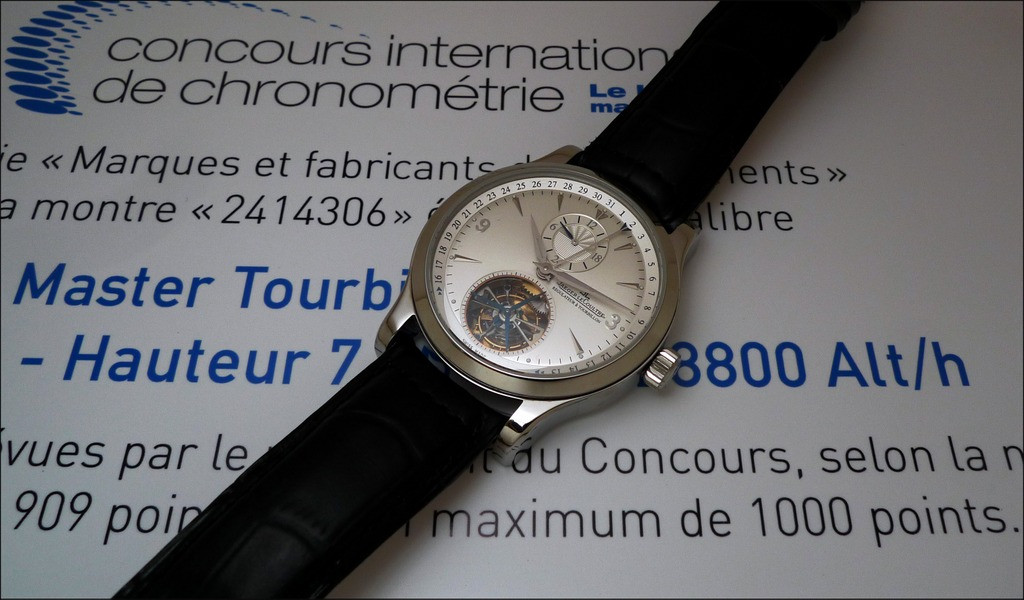
Before elaborating, you already see that Chronometry at JLC is a bit more than the Geophysic, Geomatic, and the different Cal 906s, and the History here is much longer than 18 years, only.
The Jaeger-LeCoultre Memovox reference 906 represents a significant evolution within the Memovox line, distinguishing itself with a more contemporary aesthetic and updated technical specifications compared to its vintage predecessors. This reference typically features a larger case profile and a design language that bridges traditional alarm watch functionality with modern watchmaking sensibilities. It is recognized for maintaining the dual-crown configuration characteristic of Memovox models, one for time setting and winding, and the other for setting and winding the alarm function.
This particular reference houses an automatic movement, often an iteration of Jaeger-LeCoultre's in-house calibers designed for the Memovox series, providing both timekeeping and a mechanical alarm. The case is typically crafted from stainless steel, presenting a robust yet refined appearance suitable for daily wear. The crystal is commonly sapphire, offering enhanced scratch resistance. Its dimensions reflect a preference for increased wrist presence, aligning with trends of its production era.
For collectors, the Memovox reference 906 appeals to those seeking a modern interpretation of a classic complication. It offers the practicality of an automatic movement combined with the distinctive mechanical alarm, a hallmark of the Memovox family. This reference fits into the broader Jaeger-LeCoultre catalog as a continuation of a historically important model, updated for contemporary tastes while retaining its core identity.
We can already answer to one question: We didn't have to wait for wristwatches to see some Chronometers, at the Grande Maison. Another question receives an answer: The Cal 21 RV is the first Chronometer known from the Grande Maison. Let's see all that in a chronologic way. 1/ The Torpedo Boat Chronometer: This is a very interesting example, historically speaking. It seems that the Cal 21 RV is the first chronometer from LeCoultre, as it was produced since 1860. Circa 1890, here, Edmond Jaeger of
I cannot believe the amount of work you had to do here. The pix are fantastic. The depth of information is astounding along with the history. I will have to bookmark this one I knew I would be panting on this. And now I see why you are panting! Your fingers and mouse must be shot! Seriously, extraordinary work here mon ami. Of course, you know the piece close to my heart! I can't believe the condition yours is in. Your new pix looks fantastic Best, Joe
As Chronometry is a theme dear to my heart. Thank you, once again, Joe. Best, Nicolas
A document that feels appropriate to add to this post. A 1949 ad - stating the results from the 1948 Chronometre contests... Notice the number in the ad: 464254 and 464260. Then look at the number of the the movements in your post! 464254 - it is the same movement as you have pictured in your post!! "464254 obtained the only award attributed for the smallest mean daily variation in the pocket chronometer class" !!! People, we are looking at piece of horology history here! :) The other two: 46426
Unbelievable. Thank you SO MUCH, my friend. Nicolas
I compared the number in your photos and the ad! How often do you get to see the exact movement, 66 years later?! :) Best, my friend Blomman
This thread is active on the Jaeger-LeCoultre forum with 109 replies. Share your knowledge with fellow collectors.
Join the Discussion →


