
Vintage
SJX commemorates IWC Schaffhausen's 140th anniversary by presenting the IWC Vintage Collection – Jubilee Edition 1868–2008. This article revisits six iconic IWC models, celebrating the brand's rich history and the enduring appeal of its legendary timepieces.



Six legends celebrate
140 years of IWC Schaffhausen
IWC Vintage Collection – Jubilee Edition 1868–2008
The Schaffhausen manufacturer is celebrating its anniversary with six legendary wristwatches from its past: the Portuguese, Ingenieur, Pilot’s Watch, Da Vinci, Aquatimer, Portofino – the watchmaking legends have been brought out again as attractive vintage models. For the celebration –and naturally also the great joy of all lovers and collectors of the brand.
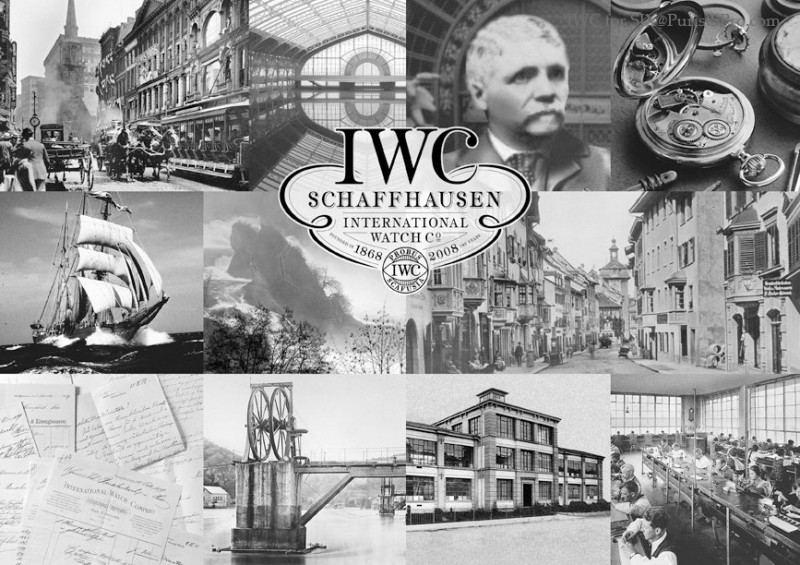
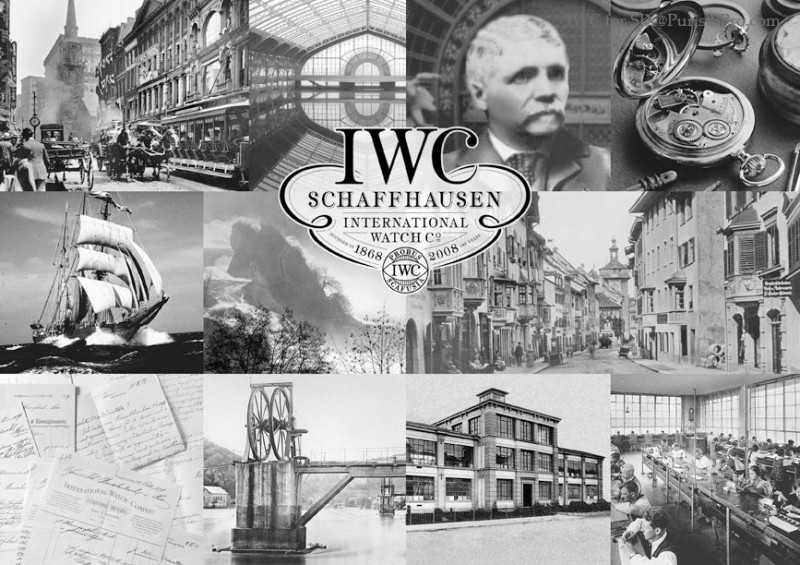
It all started more than 140 years ago in Boston where the talented and enterprising watchmaker Florentine Ariosto Jones was looking for an opportunity to set up on his own and do things much differently and better than his colleagues in the flourishing American watch industry. The director of F. Howard Watch & Cie at that time, he had of course heard of the little country of Switzerland and its outstanding watchmakers. And he was fired up by the information that workers in the Swiss watch industry produced their watches for amazingly low wages and in the main with old machines. Wages in Switzerland were then still really low, something that may seem surprising today. And so a compelling business idea came to F. A. Jones: Why not manufacture quality watches in Switzerland under more favourable conditions, but with new and better machines, for the North American market?
His idea was conceived, planned and carried out: in New York Jones set up a sales organization with two business partners where pocket watch movements manufactured in Switzerland were to be put in cases and then sold throughout North America. The company was given a grand sounding name: International Watch Company. And Jones set off by boat to Europe with his watchmaker friend Louis Kidder. Along with a whole host of ideas, the two men also took with them machines for the mass production of parts and finished design drawings for the first Swiss manufactured watches.
Initial surprise: in the watchmaking centres of western Switzerland where Jones had intended setting up his business the innovator was given the cold shoulder. The locals, who mainly produced watch parts in their homes, feared the modern machines and the concept of mass production even if it did have the indisputable advantage of consistent quality.
This is where the story could have ended. But in western Switzerland Jones met Heinrich Moser, a versatile industrialist from Schaffhausen. He made the American an offer that was tempting even if not completely altruistic: he could start immediately in Schaffhausen, a small town in northern Switzerland the American had certainly never heard of until then – in industrial buildings Moser owned. What persuaded him was that a source of energy was already available there for the machines – electricity was not even a consideration then. A hydrostation built by Moser brought the power required for the machines directly into the factory using shafts and long transmission cables. So in 1868 Jones arrived in Schaffhausen – and Schaffhausen, a long way from western Switzerland, got a watch factory. Jones was, therefore, able to realize his bold
ideas. Even his principle of manufacturing high quality watches with consistent tolerances worked – and this was the beginning of the reputation now enjoyed by Schaffhausen watches throughout the world.
What had been a promising start in watchmaking with the first “Jones calibres”, named after the company’s founder, ended in difficulties commercially for Jones when America did not lower the 25 per cent war duty imposed in 1864 – contrary to what was announced. The advantage of lower Swiss wages vanished. Jones returned to Boston and the “American watch factory” passed into Swiss hands. However, the founder did leave behind his particular aspiration for sophisticated, ever-better technical solutions. Despite the initial difficulties the manufacturer became one of the most renowned producers of sturdy and durable pocket watches.
And it was there right from the start at the turning point in watchmaking history when the wristwatch came into favour around 1900. The battle about how to wear a watch was decided for good by the 1930s and 1940s. The onset of this period of technical innovation brought some of the most exciting IWC watches, still much sought-after by collectors today. Some of them wrote watch history.
Six watches – six founding legends of today’s IWC watch families
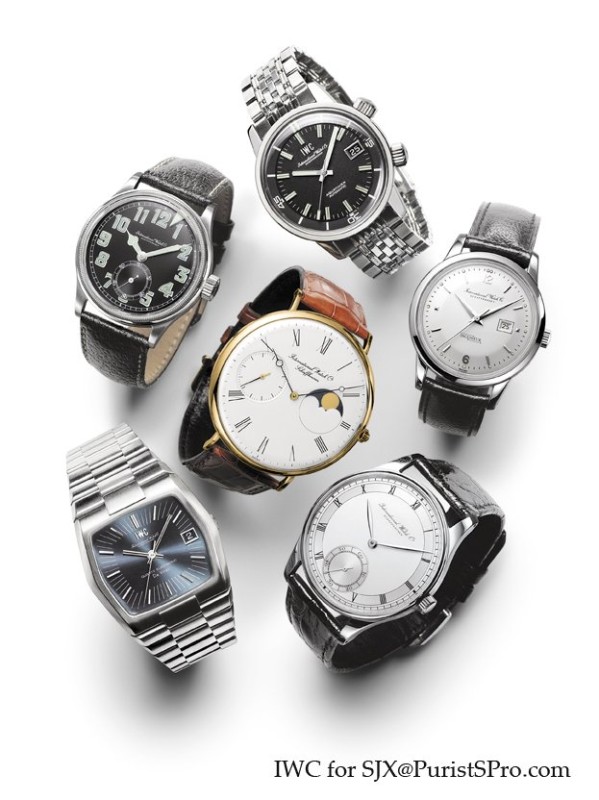
The magnificent originals that inspired this collection
Six of these milestones have been brought back as vintage models from the company’s proud history into the modern day for the manufacturer’s 140th anniversary – even if it is not a “round” one. Not as copies, something that IWC has never done, but as new interpretations of good old friends. Some with ultra-modern, up-to-date automatic IWC movements which are also used in the current series-produced models. Where historical accuracy demands it they have been equipped with hand-wound pocket watch movements based on the 98-calibre, the most famous IWC calibre and the one that has been made for the longest, but they have also been expanded, incorporating some of the elements of the earliest Jones movements. And, to the extent that their predecessors had not already appeared in the IWC extra-large format, the case of some of the vintage models has increased in size on its journey through time, which on first sight makes them distinguishable from the originals. But in this way they have also taken on completely new watch personalities. They illustrate how, for example, a 1955 Ingenieur would have looked if its case had had a 42.5 mm diameter rather than 37.5 mm.
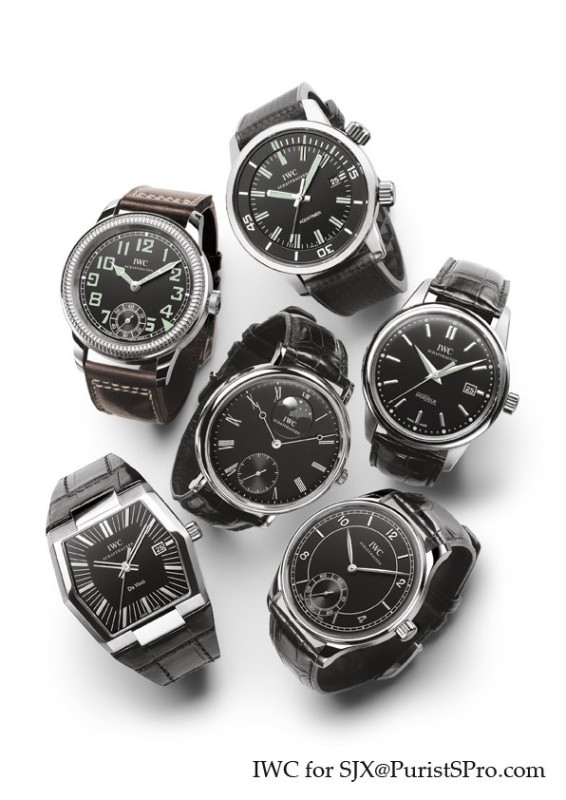
The six watches in stainless steel with black dial
The six watches, which are available in unlimited numbers in stainless steel with a black dial and in limited numbers in platinum with a silverplated dial, are more than just a “Best of” the wristwatch era at IWC. Each one of them essentially embodies the founding legends of the manufacturer’s current watch families. The first 140 vintage watches in platinum have, though, in a way already been reserved: as a special offer they are available as a unique numbered set in an ornate leather case.
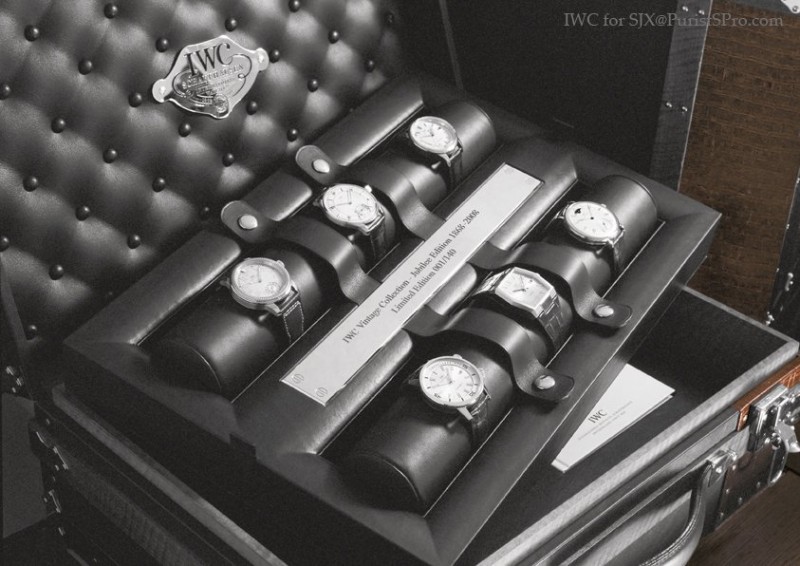
The first 140 vintage watches will be made available to connoisseurs in platinum with matching numbers as a unique set in an intricately worked leather box.
This message has been edited by AnthonyTsai on 2008-03-21 19:59:58 This message has been edited by MTF on 2008-03-23 14:30:19 This message has been edited by SJX on 2008-03-30 20:16:50The first Pilot’s Watch of 1936 starts things off. As the first special watch for the still young, gruelling form of transport it already had almost all the important features on board: for example a black dial with strong, luminescent hands and numerals that was the model for the development of the classical cockpit design, and later sometimes also a movement with antimagnetic parts of the escapement. And the first of a long series of professional pilot’s watches also had a rotating ring with a
The Portuguese of 1939 is a true watch legend. And stylistically comes as close as possible to the perfect ideal of a good watch design. As the first “wristwatch” it established the large size worn on the wrist that is very popular today. It was also the first to break the taboo of wearing a complete pocket-watch movement on one’s arm. It was successful, and still is today for IWC. It had established a completely new class of watch. There is no question that, as founder of a splendid family of I
I note that the Portuguese Vintage has alternate baton and arabic markers. The original Portuguese featured with White Dial has Roman Numerals all round. Why the change in the design? Any idea? Personally for me - it should either be all arabic or all roman. This business of alternating baton and numbers is just visually jarring and disruptive of the austere design.
The Ingenieur Automatic of 1955: No watch has defined the “technical” profile of IWC quite like the Ingenieur, which was introduced in 1955 and which was the first watch to feature the IWC automatic movement developed by Albert Pellaton. With its pawl-winding system and the spring-mounted rotor, it has remained a benchmark for watch technology at the highest level – while retaining the ultimate degree of toughness. This programmatic watch, which exemplifies the watchmaking engineering of the Sch
The Aquatimer Automatic of 1967: When IWC first took the plunge with its diver’s watches, only a few pioneers such as Jacques-Yves Cousteau or Hans Hass had discovered the beauty but also the vulnerability of the underwater world. But they helped to arouse people’s enthusiasm for these last paradises. For case makers in particular, manufacturing reliable watches for use under such extreme pressure conditions represented a challenge because when diving, the health or even the life of a diver depe
The Portofino of 1984: The most elegant but also the most unassuming family of watches from IWC, the Portofino – the classic example of understatement – has decidedly stylish origins. Collectors know this: it is the Reference 5251 watch, which was still produced until the end of the 1990s, always in small quantities. It was impossible to conceal its direct descent from an elegant Lépine pocket watch produced for decades by IWC. For it was, as regards the case, nothing other than a pocket watch c
This thread is active on the IWC forum with 51 replies. Share your knowledge with fellow collectors.
Join the Discussion →


