
Vintage
HSTE delves into the fascinating history of IWC's TiCon coating, a lesser-known innovation from the late 1970s and 1980s. His detailed post, featuring the IWC Ocean 2000, uncovers the technical challenges and eventual discontinuation of this unique blackening process. The discussion highlights the rarity and collector appeal of these specialized IWC references.


So, let me reveal the mystery on yesterday's "teaser": this is going to be a geek entry about the late 1970ies, about a company concentrating back then on technical innovation, about a collaboration with Porsche Design.
When IWC started its collaboration with Porsche Design back in 1978, the company was not only pushed to new limits in terms of design and use of materials (Aluminium, Titanium) but also in terms of coatings. Very early on it was a wish from Porsche to have for example black watches. (continue further below)

The first model out of this collaboration hitting the market was the Compass Watch reference 3510 coming to market in 1979. The watch was from Aluminum and available with black coating or olive coating. This coating was PVD coating. The disadvantages of this coating became very soon obvious with the color just flaking off, on the watch but more severely on the bracelet. This is why IWC very soon replaced the aluminum bracelets by plastic (Delrin) bracelets. The two models below are mint condition, both with the very sough after aluminum bracelets.
With the advent of the Porsche Design watches made in titanium (the Titan Chrono ref 3700 and the Ocean 2000 ref 3500) IWC started to experiment with coatings for these new titanium watches. And it was obvious that it could not be PVD. (continue further below)

So, it was in 1985 where for the first time - and to my knowlege based on all the historic catalogs that I have - also the last time, that the world came to see the IWC Ocean 2000 and the IWC Ocean 500 in black color (catalog 1985). The coating applied was called "TiCon" and was the result of long experiments with two goals: having the watch in black color and also to harden the surface of the titanium. (continue further below)
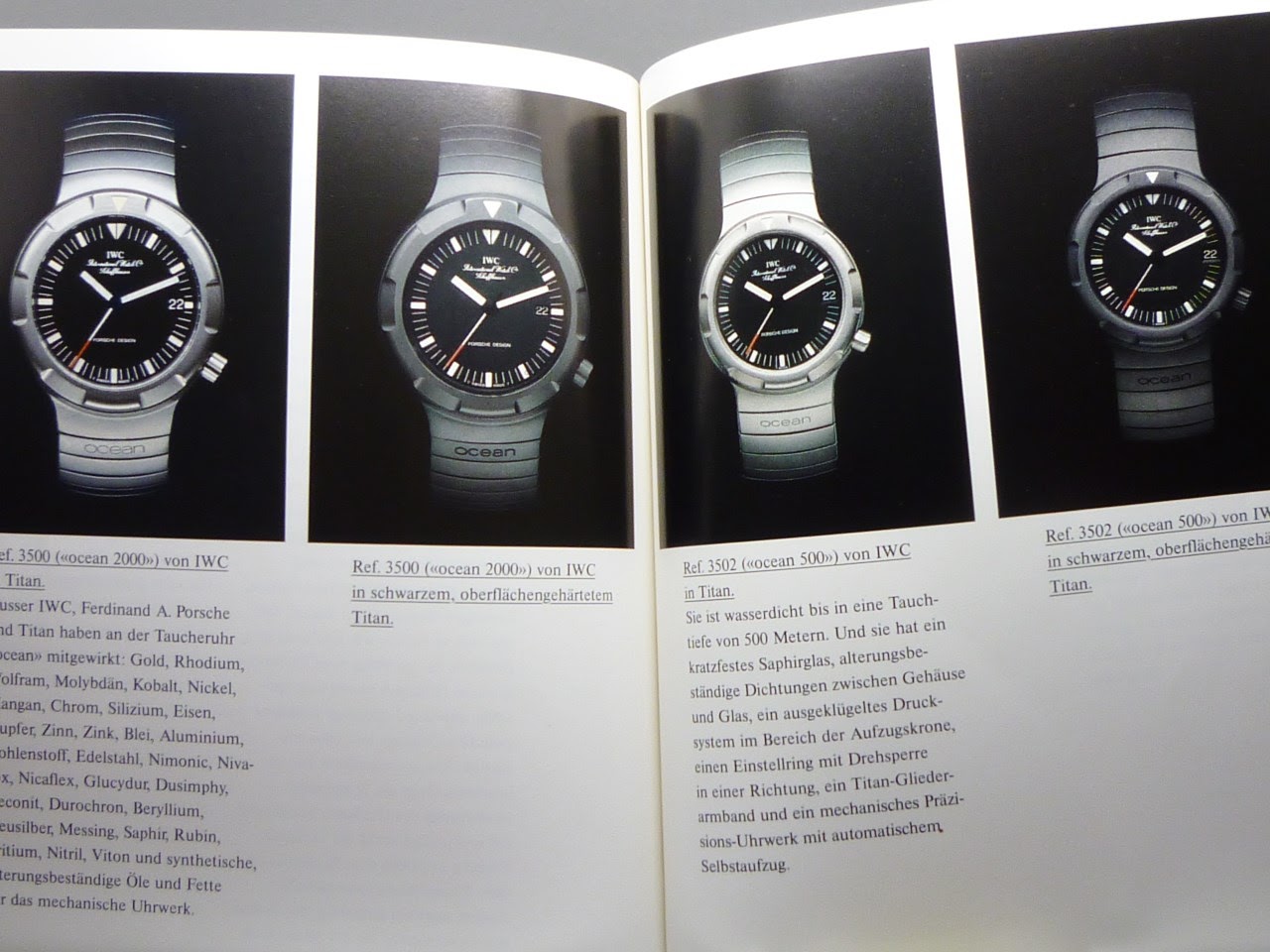
The process to "TiCon" the watches proved to be a very complicated and fairly costly process but in 1983 they succeeded with an in-house process to nitrocarburate the titanium. The titanium was hereby hardened 40 micros into the surface at a heat of 1060 degreed Celcius and bombarded with various gases. "TiCon" amalgamates the following factors: titanium carbide, titanium oxyde and titanium nitrate. This entire process of blackening titanium is described in the doctoral thesis of David Seyffer, the IWC museum curator on pages 234 to 242.
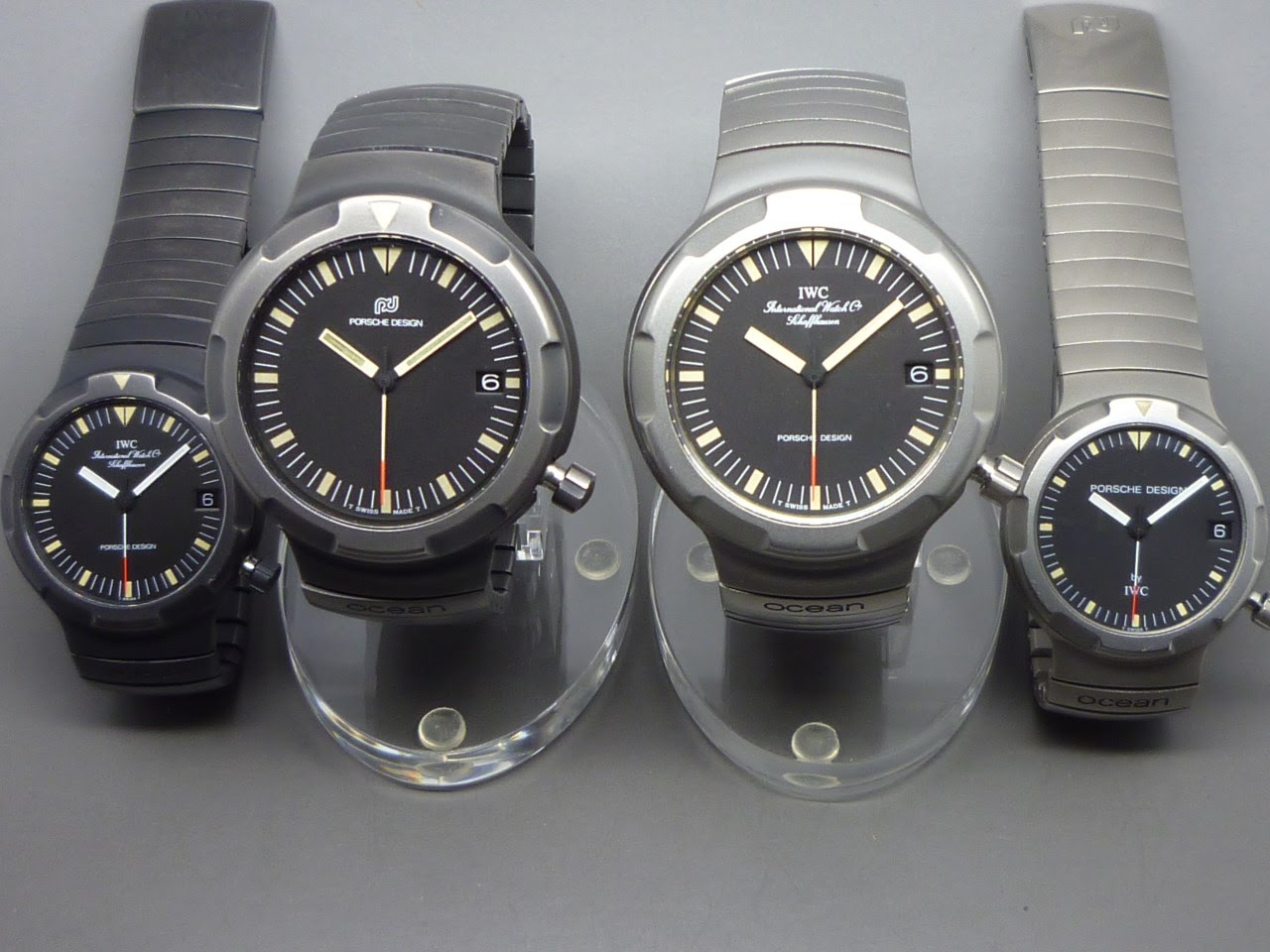
You can see below the two "TiCon versions at the left and the "normal" versions at the right. Given the fact that the coating is only a few micros into the surface means that with wearing the watch it will over time turn from a fairly concentrated black into lighter black to turn - eventually and in the extreme - back to "normal" titanium color. And this was another reason for IWC to stop selling TiCon coated watches: they realized that the coating wears off, it was also clear that you could not "re-coat" the watch and hence they decided that this did not live up to the quality standards that they had on themselves.
IWC only produced very few Ocean 2000 and Ocean 500 watches in TiCon. Whilst I was quite fast successful in finding a TiCon Ocean 500 for my wife, the hunt for a TiCon 3500 was really tough. I have only ever seen one in the public market (very recently...) over the past 10 years. By chance I had found a guy owning one but it required me working on him for years to get it. And it came with the Certificate of Authenticity from IWC. Both IWC 3500 that you can see below in the middle are very early models in totally original configuration. The "normal" one is from May 5, 1984, the TiCon one is from February 2, 1985. Interestingly though, their 7-digit case numbers are only 254 pieces apart from each other.
Cheers, HSTE


The IWC Ocean 2000, reference 3500, is a notable product of the collaboration between IWC and Porsche Design. This reference is recognized for its integrated design, where the case and bracelet form a cohesive unit. It represents a period of innovation for IWC, particularly in the application of advanced materials for watchmaking during the late 20th century. The model was part of a series that explored new frontiers in watch construction and functionality.
The reference 3500 features a titanium case, a material chosen for its strength and light weight. The case diameter measures 42mm, providing a substantial presence on the wrist while maintaining wearability. Powering the watch is an automatic movement, the IWC Caliber 3752, which offers a power reserve of 40 hours. The watch is fitted with a sapphire crystal, ensuring durability and scratch resistance for the dial.
This reference appeals to collectors interested in the history of material innovation in watchmaking and the specific design language of the IWC Porsche Design collaboration. It stands as an example of IWC's technical capabilities during a transformative era for the brand. The Ocean 2000 series, including the 3500, is a significant part of IWC's modern history, showcasing a commitment to engineering and design.
One of my favorite watches from IWC. From the time when they produced no-bullshit watches for men! Thank you for this info
Superb post amigo...superb and big congratulations on this catch Best D
The bezel on this 85 watch, out of interest is it the same as the black bezels found on the Bund versions of the Ocean 2000 (I mean was the coating technology the same?). I had a loose one a year or two ago but passed it on to a collector friend.
.....and my coclusion would be that it is probably a different procedure. Below you see my four Bunds. The three on the left are in mint condition and the "black" is much more intense and rich than on TiCon in my view and it also feels different. The one on the right and on the second picture is "used" and my impression is that the black coating is wearing off differently than on the TiCon. But I have no facts on this. Cheers, HSTE
Looking at the pictures I would tend to agree with you. To my eye the Ocean 2000 is perhaps the most impressive dive watch ever made, but try as I might I can't get past the lug design and associated limitations on bracelet and strap options. I wish that I could as they are just fantastic otherwise. Congratulations on a great line-up.
Congratulations on the successful hunt I was going to guess Ocean 2000 yesterday As I said in another thread, I just saw an add for Porsche Design claiming that they were the first ones to do an all black watch in 1972 (case and bracelet) - albeit that was not from the cooperation with IWC but before. Thanks for the never ending education you provide here
This thread is active on the IWC forum with 14 replies. Share your knowledge with fellow collectors.
Join the Discussion →


