Complications
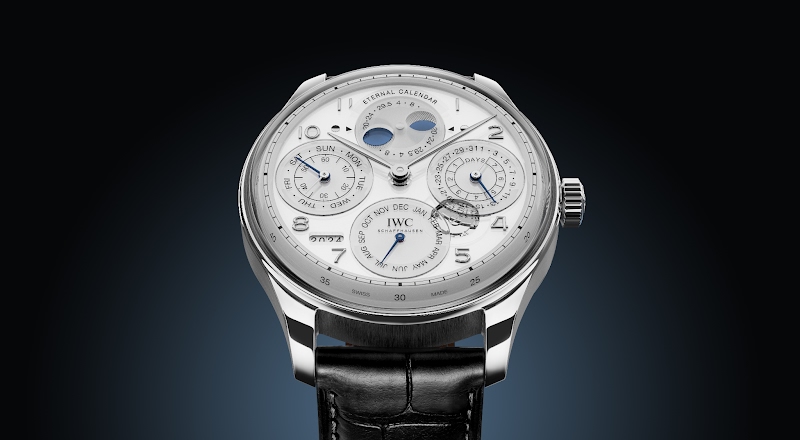
India Whiskey Charlie introduces the IWC Portugieser Eternal Calendar, a horological marvel recently recognized by Guinness World Records for its unparalleled moon phase accuracy. This article delves into the technical innovations that allow this timepiece to achieve a theoretical deviation of just one day in over 45 million years, setting a new benchmark in precision watchmaking. Readers will gain insight into the engineering challenges and solutions behind this extraordinary complication.

Schaffhausen/London, 26th June 2024: The newly introduced Portugieser Eternal Calendar has been officially recognised by Guinness World Records as the “most precise lunar phase wristwatch”. With a theoretical deviation of just one day in 45,361,055 years, the Double Moon™ indication of the Portugieser Eternal Calendar beats the previous world record by more than 43 million years. This is made possible by a new reduction gear train with three intermediate wheels, which reduces the duration of one calendar month as precisely as possible to the duration of one complete lunar cycle.
The moon phase display is arguably the most charming complication in watchmaking. It displays the current phase of the moon on the dial, ensuring that no full moon is missed – even if it is obscured by clouds. Since the introduction of its perpetual calendar almost four decades ago, IWC Schaffhausen has taken great strides to continuously improve the accuracy of its moon phase displays. Developed by IWC Schaffhausen’s former head watchmaker Kurt Klaus, the first perpetual calendar debuted in 1985 with the Da Vinci Perpetual Calendar Chronograph (Ref. IW3750) and offered a moon phase accuracy of 122 years. In 2003, IWC introduced the Portugieser Perpetual Calendar (Ref. 5021), featuring a moon phase display with an enhanced precision of 577.5 years. The new Portugieser Eternal Calendar pushes the boundaries again: with a theoretical accuracy of more than 45 million years, it has now been officially recognised as the “world’s most precise lunar phase wristwatch” by Guinness World Records (GWR). Established in 1955, GWR has evolved to the globally most recognised authority on record-breaking achievements – verifying and documenting both human and natural records. Before being awarded its title, each record is carefully audited to comply with their strict quality standards and needs go undergo a rigorous verification process.
DISPLAYING THE MOON PHASE PRECISELY IS A CHALLENGE
In
the moon phase display, a reduction gear train is placed between the
base calendar module and the moon phase disc. This gear train reduces
the duration of one calendar month to the duration of one synodic month,
which equals 29 days, 12 hours, 44 minutes and 2.88 seconds. The
accuracy of the display depends on the number of wheels used, their
proportions and the number of teeth they have. For the Portugieser
Eternal Calendar, IWC’s engineers devised a new reduction gear with
three intermediate wheels – two more than in the previous module with an
accuracy of 577.5 years.
To
develop a solution that is sufficiently robust and will function
reliably for extremely long periods of time, they defined key parameters
such as the minimum and maximum number of teeth per wheel. A computer
simulation program created specifically for this purpose was then tasked
with calculating almost 23 trillion different combinations of wheels
and teeth. In an iterative process, the engineers gradually worked their
way towards the perfect combination of wheels for this specific
application. Assuming a constant duration of the synodic month of 29
days, 12 hours, 44 minutes and 2.88 seconds, the display would
theoretically only deviate from the orbit of the moon by one day after
45,361,055 years.
LIGA PROCESS OFFERED THE REQUIRED PRECISION
Calculating the wheels was, however, not the end of the story. In order to achieve an even higher display accuracy, the backlash between the wheels was minimised by optimising the tooth geometry. To ensure that the tiny components function reliably over extremely long periods of time, alternative approaches also had to be adopted in manufacturing. As traditional metal machining would not have offered the precision needed, IWC’s engineers opted for the so-called LIGA process to manufacture the wheels. LIGA involves lithography, electroplating and moulding and is often used in the semiconductor industry. This process permits the production of exceptionally homogenous and smooth microstructures with a degree of precision that conventional manufacturing capabilities would not even be remotely capable of.


It's an engineer's moon, not that wondrous object in the sky. Here's NASA's view of the moon
Photos: Mark Kauzlarich
I saw this at Watches and Wonders - where they had the best exhibition by far - and tried it on along with their other perpetuals. I was left wondering why they didn’t match it with their obsidian dial (which stole most of the attention from everyone I saw there) which has a beautiful dial, great presence and would have made the cutout a more subtle feature. At 44.4mm diameter it’s too much for my 17.2cm wrist but I was way more tempted than I’d ever thought I’d be 😉
I got one recently - no regrets
I wonder what wear and tear will look like 😁
or servie a watch that is not broken. Same for me.
This thread is active on the IWC forum with 26 replies. Share your knowledge with fellow collectors.
Join the Discussion →


