Complications
Ed. W's detailed technical summary of Grand Seiko's 9S6X series calibers, specifically focusing on the 9S66 movement found in the SBGM031, remains highly relevant for understanding Grand Seiko's distinct approach to luxury watchmaking. This post, originally from 2013, offers a foundational comparison between the 9S6X and its predecessor, the 9S5X, highlighting Grand Seiko's commitment to reliability, legibility, and precision over purely artistic or marketing-driven strategies. Ed. W's insights into the brand's philosophy and the specific technological advancements are invaluable for collectors seeking to appreciate the engineering behind these revered timepieces.


In considering a recent purchase, I scoured the internet for any technical information pertaining to Grand Seiko's lates 9S6X series calibers. This is what I summarized. I really hope Seiko makes all this information much easier to find some day!
Grand Seiko is a distinctively Japanese luxury brand. The focus has been decidedly un-Swiss. Where the Swiss focus on artistry, marketing, and polishing, with a very few focusing on technology like Patek’s Advanced Research ref. 5550 and Omega’s Si-14 escapement. This has been a very successful as is proven by the 19.3 billion CHF export figure in 2011. The Grand Seiko focus has been on long-term reliability, legibility, precision, and beauty. We will go through what each of these mean for the Japanese as well as compare the Grand Seiko 9S6X developed in 2011 with the 9S5X developed in 1998.
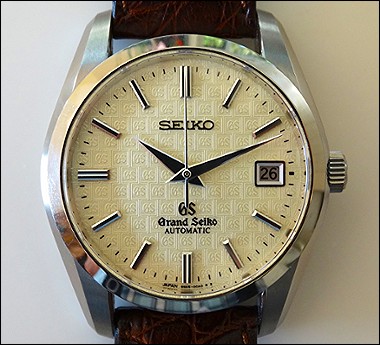
The Grand Seiko SBGM031 is very similar to the SBGM021 (Brown strap on Deployant/Tang) and SBGM023 (Solid stainless steel bracelet). The differences are in the dial, hands, rotor, and strap. Of course, the SBGM031 is also a limited edition of 1000 globally. 33 pieces went to the United States and 3 went to China.
Basic specifications:
Manufacturer Caliber 9S66
Automatic, hand wind capable and hacking (stop seconds)
28.4mm diameter by 5.9mm thick
28,800 vph
72 hour power reserve on one barrel
Spron 610 hairspring and
MEMS manufactured escapement (pallet fork and escape wheel)
Tokyo stripe finish on rhodium plated brass
Diashock shock resistance
35 Jewels
Fully made in Japan
Regulated to +5/-3 seconds in 6 positions and 3 temperatures.
Dimensions are 39.5mm diameter and 13.5mm thickness
Sapphire crystal both sides (raised “box” style crystal with antiglare on front)
3 atm water resistance
Zaratsu (blade) polished stainless steel with beveled lugs.
MSRP of 6,300 USD
The movement
The heart of the watch is the in house Grand Seiko 9S66 GMT movement. The previous version of the GMT had a 9S56 movement, with a solid caseback in the same dimensions. Both are true GMT movements, with a 12 hours hand that can be set in 1 hour increments either way (also used to set the date in either direction) and a 24 hour hand that changes with the minutes. The movements represent both an evolutionary as well as revolutionary change.

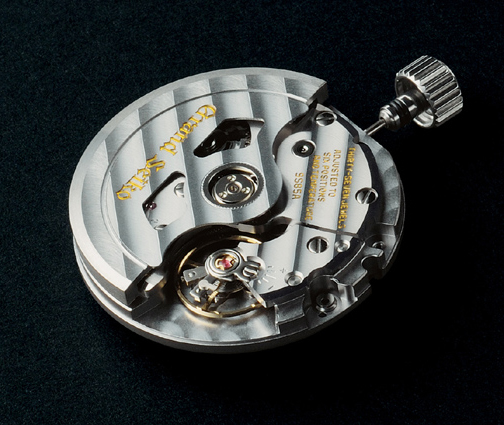
The finishing can be clearly seen in the hand wond 9S64A movement
(Note: All changes apply to all 9S6X movements compared to the 9S5X movements, i.e. 9S54, 9S55, 9S56 vs 9S64, 9S55, 9S66)
Winding system:
The new 9S66 caliber uses a small diameter, specially coated (like Rolex’s Teflon coating) reverser system for efficient winding while the 9S56 uses Seiko’s magic lever system. This may be due to the increase of power reserve from 55 to 72 hours requiring significantly more torque. The magic lever system has been known to slip under high torque.

New Reverser system
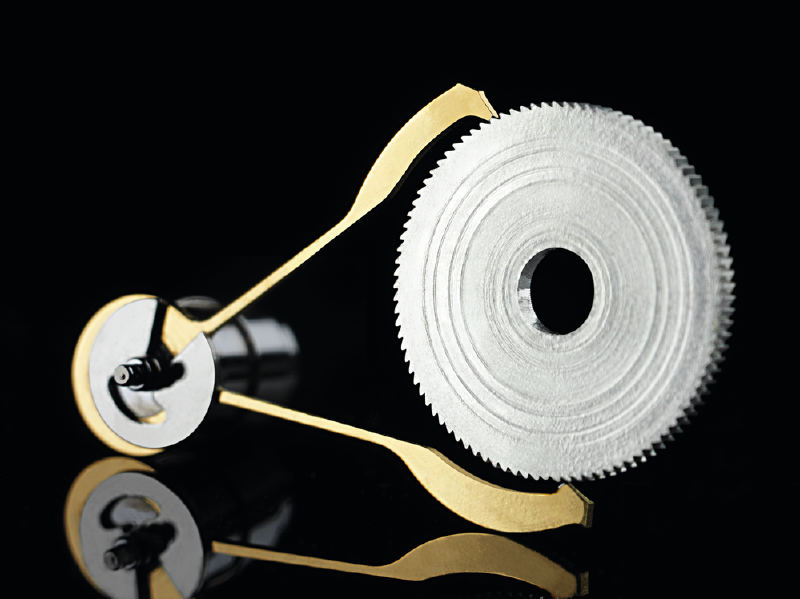
Previous magic lever pawl winding system (similar to IWC Pellaton)
Main plate finish:
The new 9S66 Caliber has perlage on the baseplate while the 9S65 has a sand blasted finish.

Balance staff:
Increase diameter from 0.07mm to 0.08mm resulting in 30% increase in strength.

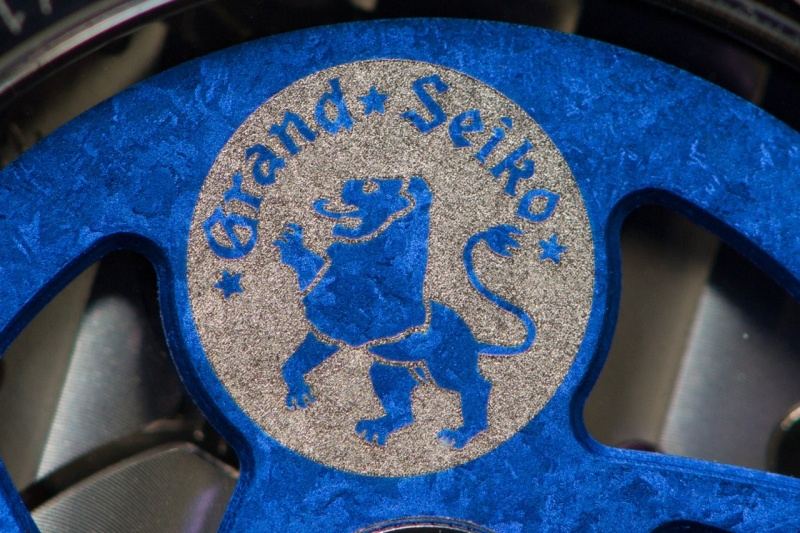
Rotor (. edition):
Slightly different shape and engraving

Calendar plate:
9S66 has the GS logo engraved throughout the plate (not visible unless dial is removed). Date size is slightly larger than the 9S56. Interestingly, both use a single Philips screw to fasten the calendar plate.


Transmission wheel bridge:
Is now part of a solid bridge instead of a stamped sheet metal plate.

Power reserve increased from 55 to 72 hours. Thickness increased from 5.4mm to 5.9mm.
Jewel count increased from 26 to 35 (for automatics only, hand wound increased from 20 to 24).
Escapement now manufactured by MEMS process and is skeletonized. Resulting in decreased weight and increased precision.
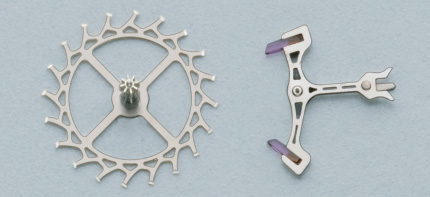
MEMS Escapement (Note the small pockets to hold oil on the escape wheel)

Under AFM (Atomic Force Microscopy)
From my tests, the movement has been very precise and strong running. Caliber 9S66 in limited edition SBGM031
Results are: (s/d deviation, amplitude, beat error, assuming lift angle of 52 degrees)
At full wind
Dial Up +5 278 0.1
Dial Down +2 273 0.1
Crown Left +3 255 0.0
Crown Right -2 256 0.2
Crown Down +4 255 0.0
Crown Up 0 262 0.1
After 8 hours
Dial Up +3 265 0.2
Dial Down +2 266 0.1
Crown Left +1 256 0.0
Crown Right -3 248 0.2
Crown Down +3 246 0.0
Crown Up -1 249 0.2

Patek's Oscillomax Silicon escapement
An interesting feature of the MEMS escapement is that it is just as accurately manufactured as a silicon escapement used in Patek Philippe’s Oscillomax escapement manufactured using Silinvar. However, the MEMS escapement is still made with conventional alloys and thus does not feature the antimagnetic properties of a fully silicon escapement. Also, ruby impulse jewels are still used instead of a full silicon pallet fork. Unlike many Swiss movements, the Seiko still uses an asymmetric screw regulator for a flat hairspring instead of a free sprung balance using either gyromax or microtesla screws. The rate, however, is still very impressive regardless. SII of Seiko Corporation actually manufacturers hairsprings for many Swiss brands as an alternative to Nivarox.
The hardness of Seiko’s steel components is actually number one in the industry today, at somewhere between 700-740 HV (Vickers), similar to the 740 HV of vintage Pateks (note, this is speculative and very difficult to verify). The recent decrease in steel hardness by the Swiss is unexplained, but may allow easier manufacturing of parts and less time since such hardness is usually accomplished by ice tempering of steel (heated to 1000 C, then quenched in 20 C oil, then frozen for -80 C for 1 hour, then baked at 160 C for several hours).
The Tokyo Stripes finish is deeper than most Côte de Genève style finishes and is highly reflective. The plates are not beveled and anglage is nowhere to be seen, but the sides are nonetheless perfectly smooth. Flat components are all highly polished to absolute flatness.
The Seiko manufacturing facility is also another reassurance of quality movement manufacturing. SJX described in his visit that the cleanroom was a class 1000 (less than 1000 particles of 0.5?m size or larger) cleanroom, which has 1/35,000th the particle concentration of normal outdoor urban air.
SJX's article here: rolex.watchprosite.com
In the next part will review the SBGM031 as a watch, rather than an engineering accomplishment.
Sources:
Chronos Japan article
home.watchprosite.com (post by Hirota-San)
The Grand Seiko SBGM021 is part of a series of GMT watches that exemplify Grand Seiko's commitment to precision and craftsmanship. This model, along with its siblings SBGM023 and the limited edition SBGM031, showcases the brand's distinctive approach to luxury watchmaking, prioritizing long-term reliability and legibility. These watches are designed for discerning collectors who appreciate understated elegance combined with robust mechanical performance.
Powered by the automatic Caliber 9S66, this movement features a 28.4mm diameter and 5.9mm thickness, operating at 28,800 vibrations per hour. It offers a substantial 72-hour power reserve from a single barrel and incorporates a Spron 610 hairspring and MEMS manufactured escapement components for enhanced accuracy and durability. The movement is rhodium-plated brass with Tokyo stripe finishing, includes Diashock shock resistance, and contains 35 jewels. It is regulated to Grand Seiko's stringent standards of +5/-3 seconds per day across six positions and three temperatures.
From a collector's perspective, the SBGM021 represents a significant offering within Grand Seiko's mechanical GMT lineup. Its technical specifications and meticulous finishing reflect the brand's dedication to horological excellence. The watch's understated design and robust movement make it a practical yet sophisticated choice, appealing to those who value precision engineering and a distinct Japanese aesthetic.
nt
Nt
so you can tear it apart and critique it :) What do you think about the MEMS vs Silicon escapement? I always thought the main benefit to silicon was its ultra precise manufacturing and antimagnetic properties, but then again if we're sometime in the future it wouldn't be possible to make a spare part (be it a wheel or the hairspring) that was originally silicon and thus that would in some ways affect longevity.
is that under certain conditions it is fragile and more prone to cracks or fracturing than metal parts. This is according to the engineers at Seiko Shizukuishi Watch Studio. - SJX
is to maximize the potential of all conventional technologies.
This thread is active on the Seiko forum with 12 replies. Share your knowledge with fellow collectors.
Join the Discussion →