The exercise of creating a skeleton watch is always difficult because the path between successful and old fashioned outcomes is very narrow. Because it is the hard law of this type of watches: by trying to display the most they can, they may fall into a too demonstrative style, at the same time ridi
The exercise of creating a skeleton watch is always difficult because the path between successful and old fashioned outcomes is very narrow. Because it is the hard law of this type of watches: by trying to display the most they can, they may fall into a too demonstrative style, at the same time ridiculous and obsolete. Fortunately for many years, brands have revised their ways of thinking about these particular pieces giving them a different purpose. While they previously embodied a kind of concentrated know-how of the traditional skills of the manufactures, they have become little by little proofs of ithe capabilities of innovation on the technical, decorative and aesthetic sides. In other words, the skeleton watches are today a symbol of modernity while they gave off in the past an outdated image.
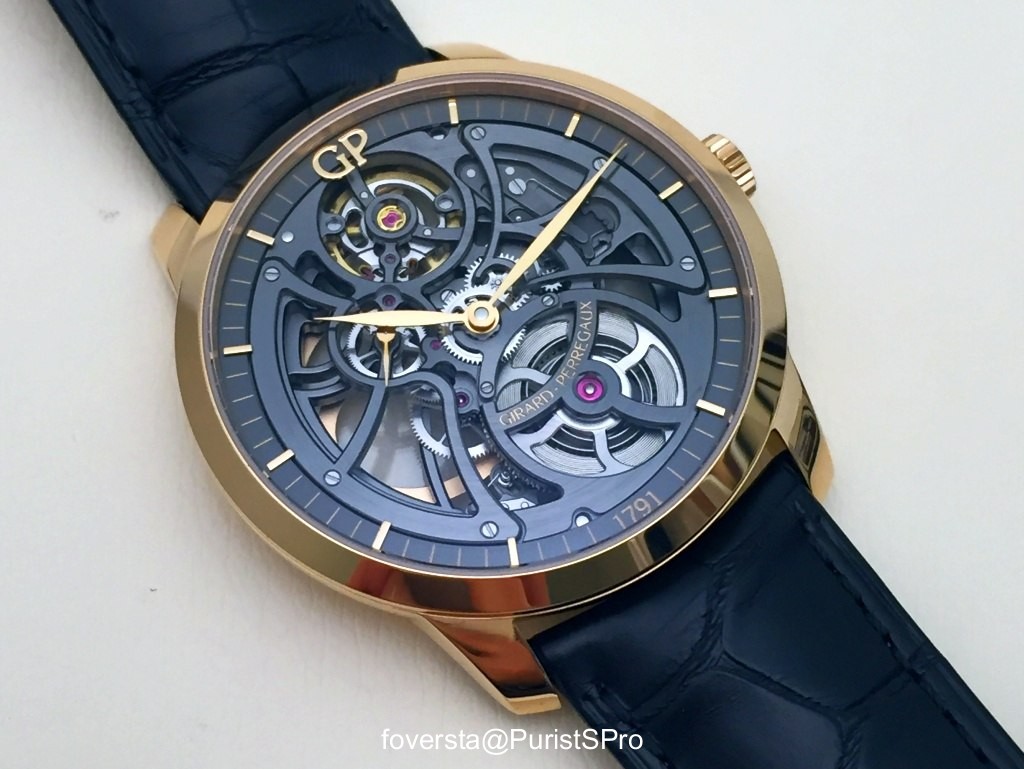
But to achieve this objective, the brands must perfectly control the ingredients and in the end, only few of them are truly able to produce convincing skeleton watches, both attractive and legible. Girard-Perregaux in its strategy of reconquest had to offer a contemporary skeleton watch in its collection to reaffirm the potential of its manufacture. It is the reason why the 1966 Skeleton was presented a few weeks ago. This watch is successful because Girard-Perregaux managed to avoid the numerous pitfalls and to have the means of its ambition.
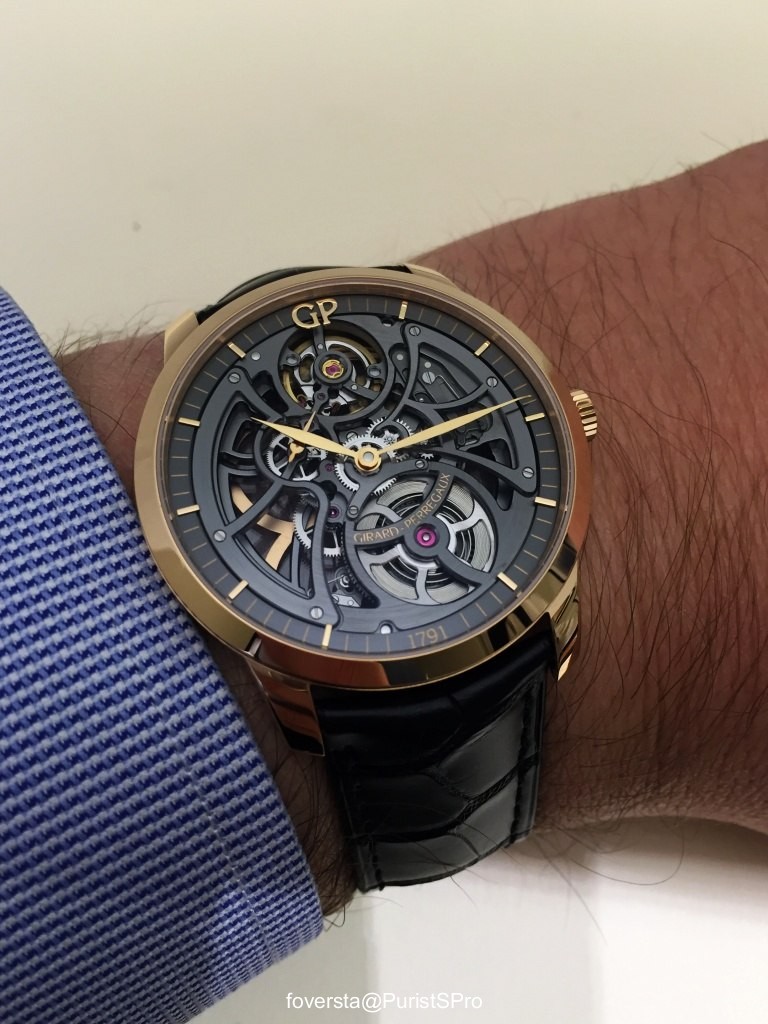
The watch has many assets. I start with the most obvious one: I just find it very beautiful. It constantly plays with the high contrast between the rose gold elements and the ruthenium anthracite grey color of the movement parts treated by electroplating. It is refined with strong character. I also particularly like the flange which creates a perfect transition between the case and the movement. The applied indexes, partially suspended, contribute to the time legibility what is quite correct because the two main hands stand out from the fine grey lace of the movement. The GP logo on top of the dial is also applied on the flange. If initially I used to find it a bit too big, this feeling has started to fade from now.
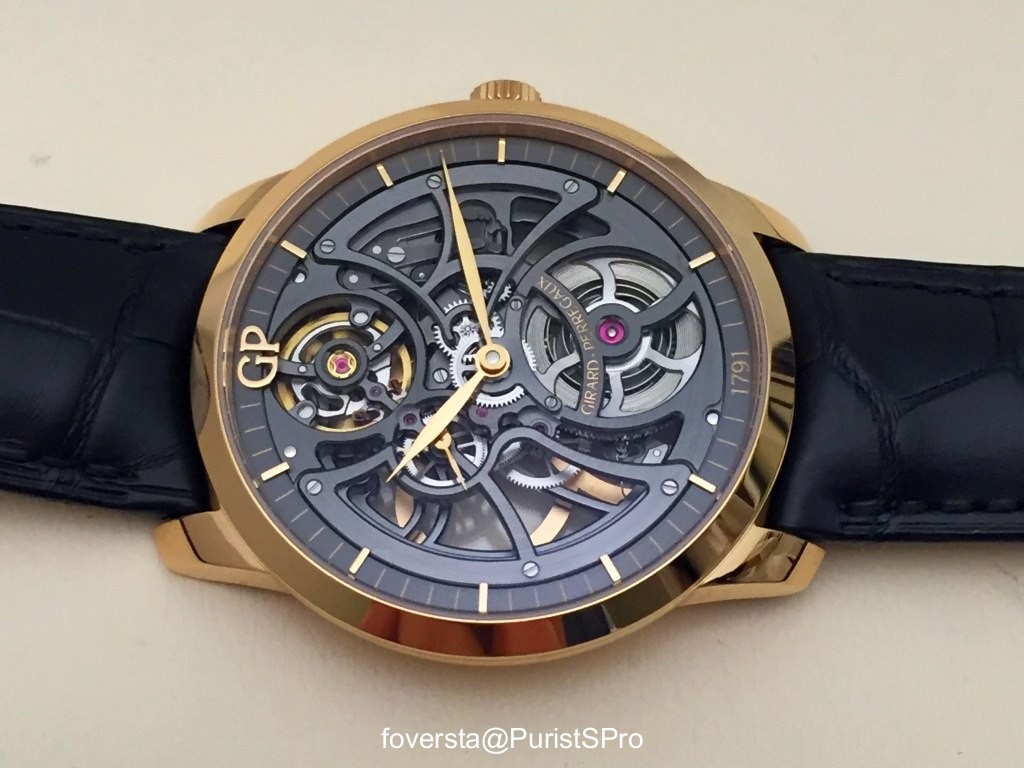
But the greatest strength of this watch lies in my opinion in the coherence between the movement and the case. Girard-Perregaux used as starting point the GP1800 base, the automatic movement with a 4hz frequency, a power reserve of over 50 hours and which powers several models in the collection 1966. The good news is that Girard-Perregaux housed it in a 38mm case, therefore smaller than the 41mm usually reserved for the GP1800 and thus better suited to the own diameter of the movement (30,6mm). The relative narrowness of the flange reflects this consistency that is noticeable at first glance.
I also like the lay-out of the movement which sets the regulating organ at the top and the barrel and mainspring in the lower zone. I find this presentation more advantageous and visually pleasant although the incabloc is a little too visible for my taste. I don't like the rendering when the barrel and the mainspring are on the foreground in a skeleton watch. Here, the eyes are first attracted by the oscillations of the balance wheel, just under the brand logo. I am however less convinced by the location of the second hand. The movement is used in this specific context with its small second configuration (as it has a central second hand when it animates the 1966 41mm). This small second is located at 10 o'clock and is very close both to the center of the watch and of the regulating organ. The consequence is that the dial animation is concentrated in a vertical central area while peripheral areas are more static. However this is a minor detail since Girard-Perregaux ensured that the movement lay-out is three-dimensional.
The 1966 Skeleton gives off a sense of volume and depth thanks to this architecture which includes several layers. The shapes of the bridges are particularly appealing by drawing an attractive and modern skeleton pattern. Even the barrel and the mainspring are well integrated into the successful design that appears to be like a link between the "classic" Girard-Perregaux "classic" and the innovative and bold one.
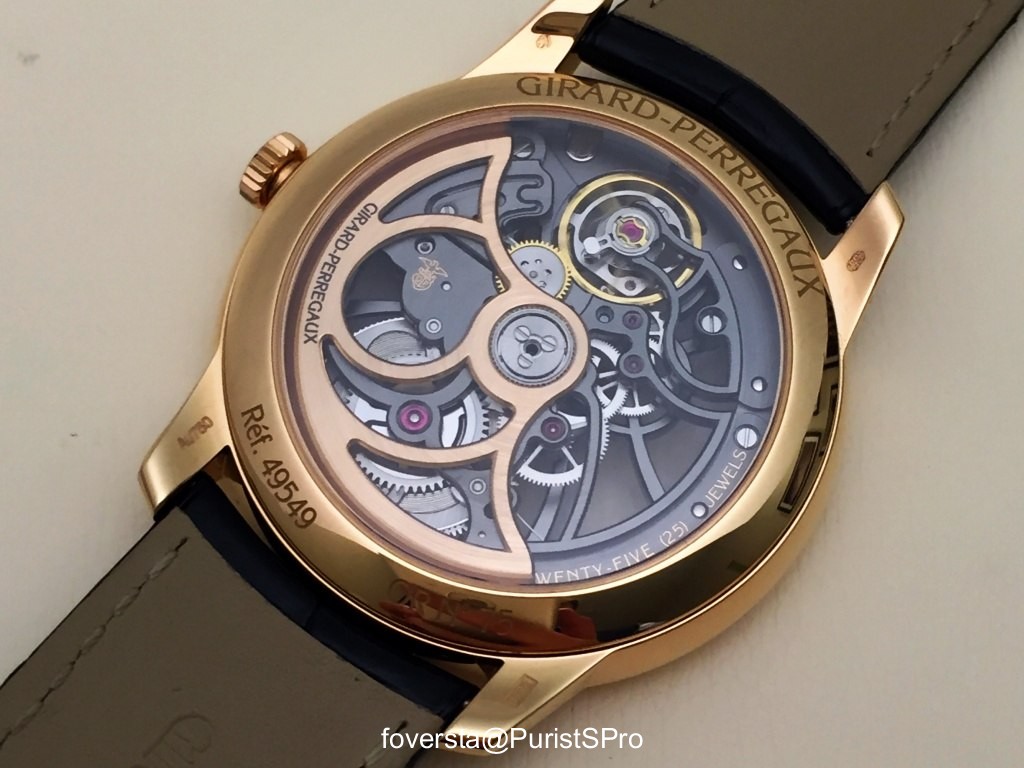
The back of the watch is on the same page and the manufacture worked with a lot of care the decoration of the gold winding mass. Obviously, its style is similar to the plate and bridges of the movement and features a high-level skeleton approach. The shape of the links between the center of the mass and its peripheral area creates a mirror effect with the bridges shapes of the movement. However, the curves provide an additional dynamic and when it is moving or not, it offers the same delightful spectacle. My only complaint is the presence of the inscription "Girard-Perregaux" on it. I find unnecessary because the brand name is reminded on the periphery of the movement, on the back bezel.
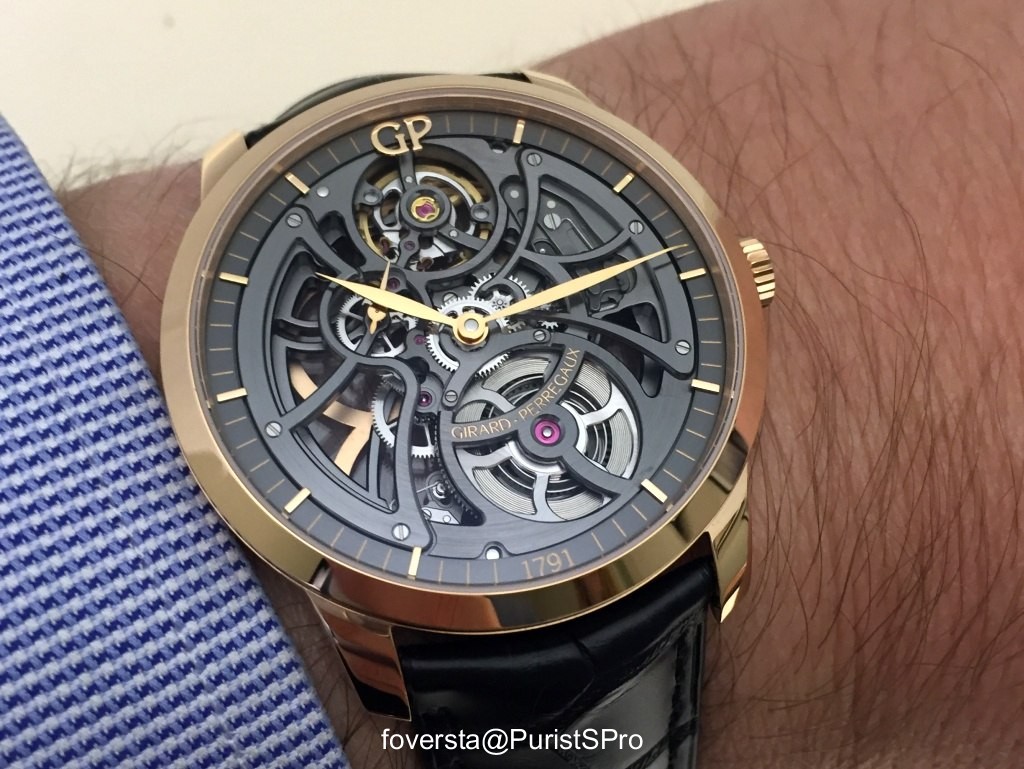
The feelings provoked by the 1966 Skeleton when put on the wrist only confirm the first impressions. Its size is ideal because, and it is a surprise for a watch featuring a dark and busy dial, it seems larger than it is actually. The diameter (38mm) / thickness (9,27mm) ratio is balanced and the piece, although it is relatively thin, doesn't have the ambition to play on the ultra-flat field to give sufficient feeling of depth. And very quickly, we focus our attention on the many details that adorn the dial and the perfect execution of the decoration, the chamfering, the satin-polished finishes. With its contemporary and elegant style, the 1966 Skeleton offers a rare blend of technical and refined atmosphere. It masterfully puts on stage the 173 components of the movement, thus becoming the ideal flag bearer of the technical and decorative expertise of the manufacture.
Thanks to the Girard-Perregaux team for its warm welcome at Baselworld.
Pros:
+ the coherence between the movement and the case
+ the contemporary and refined style
+ the lay-out of the movement
+ the decorative finishes
+ the time legibility for this type of watch
Cons:
- the location of the small second hand
- the incabloc is a bit too visible at the top of the dial
This message has been edited by foversta on 2016-04-17 08:18:03