Stephen Netherwood's detailed article, shared by Bill, sheds light on the often-overlooked vintage mechanical divers from Citizen, specifically the Twin Crown Ref. 61-5111. This piece offers a deep dive into its design, movement, and historical context, providing valuable insights for collectors interested in Japanese horology. It highlights Citizen's significant contributions to dive watch history beyond the more commonly discussed brands.
By Stephen Netherwood.
In the wider world, Citizen is maybe not so well known for its vintage mechanical watches, and particularly for their divers made from the mid 1960s and through the 1970s. Although there's a page on this blog which describes the various divers (https://sweep-hand.org/citizens-vintage-divers-1962-to-1980/) there is sometimes a little detail or two to add. And with many thanks to Marty, a visitor to my blog, I am able to add a little bit of information on Citizen's twin crown range.
Rated at 100 meters, Citizen designed this diver with a 'compressor' style case - two crowns, one to wind and set the watch, and the other to move the inner rotating ring. As far as I know they were produced around 1968 to 1970, using the 5270 automatic movement, a variant of the 52 series of calibres first produced in 1965. This was a very successful family of movements, used in two of Citizen's better known ranges, the Crystal Seven and Seven Star, as well as high end Chrono Masters and some less well known models - see here for a 'family tree': https://sweephand.files.wordpress.com/2012/04/52familytree-v2secure.pdf
Typical of its day, the movement runs at 18,000 beats per hour. The 5270 variant has 21 jewels with date / day complications, quick setting for the date only, and no 'hacking'. Japanese domestic market models carry the 'Seven Star' and 'parawater' monikers whilst export models lose the model name and are marked 'waterproof'. There were several dial colours - black, blue, silver and red. And this brings us to Marty's example - a nice example of the black version:
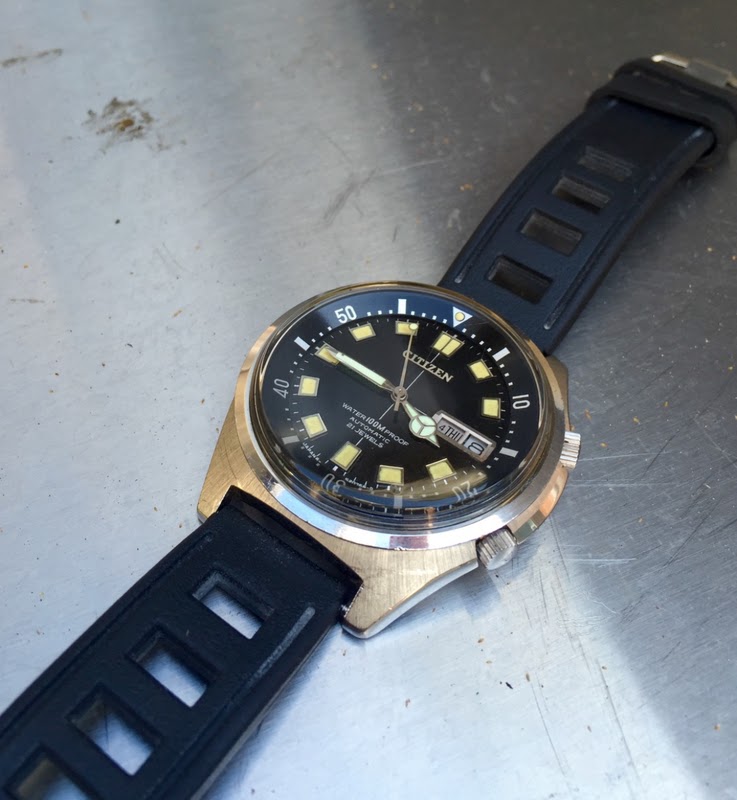
Citizen Diver 100m
The 'Mercedes' hour hand is typical of these, although occasionally they can be found with a straight hand. I've noticed that the inner rotating rings, turned by the upper crown, seem to wear very well, even on examples where+ the dial itself is poor. Note the dial code below the six o'clock marker - the presence of a correct dial code is a good sign of originality. Also note the radial brushing on the upper face of the case and well defined angles and curves, which show that the case has not been polished.
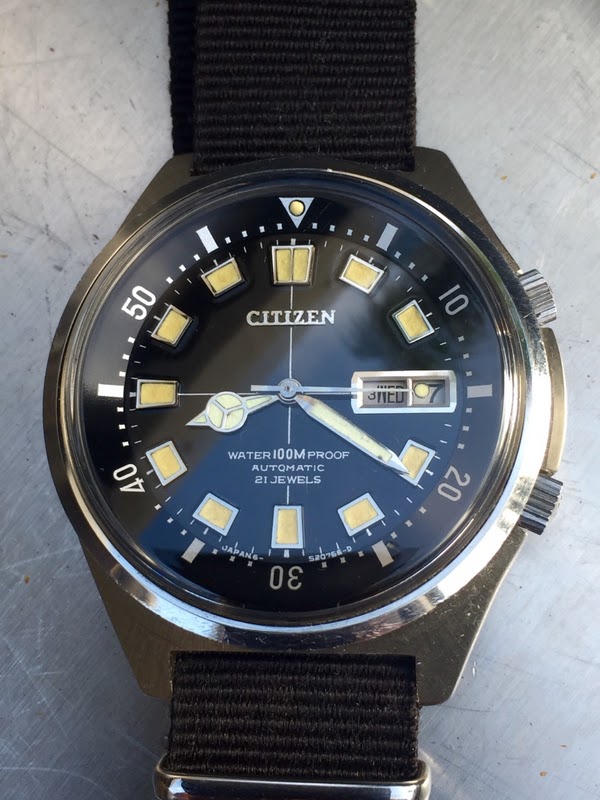
Citizen Diver 61-5111 black dial.
The two crowns are identical, and are signed, with 'CTZ' on this example, or with 'C' on others. The case measures about 42mm across, and is comfortable on the wrist. The acrylic crystal sits high on the face of the watch:

Citizen crowns marked CTZ
The screw down case back is typical of Citizen pieces from this era:

Citizen Diver with model and serial engraved.
Note that the back is stamped 'parawater' rather than proof - this is not that unusual and is not of concern when considering correctness. The case number - 4-520343 - is clearly marked, and the serial number (00321363) gives a production date of March 1970 - from the first three digits. And this brings us to the new piece of information: most of these models have the case number, but no model number, but on this one a model number is stamped on the back - 61-5111. This is something I can add to the diver reference page.
Many thanks again to Bill for sharing his watch - all photos are his and should not be reproduced elsewhere without permission.
Big thank you to Stephen who authored this piece and is an expert in the domain of Vintage Citizen watches.
Source:
https://sweep-hand.org/ 


