Innovation
In this insightful article, patrick_y introduces the extraordinary work of independent watchmaker Christian Klings, a master craftsman operating outside the mainstream. patrick_y highlights Klings's dedication to traditional methods and his groundbreaking innovations, particularly in reimagining the detent escapement. This piece underscores the enduring value of artisanal horology and the pursuit of perfection without modern technological shortcuts.


Klings is a watchmaker whom is constantly out of the lime light. In his entire career, he’s only made about three dozen or so watches. Compared to Picasso who made over 30,000 artworks or Monet who made around 2500 artworks in his career, this is a tiny number. All of which were created out of a tiny atelier outside of Dresden, Germany.

Klings, like many other top watchmakers, is a stout traditionalist. He uses no computer aids nor advanced machinery to create his timepieces. No, he makes his pocket watch and wrist watches in a method that faithfully replicates how watches were made over two centuries ago. Mathematical calculations and gear teeth counts are written out in the margins of his sketches. He cuts his own gears, pinions, and many watch parts by hand. He even fuses his own cases and dials. Very little is externally supplied. I presume the sapphire glass is externally supplied.

A true artist is also necessitates invention. Klings tourbillons are based off the detent escapement – historically correct for a centuries old watch – the same escapement chosen by modern watchmakers like F.P. Journe when Journe made his first tourbillon pocket watch. However, Klings went about the detent escapement in his own in a radical way. Detent escapements have their own characteristics; they are somewhat fragile escapements, they’re susceptible to shock, and they’re not self-starting. They were ideal however because they used less energy, they were accurate, and they run lubricant free! Klings radical contribution is he made the detent escapement self starting by tying back the energy in the mainspring to a spring that connected to the escapement. Thus, in basic terms, when the mainspring is wound, it would pull on a spring that would then interact with the escapement; this tugging effect is enough to start the escapement. Keeping in mind, for over two centuries, the detent escapement has been equipped with a self-starting mechanism. Neither Breguet nor Journe nor every famous watchmaker between them thought to accomplish this task.

The sketch above and below show the self-starting mechanism in action.
Klings also made the mechanism much more resistant to shock and (perhaps my favorite feature) added a soft-stop zero-reset mechanism that allows the second hand to run until it reaches "0" then stops the second hand - this is much more difficult to achieve than a typical heart cam zero-seconds reset.
Significant inventions by Klings is not limited to this one case. He’s also created the “Mosquito Escapement” and the “Desmodromic Escapement.” I wised there was more detailed information about these inventions, but the modest watchmaker only has a modest website where you can casually learn the most basic principles behind these creations:
https://www.christianklings.com/timepieces/escapement-mosquito/
https://www.christianklings.com/timepieces/escapement-desmodromic/
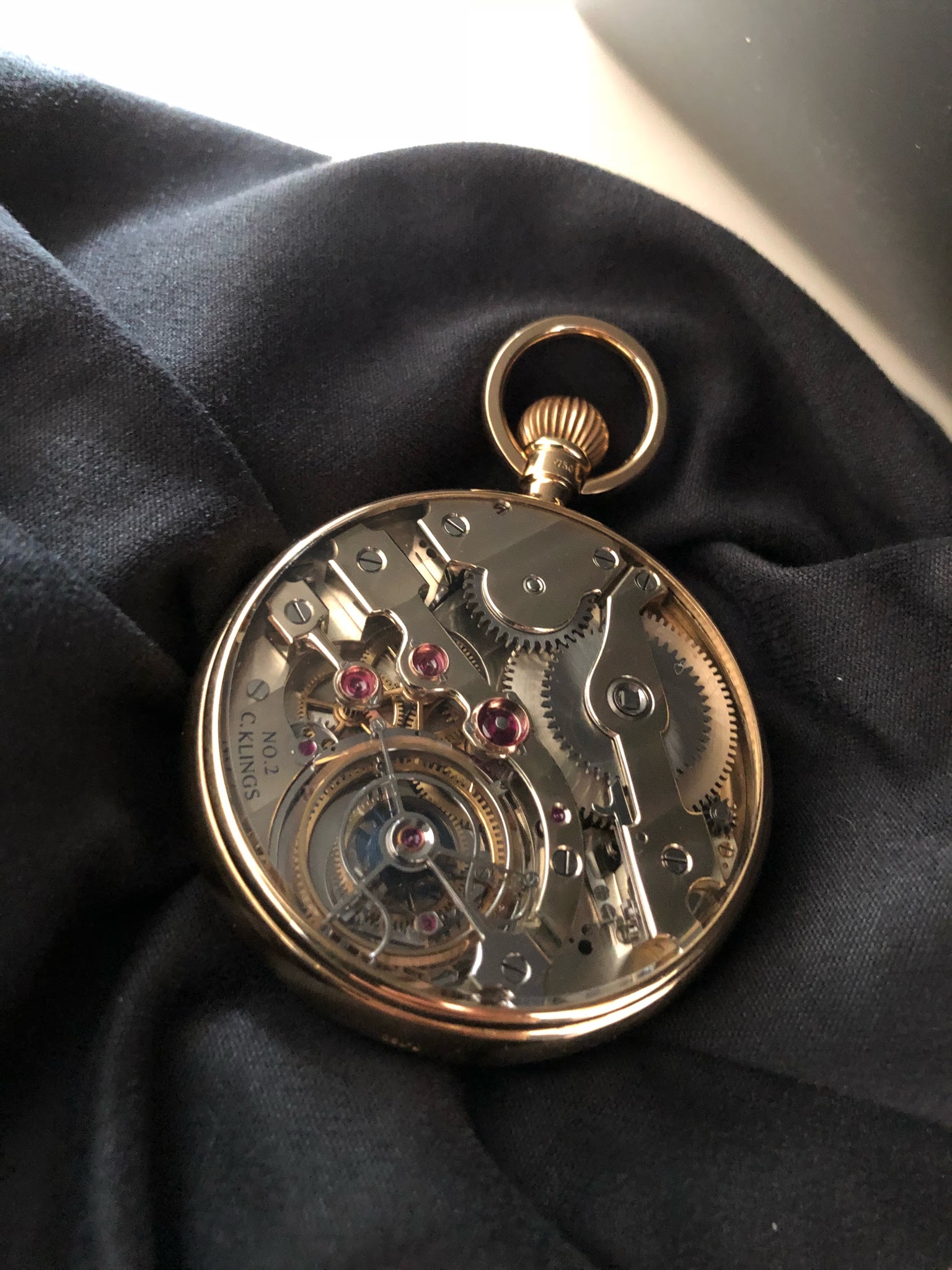
The ”Christian Klings Tourbillon No. 2” is the only tourbillon pocket watch Klings has ever produced. The production of the watch started in 2001 and was only finished in 2015/6. Imagine spending fifteen years on your homework. Nuclear power plants are built in less than fifteen years. A tremendous amount of research and development went into the self-starting mechanism along with an even greater amount of trial and error. A typical employee working 8 hours a day, 40 hours a week, and 50 weeks a year; typically works around 2000 hours a year. Over a fifteen year period it’s quite likely that an entire year’s worth of work was devoted to this watch. The self-starting mechanism was never patented. Patenting this invention is unnecessary since detent escapements are already commercially unpopular, thus the patent wouldn’t generate any returns. The technical drawings are instead a part of the watch itself and included with the watch.

The Tourbillon mechanism is an amazing piece of mechanical prowess. The beat of this watch is unusually low, only 14,400 vph. Which is also extremely visually pleasing to the eye.

The moon phase of the watch was made out of little gold beads, pounded and flattened into discs, then refined, honed, profiled into a dome, then finally cut. Once the golden discs were polished and cut, it would be finally joined into the blue disc.
Now…. This watch is definitely a piece of watchmaking history. It’s also incredibly well made, beautifully made, and an exquisite work of art. Coincidentally, it’s going to be auctioned soon at the upcoming 2022 Fall Geneva auctions. As a lover of watches and inventions, I feel that this piece should be put in a museum. It almost pains me physically that it’s going to likely stay in private hands. I hope a museum acquires this piece and like the Karl Lagerfeld Royal Oak, it will be held and shown to the public, for future posterity to appreciate. And if a private collector does become the new owner, I hope he will share the story behind the watch with his friends, family, and all whom will listen. No doubt, this Klings Pocket Watch is not just "a watch" as a watch implies something that was made in large quantities; no, this is Original Fine Art as it is a unique piece, artisan made, and was never designed to be made in large quantities.
Thus, I invite you, the reader to share your thoughts about this beautiful pocket watch and your thoughts about private ownership of art. I suppose there's not a reliable alternative to private ownership - governments rise and fall - institutions run out of money sometimes; there's probably not a perfect solution. But what are your thoughts?
Bibliography:
- Reporting by former WPS Moderator SJX: https://watchesbysjx.com/2016/09/introducing-the-christian-klings-tourbillon-nr-2-with-self-starting-detent-escapement.html
- Christian Klings website www.christianklings.com
...but let's try to keep him a secret : )
I heard from a friend that he is impossible to get a hold of.
is now retired.
You my friend need to consider a Miki Eleta clock (before he retires)! It'll go well with your electric Bugatti sports car!
I don't own a world class clock yet but I think a Mika Eleta clock may be a bit too up market for me. A modest Erwin Sattler will be fine.
We can always ask Eleta to make a smaller clock. You, like me, like simple watches as much as the complex ones. Maybe a simpler clock will be the right one for you!
This thread is active on the Horological Meandering forum with 33 replies. Share your knowledge with fellow collectors.
Join the Discussion →