Manufacture
MTF's detailed exploration of Cartier's Métiers d’Art Watch Collection from 2013 remains highly relevant for understanding traditional decorative techniques in haute horlogerie. This initial report focuses on grisaille enameling, a grand feu technique that showcases Cartier's commitment to preserving and innovating ancient skills. Readers gain insight into the intricate process behind these artistic dials, underscoring the enduring value of craftsmanship in luxury watchmaking.
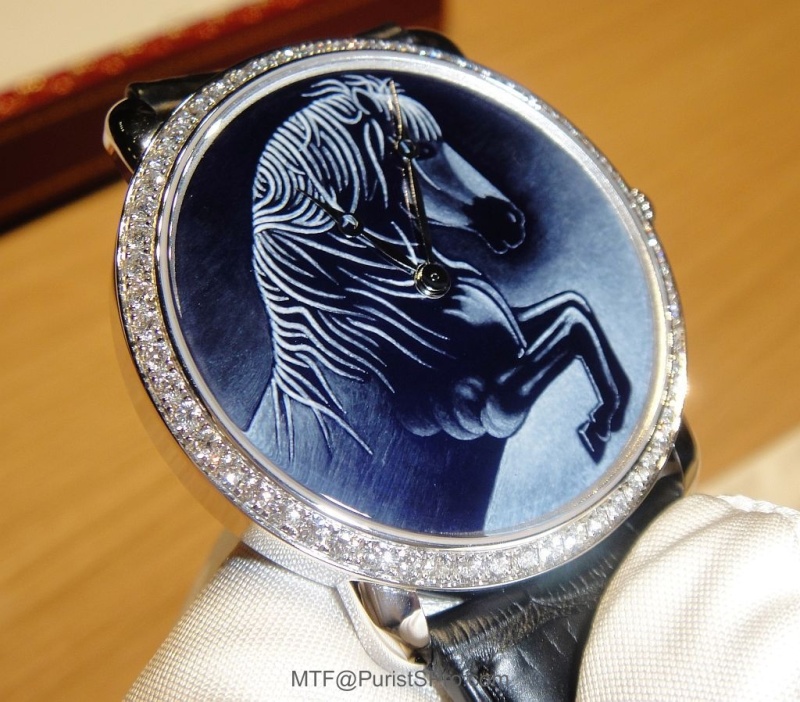


Since Cartier set up the Haute Horlogerie division, they have tried new techniques in both 'future technology' and 'ancient skills' to explore the possibilities of craftsmanship.
On one hand, they are pushing the frontiers of mechanical engineering and on the other, they are reviving forgotten decorative arts like plique-à-jour enamelling, grisaille enamelling, straw marquetry, gold granulation and cameo.
In this first report of the techniques found in the Métiers d’Art Watch Collection, we will be looking at one of the grand feu enamelling techniques used to make watch dials used by Cartier in the 2013 Collection.
Enamel Techniques
Enamel first appeared around the Mediterranean Sea in ancient times as did the forming of crystal glass. It was used in jewellery and other body adornments before spreading to Europe. Watchmakers adopted the technique much later than jewellers, probably in the 15th century. Essentially, all vitreous (porcelain) enamels are melted fusion of powdered glass with colouring mineral oxides on metal substrates.
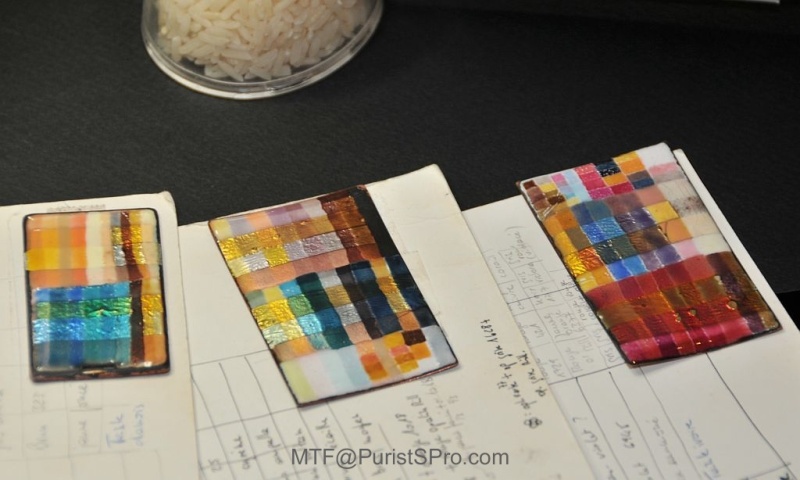
Compared with “classic” enamels, the distinctive nature of “grand feu” enamels is because they reach their melting point at a far higher temperature (820°C – 850°C). This technique makes them extremely pure and guarantees the longevity of the resulting products.
Raw enamel comes in lumps or as coarse powder. During the preparation process, the material is ground in a mortar to create an extremely fine powder, which is then thoroughly rinsed. The cleaned and ready-to-use enamels are stored in distilled water.
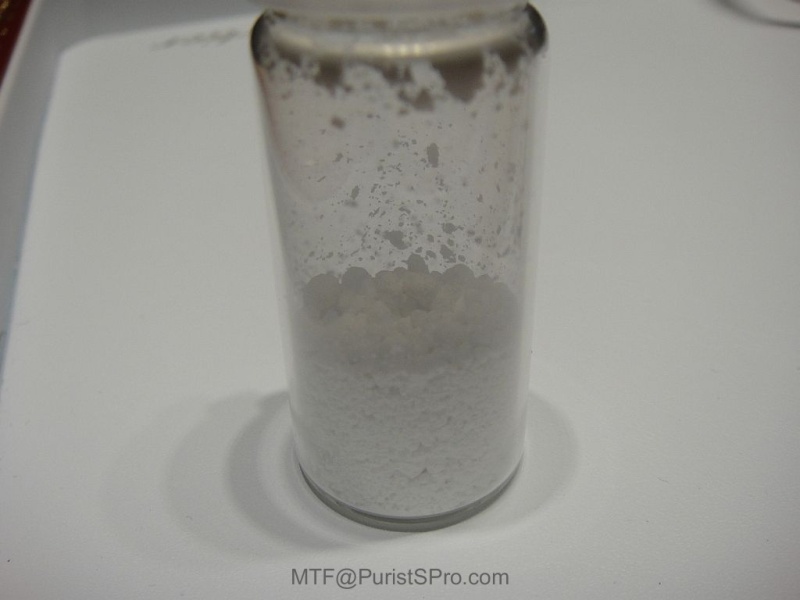
Blanc de Limoges enamel powder
Enamel is always placed on a metal die mould and only copper, silver and gold have the qualities required for this purpose.
Cartier uses precious 18K white gold as the ‘base’ metal for their enamel dials.
Counter enamelling, not strictly a technique, but a necessary step in many techniques, is to apply enamel to the back of a piece as well - sandwiching the metal – to create less tension on the glass so it does not crack, warp or buckle. The enameller can then apply the enamel using a fine brush, with plant glue as the carrier medium. It is left to dry before proceeding to the firing process.
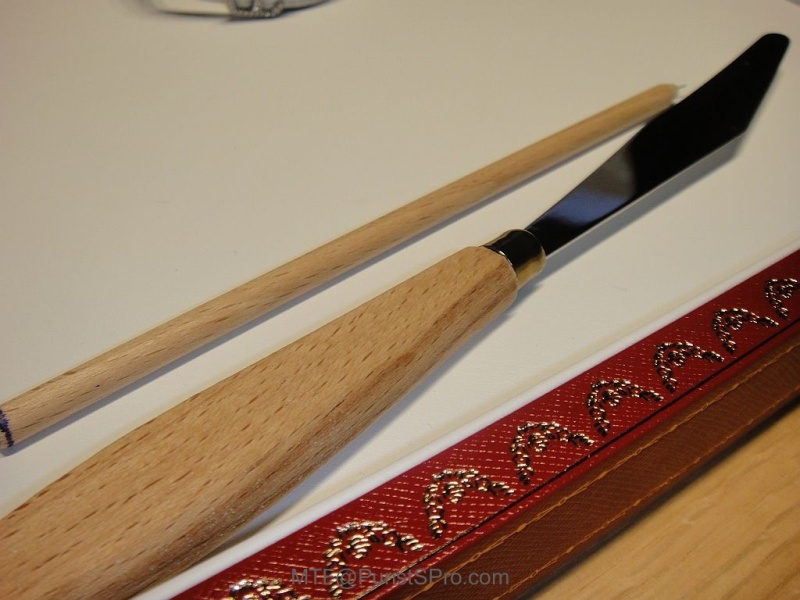
Painted Enamels and Grisaille
Traditionally very finely ground metallic oxides are painted onto a white enamel base with fine brushes and fired, layer upon layer. The process, which is analogous to painting, can produce a detailed three-dimensional quality.
Grisaille is painted in a similar fashion but reversed: the background is black or dark blue and the images are applied in various densities of white to give a “chiaroscuro” effect. Painted enamel, a design in enamel is painted onto a smooth surface. Grisaille and Limoges enamel are sub-categories of painted enamel.
Grisaille, French term meaning "greying", where dark, often blue or black background is applied, then limoges (Limoges porcelain) or opalescent (translucent) enamel is applied on top, building up designs in a monochrome gradient, paler as the thickness of the layer of light colour increases.
Limoges porcelain, named after the town in France where it was invented, is the technique of "painting" with special enamel called "blanc de limoges" over a dark enamelled surface to form a detailed picture, often human figure.
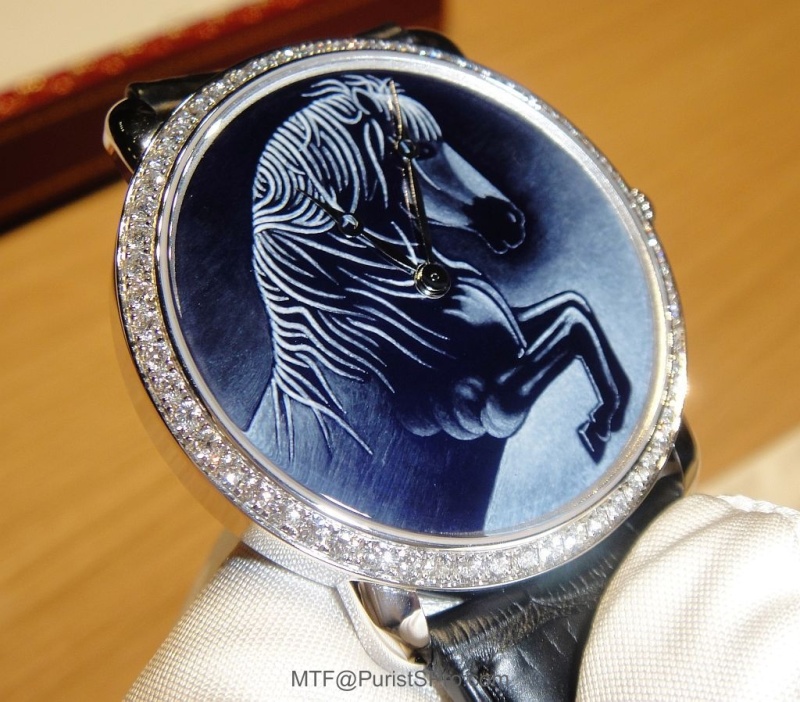
The craftsman coats the dial with brilliant blue enamel and fires it. Then, with a fine brush, he progressively draws the motif in Limoges white, which evolves during a series of six to eight different firings. The enamelling of this piece took almost 40 hours to complete. Through painting, the craftsman can shade the whites to bring out shadows, contrasts and plays of light to create relief.
For 2013, Cartier wanted to evoke the sparkle of moonlight on the proud mane of an Andalusian horse in enamel. The shadows and shafts of light in nocturnal shades of midnight blue are splendidly reproduced in grisaille enamel. As in a painting, marine blue is the base that supports and magnifies the white.
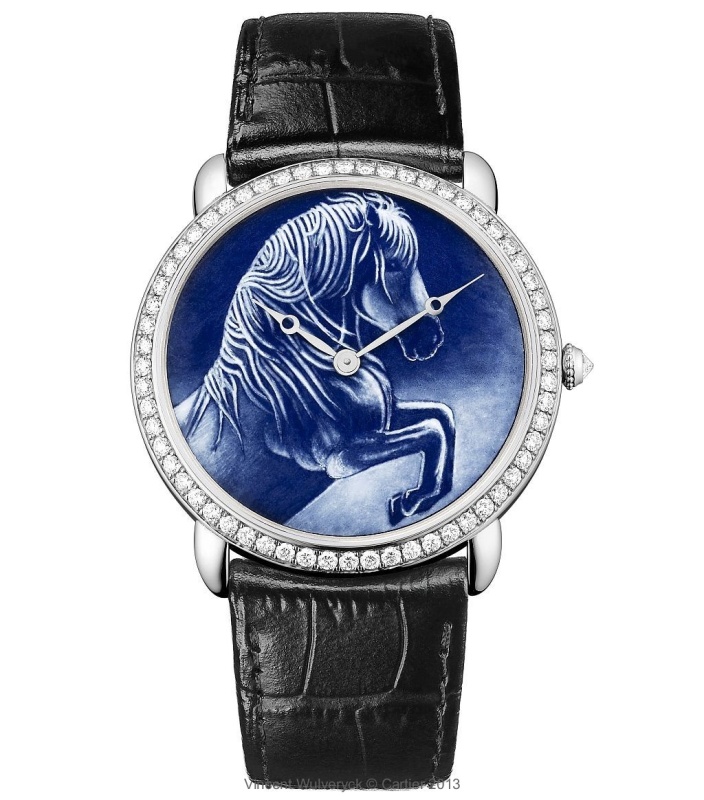
Ronde Louis Cartier watch, XL size, horse motif, grisaille enamel
Case: rhodium-coated 18K white gold, set with 61 brilliant-cut diamonds totalling 1.57 carats
Crown: beaded crown set with a brilliant-cut diamond
Dial: 18K white gold, horse motif in grisaille enamel
Strap: semi-matt black alligator skin
Buckle: double adjustable folding buckle in 18K white gold set with 43 brilliant-cut diamonds totalling 0.42 carats
Water-resistance: 30 metres / 100 ft / 3 bar
Manufacture mechanical movement with manual winding, calibre 430 MC
Numbered limited edition of 80 pieces
Cartier Métiers d’Art Series
Cartier Métiers d’Art part 1 - Grisaille Enamel: CLICK the following URL link:
cartier.watchprosite.com
Cartier Métiers d’Art part 2 - Miniature Painting and Plique-à-jour Enamel: CLICK the following URL link:
cartier.watchprosite.com
Cartier Métiers d’Art part 3 - Engraving and Champlevé Enamel:CLICK the following URL link:
cartier.watchprosite.com
Cartier Métiers d’Art part 4 - Gold Granulation: CLICK the following URL link:
cartier.watchprosite.com
Cartier Métiers d’Art part 5 - Agate Cameo Carving: CLICK the following URL link:
cartier.watchprosite.com
Does anybody have hands-on sightings of these rare watches?
With only 80 pieces but many more boutiques, how do they chose where to send the stocks?
Regards,
MTF
This message has been edited by MTF on 2013-09-10 12:28:34
Oh yes I had the chance to handle similar Cartier watches... And I can't wait to read your post about this: ;) Fx
This thread is active on the Cartier forum with 2 replies. Share your knowledge with fellow collectors.
Join the Discussion →