
Complications
MTF presents the second part of his 2013 Cartier Métiers d’Art Watch Collection report, focusing on the intricate techniques of miniature painting and plique-à-jour enamel. This detailed exploration highlights Cartier's commitment to reviving ancient decorative arts, showcasing how these demanding crafts bring watch dials to life with exceptional artistry and technical skill.



Since Cartier decided to set up the Haute Horlogerie division, they have tried new techniques in both future technology and ancient skills to explore the possibilities of craftsmanship.
On one hand, they are pushing the frontiers of mechanical engineering and on the other hand, they are reviving forgotten decorative arts like plique-à-jour enamelling, grisaille enamelling, straw marquetry, granulation and cameo.
In this second report of the techniques found in the Métiers d’Art Watch Collection, we will be looking at a couple of the grand feu enamelling techniques used to make watch dials used by Cartier in the 2013.
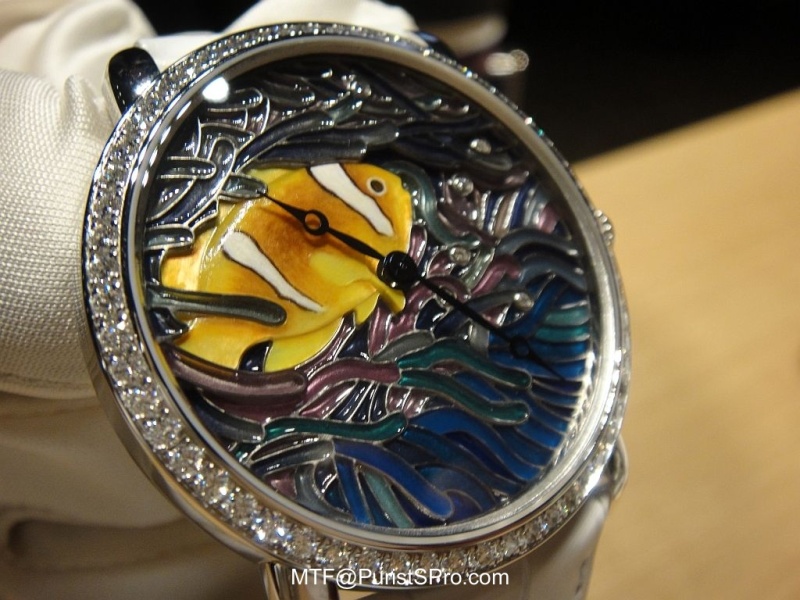
Plique-à-jour
In this technique, the enamel is fired into an open metal framework, with the result resembling stained glass.
Plique-à-jour, French for "braid letting in daylight" where the enamel is applied in cells but with no backing, so light can shine through the transparent or translucent enamel. It has a 'stained-glass' appearance.
Miniature painting
The technique of miniature enamelling or enamel painting is probably the one that requires the most patience and artistic know-how on the part of the enameller. This technique consists in coating a gold plate with a layer of baked enamel that will serve as a base for the motifs.
The latter are then applied to this first layer of enamel and entirely painted by hand. The powders used for miniature enamel painting are extremely fine and are mixed with natural oily essences to facilitate their application.
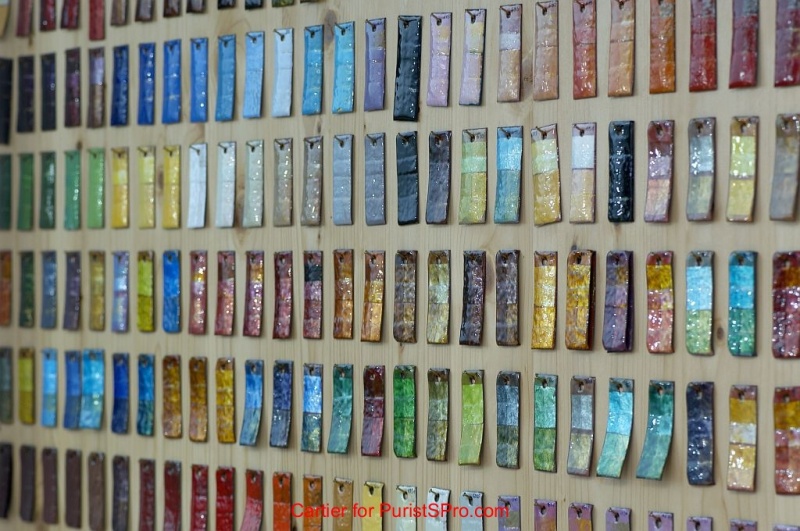
Olivier Ziegler © Cartier 2009
Colour palette
The painting is applied in several fine layers, each fixed by a firing operation. The colour of the enamels becomes more intense with the successive firings, which means that the enameller needs to know ahead of time how many firings are required, as well as the exact influence of these operations on the development of the colours.
Once the painting is complete, the “Geneva” technique is implemented: the latter is fundamental to the method and consists in protecting the painting using a transparent enamel known as flux in order to give special depth and radiance to the work.
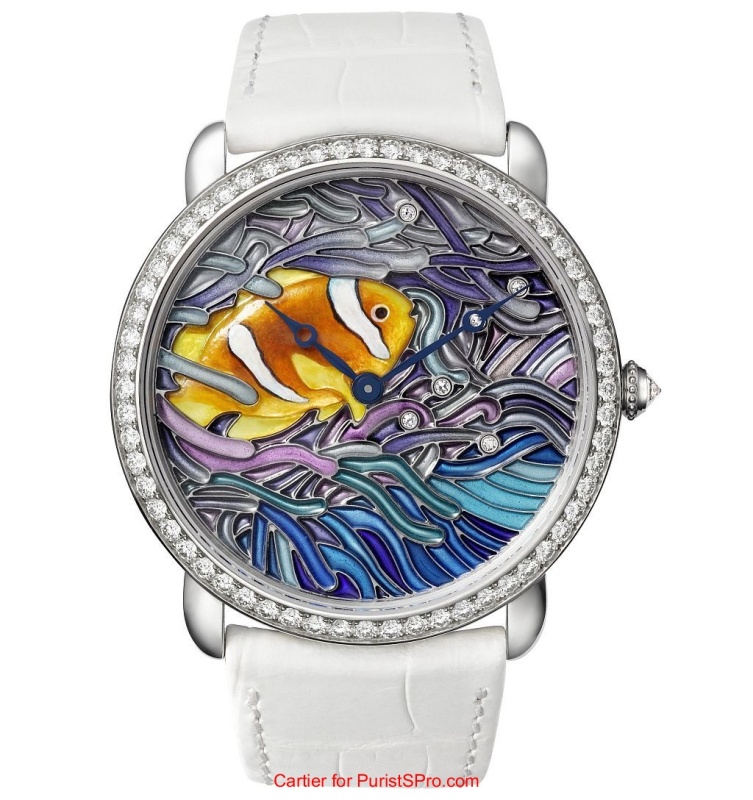
Ronde Louis Cartier watch, XL size, fish and coral motif, engraved mother-of-pearl, miniature painting and plique-à-jour enamel
Vincent Wulveryck © Cartier 2013
Case: rhodium-coated 18K white gold set with 61 brilliant-cut diamonds totalling 1.57 carats
Crown: beaded crown set with a brilliant-cut diamond
Dial: 18K white gold, engraved mother-of-pearl with motif of miniature-painted fish and coral in plique-à-jour enamel, 6 brilliant-cut diamonds totalling 0.02 carats
Strap: semi-matt white alligator skin
Clasp: adjustable double folding clasp in rhodium-coated 18K white gold set with 43 brilliant-cut diamonds totalling 0.42 carats
Water-resistance: 30 metres / 100 ft / 3 bar
Movement: Manufacture mechanical movement with manual winding, calibre 430 MC
Numbered limited edition of 30 pieces
Personal thoughts
The complexity of this dial cannot be emphasised more.
Remembering that enamel requires a metal base to adhere to for 'firing', it is a wonder to me how Cartier managed to incorporate mother-of-pearl that would shatter at high temperatures.
To complicate matters, they decide to engrave the mother-of-pearl, which, is another shatter-risky operation.
Miniature painting requires multiple enamel paste application-firing cycles, each of which adds to the risk of warping and shattering. The colours change after each firing so the enamellist needs to know what the 'final' colour will be after the number of firings that each section is exposed to. Since the number of firings are different for different sections, the intermediate colours are no definitive indicator of the whole picture.
The stained-glass effect is done in 'cells' without backing enamel to strengthen the piece. This gives an ethereal glow to the piece but also risks warping and shattering without the heat-sink of a backing.
Finally, the setting of 6 diamonds amongst the coral painting meant that the artist must have already known in advance where NOT to paint enamel to allow the gem-setter space for the stone settings. care must be taken by the gem-setter when 'closing' the setting not to twist and crack the:
1) engraved mother-of-pearl,
2) miniature enamel painting,
3) plique-à-jour enamel.
Suffice to say: I have new-found respect for the artisans working for Cartier.
Background on enamel techniques
Enamel first appeared around the Mediterranean Sea in ancient times as did the forming of crystal glass. It was used in jewellery and other body adornments before spreading to Europe. Watchmakers adopted the technique much later than jewellers, probably in the 15th century. Essentially, all vitreous (porcelain) enamels are melted fusion of powdered glass with colouring mineral oxides on metal substrates.
Compared with “classic” enamels, the distinctive nature of “grand feu” enamels is because they reach their melting point at a far higher temperature (820°C – 850°C). This technique makes them extremely pure and guarantees the longevity of the resulting products.
Raw enamel comes in lumps or as coarse powder. During the preparation process, the material is ground in a mortar to create an extremely fine powder, which is then thoroughly rinsed. The cleaned and ready-to-use enamels are stored in distilled water.
Enamel is always placed on a metal die mould and only copper, silver and gold have the qualities required for this purpose.
Cartier always uses precious 18K white gold as the ‘base’ metal for their enamel dials.
Counter enameling, not strictly a technique, but a necessary step in many techniques, is to apply enamel to the back of a piece as well - sandwiching the metal – to create less tension on the glass so it does not crack, warp or buckle. The enameller can then apply the enamel using a fine brush, with plant glue as the carrier medium. It is left to dry before proceeding to the firing process.
Cartier Métiers d’Art Series
Cartier Métiers d’Art part 1 - Grisaille Enamel: CLICK the following URL link:
cartier.watchprosite.com
Cartier Métiers d’Art part 2 - Miniature Painting and Plique-à-jour Enamel: CLICK the following URL link:
cartier.watchprosite.com
Cartier Métiers d’Art part 3 - Engraving and Champlevé Enamel:CLICK the following URL link:
cartier.watchprosite.com
Cartier Métiers d’Art part 4 - Gold Granulation: CLICK the following URL link:
cartier.watchprosite.com
Cartier Métiers d’Art part 5 - Agate Cameo Carving: CLICK the following URL link:
cartier.watchprosite.com
Dr M. Teillol-Foo (2013) PuristSPro
This message has been edited by MTF on 2013-09-10 12:25:15
Seems extremely complicated and time consuming. Even though the process is difficult, I wonder if the skilled artisans are still able to make dials such as the Clownfish Dial on their 1st attempt. Or do they have to try 2, 3, or 4 times? - AT
We may never know...... Logic presumes that as in Life, "stuff happens" so we expect so-called "R & D failures". The two Swiss industries with high R & D fail rates are enamel dial making and pharmaceuticals! You essentially pay for the ones that broke. :-) Regards, MTF
Fired enamel dials are of tremendous interest to me. Thank you for sharing this with us! And congratulations to Cartier for being able to sustain this rare and fine art.
See if they can make a Portrait Upon Sample. But all kidding aside, that's an amazing looking fish tank!
This thread is active on the Cartier forum with 5 replies. Share your knowledge with fellow collectors.
Join the Discussion →