New Release
India Whiskey Charlie introduces the Breitling Navitimer B02 Chronograph 41 Cosmonaute Artemis II, a limited edition timepiece that honors astronaut Scott Carpenter's 1962 orbital flight. This new Cosmonaute features a galaxy-blue meteorite dial and commemorates modern space exploration, reinforcing Breitling's legacy as the first Swiss wristwatch in space. The watch combines historical significance with unique material aesthetics.


In 1962, astronaut Scott Carpenter approached Breitling with a request: a special Navitimer featuring a 24-hour dial for his orbital flight aboard the Aurora 7 spacecraft. The result became the first Swiss wristwatch in space. More than six decades later, the Cosmonaute remains part of space exploration's story. To honor its past and future, Breitling launches a new limited edition: the Navitimer B02 Chronograph 41 Cosmonaute Artemis II, featuring a striking galaxy-blue meteorite dial. A piece of space brought to the wrist, every dial is unique.
For over 70 years, the Navitimer has taken on many roles, from essential pilots' tool to cultural icon.
This
year, Navitimer Stories will bring these chapters to light across
aviation, lifestyle, and technical savoir faire, showing why this
remarkable timepiece remains as relevant today as ever.
On May 24, 1962, Mercury 7 astronaut Scott Carpenter orbited Earth three times wearing his custom Navitimer. Carpenter had known the pilot's chronograph from his days of flight training and trusted the functionality of its computational slide rule. Designed to his specifications, Carpenter's version, later named the Navitimer Cosmonaute, featured a 24-hour display to distinguish day from night in orbit. With that flight, Breitling officially earned the distinction as the first Swiss wristwatch in space. The watch's relevance did not end there: astronauts continue to wear the Cosmonaute on missions today.
The limited-edition watch pays tribute to Carpenter's historic flight while looking toward to the future of space exploration. Produced in just 450 pieces, it houses the hand-wound Breitling Manufacture Caliber B02 and features a galaxy-blue meteorite dial, cut from an extraterrestrial stone. Composed primarily of iron and nickel, the meteorite reveals its natural crisscrossing Widmanstätten pattern when etched, ensuring no two dials are alike. The watch commemorates modern space exploration with the engravings “Artemis II” and “One of 450.” The Artemis II mission logo is printed on the open caseback.
Breitling CEO Georges Kern says: “The Cosmonaute was created for space. Bringing a material from the cosmos into its design reflects the same curiosity about the unknown that continues to drive space exploration today.”
The 24-hour chronograph that stands apart
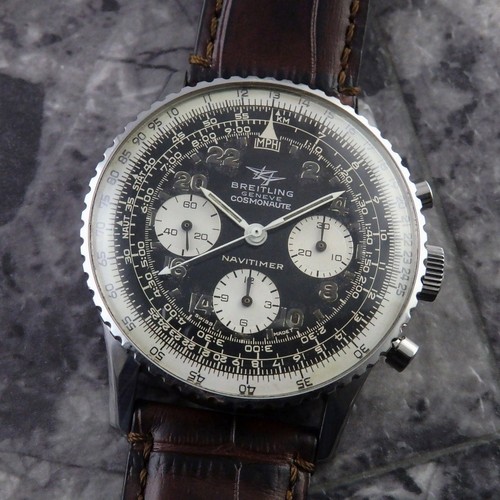
A true Navitimer at heart, the Cosmonaute retains all the signature elements of the aviation icon: the circular slide rule for calculations, the AOPA wings logo, and the three-subdial chronograph layout. What sets it apart is its 24-hour display, powered by the Manufacture Caliber B02. Developed for spaceflight, the dial aligns with mission-control time to keep day and night unambiguous in orbit where the sun rises and sets roughly every 90 minutes.
The watch recalls the original Cosmonaute with its classic proportions and 41 mm case. It features a galaxy-blue meteorite dial, a first for the Cosmonaute, paired with a black slide rule, red chronograph seconds hand, and red accents. It's fitted on a dial-matching blue alligator strap.
A legacy worn beyond Earth
While several brands claim milestones in space exploration, only Breitling can state it produced the first Swiss wristwatch worn in orbit. It was the first purpose-built wristwatch for spaceflight, later released to the public in the same configuration requested by Carpenter.
The Cosmonaute's connection to space did not end with its first flight. Over the decades, Breitling watches have continued to appear on the wrists of astronauts and spacefarers alike. John Glenn, the first American to orbit Earth, wore the Navitimer Cosmonaute ref. 809 in his daily life. James McDivitt, commander of the Gemini 4 and Apollo 9 missions, also chose a Navitimer Cosmonaute Mk. 5 as his personal wristwatch.
In 1996, Claudie André-Deshays, France's first woman in space, wore a Cosmonaute on her left wrist and a Breitling Aerospace on her right during her mission aboard Soyuz TM-24. More recently, in 2022, astronaut Robert Hines wore a Navitimer B-1 limited edition during a mission aboard the Dragon spacecraft en route to the International Space Station. In July 2025, Polish ESA astronaut Sławosz Uznański-Wiśniewski also wore a 24-hour Navitimer during a 20-day spaceflight.
The Navitimer B02 Chronograph 41 Cosmonaute stands as both tribute and continuation. A watch designed for an astronaut and still trusted by those pushing beyond Earth's atmosphere today.


The Cosmonaute reference 809 is notable for its 24-hour dial, a distinguishing feature within its model family that caters to specific timekeeping requirements. This configuration allows for a single rotation of the hour hand per day, providing a different visual representation of time compared to standard 12-hour displays. It represents a functional variation designed for contexts where distinguishing between AM and PM is less relevant than a continuous daily cycle. This reference maintains the core design principles of its series while offering a specialized dial layout.
This particular reference features a stainless steel case, typically measuring 41mm in diameter. It houses a manual-wind movement, often a Venus 178, known for its robust construction and reliability. The crystal protecting the dial is commonly acrylic, a material chosen for its durability and ease of repair. The movement provides a power reserve suitable for daily wear, requiring manual winding to maintain operation. The case design incorporates pushers and a crown characteristic of its period.
For collectors, the reference 809 holds interest due to its unique 24-hour dial and its place within the broader history of the brand's chronographs. It appeals to those who appreciate specialized timekeeping instruments and the technical solutions employed to achieve them. The model's variations, particularly in dial execution and movement iterations, are points of study for enthusiasts. Its enduring design and mechanical integrity contribute to its appeal in the vintage watch market.
I was surprised to see it's not an automatic, you'd think they have better things to do up there than remembering to wind their chronograph!
There's a comment from Reid Wiseman saying he used his to measure MET (mission elapsed time), in which case a date complication would come in handy.
This thread is active on the Horological Meandering forum with 6 replies. Share your knowledge with fellow collectors.
Join the Discussion →