
Automotive
AnthonyTsai introduces the BMW i3, BMW's first series-produced electric vehicle, highlighting its role in shaping future premium personal mobility. The article details the i3's innovative LifeDrive architecture, intelligent lightweight design, and commitment to sustainability. This initial look provides a comprehensive overview of BMW's groundbreaking entry into the electric car market.


Woodcliff Lake, NJ – July 9, 2013 The BMW Group is set to play a leading and groundbreaking role in shaping personal mobility at the premium level well into the future. The research and development work carried out since 2007 as part of project i has laid the foundations for sustainable mobility solutions influenced by environmental, economic and social change around the world. The BMW Group is pursuing an integrated approach, as embodied by the new BMW i sub-brand, in its drive to achieve the necessary balance between individual needs and the global mobility requirements of the future. BMW i is committed to creating innovative vehicles and mobility services with premium character that is defined squarely in terms of sustainability. This vision is about to become reality: the BMW i3, the first series-produced model from the new brand, offers customers zero driving emission mobility in a premium car package.
The BMW i3
The Ultimate Driving Machine in a new era of mobility
From drawing board to detail: intelligent lightweight design, rigorously applied. The BMW i3 embodies a particularly rigorous commitment to the principles of intelligent lightweight design as the basis for enhanced driving pleasure, a lower energy requirement and longer range. Every step in the development of the series production model has been shaped by the demands of weight optimization, from the concept underpinning the vehicle architecture and the development of individual components to the smallest details of the car’s design. Every decision on the selection of materials and component geometry was driven by a central principle of intelligent lightweight design: the combination of maximum functionality with minimum weight.
The LifeDrive architecture developed specifically for BMW i models has created the perfect framework for purpose-built electrically powered car concepts. Here, the carbon-fibre-reinforced plastic (CFRP) construction of the passenger cell (Life module) plays a central role. Such extensive use of this lightweight and crash-safe high-tech material is unique in volume car production.
The principle of lightweight design also governs the aluminum Drive module and the connection between the two elements. The body structure – shaped by its LifeDrive architecture – enables the use of a trailing edge element made by glass-fiber-reinforced plastic injection molding. And that contributes a 30 percent weight saving compared with a conventional sheet steel solution. The direct connection between the power electronics and electric motor in the rear of the BMW i3 reduces the length of cabling required and cuts the overall weight of the drivetrain by around three pounds (1.5 kilograms). Weight-minimizing construction also sets the tone for the chassis components of the BMW i3. For example, the forged aluminum suspension links weigh around 15 percent less than in a conventional design, the hollow drive shaft is 18 percent lighter than a conventional equivalent, and the standard 19-inch forged aluminum wheels of the BMW i3 are 36 percent lower in weight than comparable steel rims of the same size.
Using a magnesium supporting structure for the instrument panel saves weight on two fronts. Superior material attributes over conventional sheet steel allow these components to boast optimized geometry, which results in a weight reduction of some 20 percent. In addition, the high composite rigidity of the magnesium supporting structure lends it a strengthening effect, which allows a reduction in components and lowers weight by a further 10 percent. The door trim panels are made from renewable raw materials and tip the scales around 10 percent lighter than conventional equivalents. And the rigorous application of the lightweight design strategy extends to screws and bolts made from aluminum. The engineers’ detailed commitment to the principle of lightweight design is lent visible expression by the honeycomb structure of the windscreen wiper blades. In addition, a cast aluminum mount was developed specially for the wipers of the BMW i3, its force-flow-optimized geometry also yielding a reduction in weight.
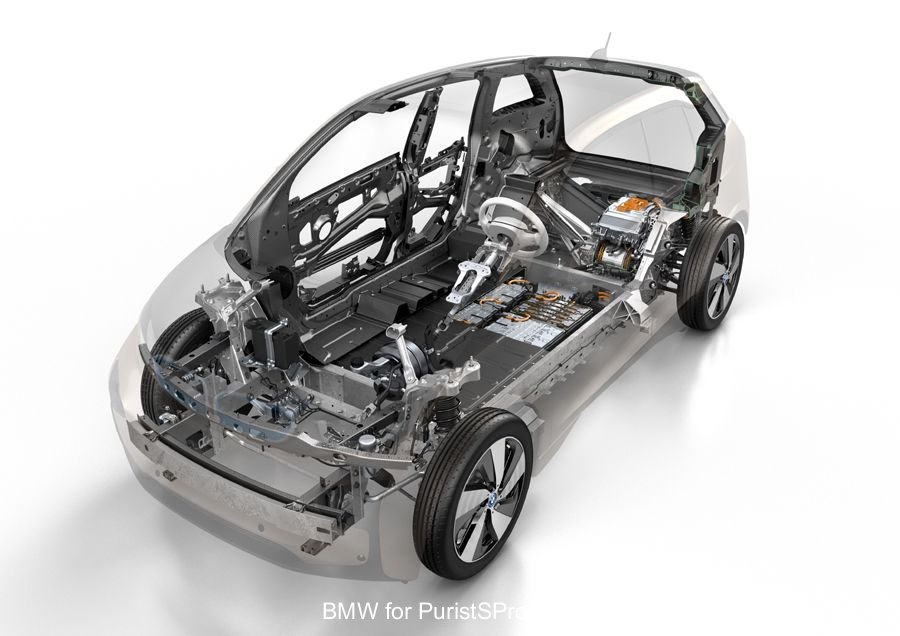
Rear-wheel drive, a low center of gravity, balanced weight distribution and a specific suspension set-up provide the perfect platform for agility and driving pleasure.
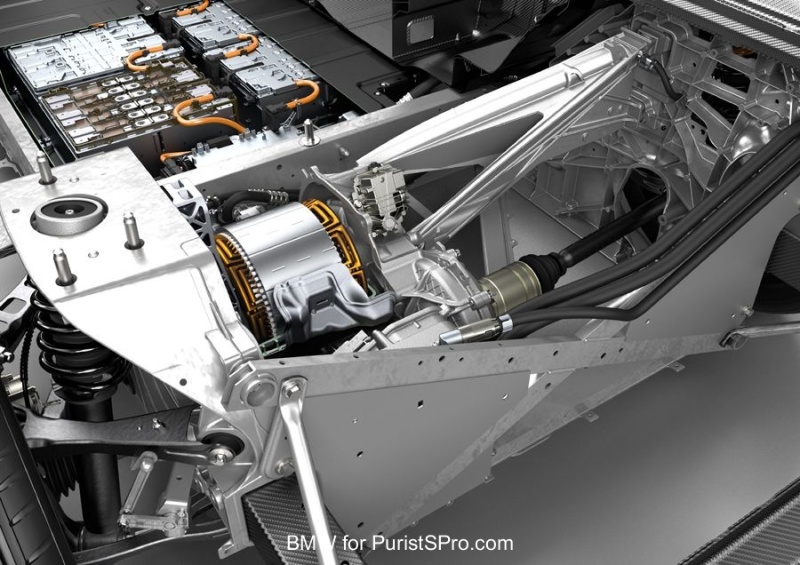
The low and central position of the battery pack has a similarly positive effect on the car’s agility to the balanced 50:50 weight distribution enabled by the arrangement of all the components in the Drive module. The battery is encased in aluminum sections and is particularly well positioned from a crash safety perspective. The electric motor and transmission unit are located in direct proximity to the driven rear axle. Underpinning their space-saving integration into the Drive module is a compact and harmonized construction facilitated by the in-house development of the drive components at the BMW Group. The clear subdivision of Life and Drive modules means no central tunnel is necessary – a particular feature of the car’s construction that has noticeable benefits for the freedom of movement and the generous space available inside the BMW i3.
The car’s rear-wheel drive allows the front axle to remain free of torque steer and fulfill its steering function to full effect. As with current models from the BMW and MINI brands, electric power assistance also sends the BMW i3 driver’s steering commands to the road with smoothness and precision. Its extraordinarily small turning circle of 32.3 ft (9.86 m) and a steering set-up that demands just 2.5 turns from lock to lock enhance the agile handling of the BMW i3. This agility is the defining characteristic of the driving experience, especially in the car’s urban habitat. In addition, a long wheelbase (101.2 inches/2,570 mm), the Drive module’s rigid aluminum frame and advanced chassis technology provide the perfect ingredients for a sure-footed and relaxing ride.
The suspension components of the BMW i3 stand out with their minimized weight yet extremely stiff construction. The BMW i3 has MacPherson single-joint front suspension and a five-link rear axle mounted directly to the Drive module. This design assists the functional separation of wheel location and suspension, resulting in sporting driving characteristics defined by impressive longitudinal and lateral dynamics combined with superior suspension comfort. The rigorous adherence to lightweight design principles yields a reduction in unsprung masses to the benefit of ride comfort at all speeds. The BMW i3’s forged aluminum wheels also boast outstanding rigidity and extremely low weight at about 15 lbs (7 kg) each.
The dimensions of the standard tires (155 / 70 R19) are specific to the BMW i3. The large and comparatively narrow tires allow an excellent balance between dynamics and drag, and the aerodynamic properties and rolling resistance of the tires are designed to provide extremely efficient driving. However, their contact patch barely differs from that of the tires fitted as standard on conventional cars. Indeed, even when the BMW i3 is driven with sporting intent, longitudinal and lateral dynamic forces are always transferred with great assurance and poise. Interventions by the BMW i3’s DSC (Dynamic Stability Control) driving stability system are only required in extreme situations, and body movements are minimal.
The standard DSC system offers all the functions familiar from current BMW models, including the Anti-lock Braking System (ABS), Cornering Brake Control (CBC), Dynamic Brake Control (DBC), Brake Assist, Brake Standby, Start-Off Assistant, Fading Compensation and the Brake Drying function. The DTC (Dynamic Traction Control) mode, activated at the touch of a button, raises the intervention thresholds of the stability control system and allows a controlled degree of slip through the BMW i3’s driven wheels when pulling away on snow or loose sand or in particularly dynamic cornering.
BMW eDrive: electric motor sets new standards in power density and efficiency. The hybrid synchronous electric motor developed and produced specially by the BMW Group for use in the BMW i3 generates output of 125 kW/170 hp and puts maximum torque of 250 Newton metres (184 lb-ft) on tap from the moment the car pulls away. The BMW i3 dashes from 0 to 60 mph (about 0-100 km/h) in about seven seconds. With a time of 4.9 seconds for the sprint from 50 – 75 mph (80 to 120 km/h), it boasts a level of sporting ability that comparably sized combustion-engine cars would require far higher outputs to achieve.
Beyond the traditional immediacy of response offered by electric motors when pulling away, power development in the BMW i3 also remains unbroken through higher speeds. Power is sent to the rear wheels through a single-speed transmission, allowing the BMW i3 to accelerate with an uninterrupted flow of power up to its top speed, which is limited to 93 mph (150 km/h).
This linear power delivery extending into high rev ranges can be attributed to a special electric motor design developed exclusively for the BMW i3. BMW eDrive technology has been employed to take the principle of the permanently excited synchronous motor to another new level through detailed optimizations. A specific arrangement and dimensions for the components used to generate drive produces a self-magnetizing effect only otherwise induced by reluctance motors. This additional excitation causes the electromechanical field formed by the current supply to remain stable even at high revs. The maximum revs of the motor developed for the BMW i3 – known as a hybrid synchronous motor on account of its specific combination of properties – are 11,400 rpm.
The innovative design principle behind the electric motor in the BMW i3 helps it to run extremely effectively across a wide load band. The motor’s average power consumption of around 0.13 kilowatt hours per kilometer (0.21 kilowatt hours per mile) in the New European Driving Cycle (NEDC) plays a key role in optimizing the car’s range. This is an extraordinarily low figure, especially considering its maximum output and torque. The BMW i3 is therefore the most economical electrically powered car of its size and output class. The power density of the electric motor, weighing in at no more than around 110 lbs (50 kg), sets a new benchmark for electric vehicles. The BMW i3’s motor also stands out with its smooth running and low vibrations, while acoustic comfort and vibration damping similarly meet the high standards expected of a premium car.
Driving pleasure, BMW i-style: instantly responsive, agile and uniquely assured. Zero CO2 driving emissions provide the most compelling argument for electric mobility in urban areas. But the appeal of all-electric vehicles is further enhanced by their instantaneous power delivery – which also allows the BMW i3 to deliver rousing acceleration in city traffic – and their quietness, which is a major contributor to the relaxed and comfortable driving experience on board the BMW i3.
Also helping to deliver the BMW i3’s engaging driving experience is the single-pedal control feature carefully configured by the BMW Group’s drive system development engineers. Recuperation mode is activated the moment the driver takes his foot off the accelerator. The electric motor switches from drive to generator mode, feeding power into the lithium-ion battery. At the same time, it generates a precisely controllable braking effect. This recuperation is speed-sensitive, which means the car “coasts” with maximum efficiency at high speeds and generates a strong braking effect at low speeds. The ability to accelerate and brake using just one pedal creates a uniquely direct interaction between driver and car. Thinking ahead in city traffic can allow the driver to carry out 75 percent of braking maneuvers without applying the brake pedal. The brake lights illuminate if the amount of recuperation in progress produces the same braking effect as actually pressing the brake pedal. The conventional braking system only joins the action if the driver summons greater braking power by depressing the brake pedal.
Intensive use of this form of brake energy recuperation through the motor also increases the range of the BMW i3 by as much as 20 percent. And the “coasting” facility further enhances the user-friendly nature of single-pedal control. The BMW i3’s accelerator has a distinct “neutral” position; i.e. rather than switching straight to energy recuperation when the driver eases off the accelerator, the electric motor uses zero torque control to decouple from the drivetrain and deploy only the available kinetic energy for propulsion. In this mode, the BMW i3 glides along using virtually no energy at all. This is another example of how an anticipatory driving style can preserve energy and further increase the car’s range on electric power.
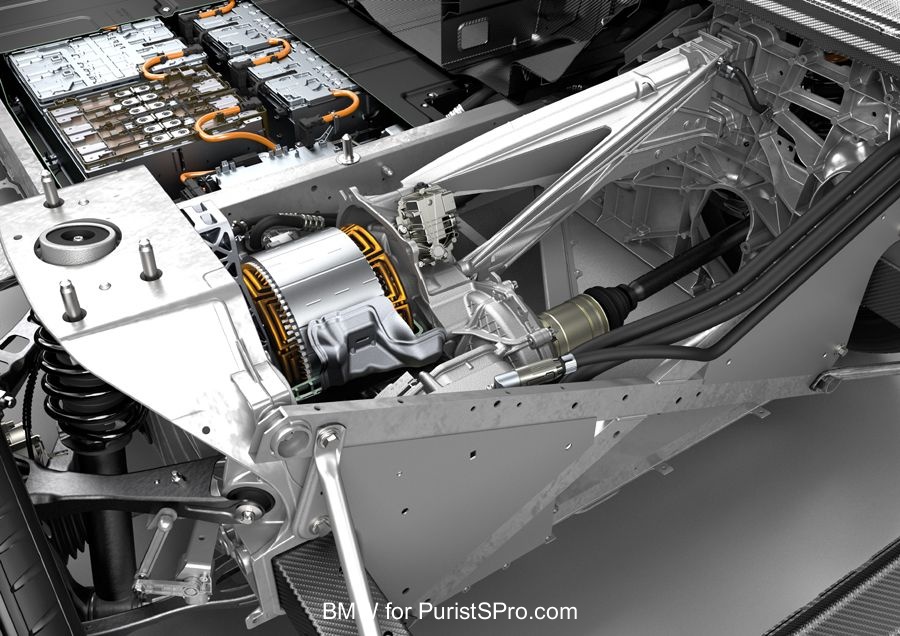
Optimized performance and range through the in-house development of storage technology and energy management.
Specially developed lithium-ion storage cells supply the drive system with the energy required. The BMW Group also utilizes its technological expertise in the development of numerous battery system components in order to bring about a comprehensive optimization of the high-voltage battery pack. These include specific components which ensure the interconnection of the cells themselves as well as the connection between the battery system and the vehicle. They also comprise the integrated control unit and the electronic components in the proximity of the cells, including battery management sensors. Apart from procurement of storage cells from a specialist manufacturer, all the development and manufacturing stages are carried out at the BMW Group. The high-voltage battery is produced on a state-of-the-art assembly line at BMW Plant Dingolfing.
The high-voltage battery in the BMW i3 consists of eight modules (each with 12 individual cells), which together produce a rated voltage of 360 volts and generate approximately 22 kilowatt hours of energy. The lithium-ion cells used in the battery stand out with their high energy density and impressive cycle life. They are designed to perform their energy storage function over the vehicle’s entire lifespan. In order to maintain their output and storage capacity over time, the battery management system therefore controls both the charging and the discharging processes, as well as the operating temperature of the cells. When the vehicle is on the move all the cells are used equally to supply energy. However, it is also possible to replace individual modules in the event of a fault. The air conditioning coolant is used to provide extremely effective cooling of the high-voltage battery, and this fluid can also be warmed using a heat exchanger. All these characteristics enable the optimum operating temperature of around 70oF (20oC) to be reached before a journey begins, even when the ambient temperature is low. This preconditioning ensures the battery operates to optimum effect in terms of power output, range and durability. The BMW Group has planned and developed this battery to last for the full life of the vehicle.
As well as the drive unit, all the other electrically powered systems on board the BMW i3 are also designed to run as efficiently as possible. For example, energy-saving light diodes are used to provide interior and exterior illumination. And an optional interior heating system based on the principle of a heat pump uses up to 30 percent less energy in city driving than conventional electric heating.
The battery pack is mounted flat in the Drive module and weighs approximately 450 lbs (230 kg). The battery casing and its model-specific attachment systems were developed by the BMW Group to provide the high-voltage battery with extensive protection against environmental factors and in the event of a crash. Three levels of safety, including a cut-off mechanism, for the car’s software and hardware provide reliable protection for the electrical system as a whole.
The power electronics responsible for the interaction between the battery and electric motor are also developed by the BMW Group. The power electronics serve both as an inverter for the power supply from the battery to the electric motor and as a voltage transducer interacting between the high-voltage battery and the 12-volt onboard power system. Highly sophisticated software control ensures the best possible current flow during energy recuperation on the overrun. And the operation of battery charging systems is also integrated into the power electronics, which regulate charge outputs of between 3 kW and 50 kW, depending on the electricity source.
Flexible, fast and convenient: charging from the mains supply. In order to make topping up the car’s power supply as user-friendly as possible for the driver, the BMW i3 lays on an extremely flexible and efficient charging system. Customers can charge their car from a home BMW i charging station. In the US, it can also be charged from any public charging station with a SAE J1772 connector. When the BMW i3 is plugged into a public DC fast-charging station (50 kW) it only takes about 20 minutes for the battery to reach 80 percent capacity.
Optional range extender acts as a spare tank. If desired, the BMW i3 is also available with a range-extender engine, which maintains the charge of the lithium-ion battery at a constant level while on the move as soon as it dips below a certain value. Performing this role is a 650cc two-cylinder gasoline engine developing 34 hp/25 kW, which is mounted immediately adjacent to the electric motor above the rear axle. Specifying the range extender has no effect on luggage capacity: the 2.4 gallon (nine liter) fuel tank is located in the front section of the car.
The combustion engine drives a generator to that produces electricity. It is brought into play as required, responding optimally to match the load and running extremely efficiently. Driving in ECO PRO mode or ECO PRO+ mode can increase the range of the BMW i3, in each case by up to approximately 12 percent. And if the range extender is specified, the BMW i3 will be able to travel more than 60 miles (100 km) further before refueling. The BMW i3 is the world’s first electrically powered car to offer the option of a range extender engine used exclusively to generate electric power.
Intelligent connectivity for sustainable mobility: BMW ConnectedDrive in the BMW i3.
The BMW i3 is an electric car offering complete connectivity. Cutting-edge driver assistance systems coupled with mobility services from BMW ConnectedDrive that have been specially tailored for the all-electric drive technology serve to optimize safety, convenience and the usability of in-car infotainment products, as well as providing the ideal conditions for completing everyday journeys with zero driving emissions. BMW ConnectedDrive is unique in the way it helps drivers to implement their mobility plans to combine sustainability and driving pleasure in perfect harmony.
Navigation services that have been purpose-developed with the demands of electric mobility in mind complement the proven products from the revised BMW ConnectedDrive portfolio unveiled in 2013. These include mobility services, such as the Concierge Services for information and the Intelligent Emergency Call function, along with an array of innovative driver assistance systems that make an effective contribution to enhancing the convenience and safety of urban mobility. Access to the BMW ConnectedDrive services is ensured by an embedded SIM card that comes built into the vehicle as standard equipment.
Connectivity between driver and car is also taken into a whole new dimension in the BMW i3. The BMW ConnectedDrive Remote app for BMW i also makes the vehicle data used for mobility planning available on the customer’s smartphone. Alongside the pedestrian navigation function for finding the way from the parked car to the final destination and back again, BMW ConnectedDrive also boasts a unique intermodal route guidance feature that is capable of incorporating local public transport connections into mobility planning. The BMW ConnectedDrive services for BMW i guide customers to destinations accurately and efficiently. They can plot the route for the BMW i3 from the driveway to a parking space, assist in the driver in changing to the correct bus or underground line, and help complete the final leg of the journey on foot.
BMW ConnectedDrive services for safe, convenient mobility in the urban landscape.
The Driving Assistant Plus that is optionally available for the BMW i3 comprises Collision Warning with brake priming function, which is activated at speeds up to about 35 mph (60 km/h) and is able to respond to both moving and stationary vehicles ahead, as well as to pedestrians. It also comes with Active Cruise Control including Stop & Go function. In addition to visual and audible warnings, the system is furthermore capable of braking the vehicle by itself, if required, with up to maximum stopping power. The Parking Assistant can likewise be found on the list of option packages and performs the steering maneuvers at the same time as controlling accelerator, brake and gear selection, enabling fully automated parallel parking of the BMW i3. There is also the option of a rear view camera for the BMW i3 to supplement the standard Park Distance Control (PDC) with rear sensors. Another handy optional extra is the Traffic Jam Assistant that allows drivers to delegate the tasks of pulling away, braking and steering to keep the vehicle in lane. Meanwhile, the Speed Limit Info system is also offered in conjunction with the navigation system.
The various mobility services from BMW ConnectedDrive und 360° ELECTRIC that have been specially developed for BMW i focus on the aspects of navigation and energy management. The comprehensive exchange of information between driver and vehicle allows the current mobility requirements to be checked against the available energy resources. Under everyday conditions, a fully charged BMW i3 is capable of covering a distance of 80 – 100 miles (130 to 160 km) before having to be plugged into a power supply again. The field trials conducted as part of project i, which involved over 1,000 test customers and clocked up more than 12.5 million miles (20 million km) of practical driving, revealed that this driving range is more than enough for day-to-day mobility requirements in urban environments, where the average distance covered daily is around 30 miles (approx. 45 km). The BMW ConnectedDrive mobility services included with the BMW i3 as standard help to tailor this general compatibility to any individual driving situation. Intelligent connectivity paves the way to maximum driving pleasure in a car whose drive system produces zero driving emissions.
Precise, up-to-date and reliable: navigation system with dynamic range display. The BMW i3 can be optionally equipped with a navigation system whose functionality has been extended to include the BMW ConnectedDrive services developed specifically for BMW i. The Driving Range Assistant is invaluable for both route planning and the current journey. If the destination selected in the navigation system lies beyond the vehicle’s current range, it comes to the driver’s aid by suggesting switching to the ECO PRO or ECO PRO+ mode, as well as calculating a more efficient alternative route. And if the battery has to be recharged at a public charging station, the driver is given a choice of available stations in the neighborhood.
A further key element of the linked-up navigation unit is a dynamic range display, which delivers remarkably precise, up-to-date and reliable information by factoring in all the relevant variables. The battery’s charge status, the driving style, activity of electric comfort functions and the selected driving mode are all taken into account for the calculation, along with the route’s topography, current traffic levels and the outside temperature. The system is therefore able to make allowance for the extra energy required for an upcoming climb, stop-start traffic or a traffic jam on the selected route, and lower its range calculation accordingly. The up-to-the-minute and detailed real-time traffic information provided by the RTTI system is also added to the equation. The information is analysed and evaluated centrally by the BMW ConnectedDrive server that is in permanent communication with the vehicle. The SIM card that comes built into the BMW i3 ensures a reliable connection between the vehicle and the BMW ConnectedDrive server.
The dynamic range display is visualized on the central information display in the BMW i3 as a peripheral contour within the navigation map. Taking the vehicle’s current location as a starting point, all points that can be reached in the various driving modes are displayed in the form of a range spider map.
BMW ConnectedDrive Services enable mobility planning to the current destination and beyond. Apart from the information required for the route guidance currently in progress, the navigation system also helps drivers to plan mobility requirements beyond their present destination. For the purpose of energy management, not only are the current battery capacity levels taken into account, but the various options for recharging are also considered. The lithium-ion battery in the BMW i3 can be recharged from SAE J1772 Level 2 rechargers in the US to give maximum flexibility. The BMW ConnectedDrive services help drivers to quickly pinpoint these charging points by displaying all available charging stations along the route or in the vicinity of the destination on the navigation map. In the same way that points of interest such as restaurants, hotels and tourist sites are visualized, charging stations and parking facilities can also be shown in the information display if desired.
The BMW ConnectedDrive server additionally provides up-to-the-minute data indicating whether potential charging stations will be available on arrival. For instance, drivers can call up a station located close to the journey’s destination in advance. The system also notifies them of the charging time required before commencing the return journey or the onward journey to the next destination. The wealth of functions offered by the navigation system with its BMW i-specific BMW ConnectedDrive services makes it possible to plan journeys using electric power alone with supreme precision, reliability and convenience.
Intelligent link-up between driver and vehicle: the BMW ConnectedDrive Remote app for BMW i. The mobility planning information provided is made available on the customer’s smartphone as well as in the vehicle. This connectivity is provided by an application developed especially for BMW i for mobile phones with the iOS and Android operating systems. The app is an enhanced version of the remote services offered by BMW ConnectedDrive.
The Remote app for BMW i allows drivers to access vehicle data and relevant information on route planning at any time. The driver is also able to use the app to call up a display of charging stations that are either full or have spaces, and see whether they are located within the vehicle’s current driving range. To this end, the range contour is also displayed here just as it is in the vehicle’s navigation system. This highly intelligent form of connectivity allows drivers to check the status of their BMW i3 and even plan forthcoming journeys while away from their vehicle – whether at home, at work or walking to the car park. The recharging facilities provided by the ChargeNow network of charging stations are also shown.
If the vehicle is plugged into the BMW i charging station or a public charging station, the charging procedure can be controlled both remotely and using a timer function. A range calculation graphic identical to that in the vehicle can be viewed on the smartphone too. The BMW i App can also be used to search for and select a navigation destination or a free charging station and then import it to the vehicle’s system. Besides this, the available charging stations along the route and in the vicinity of the destination are likewise visualized in the BMW i App, just as they are in the vehicle’s information display. This enables the driver not only to plan the upcoming journey in good time and with foresight, but also to make adequate preparations for further mobility requirements beyond the immediate future.
Drivers have the ability to control not just the charging process remotely but also the advance preparation of the vehicle. If the BMW i3 is plugged into a charging station or the BMW i charging station, the energy supply can be controlled from the smartphone. The vehicle’s air conditioning and heating of the high-voltage battery can likewise be activated remotely. Pre-heating the battery ensures optimum operating status for performance, range and battery durability, even at low ambient temperatures. There is also the option of programming the charging process using the app so that charging takes place when electricity is cheaper, for example using off-peak tariffs at night.
Once a journey has been completed, customers are able to compare the efficiency of their driving style anonymously with that of other BMW i3 users. At the same time, they are given further efficiency-enhancing pointers as well as tips for honing the way they drive.
In addition to this, BMW i offers pioneering mobility services under the umbrella of 360° ELECTRIC that can be incorporated into the customer’s mobility planning. These include the premium car-sharing service DriveNow, which has been available in Germany since 2011 and in San Francisco since September 2012. It was here that the ParkNow facility was also introduced as a world first, enabling parking spaces to be booked via a smartphone app.
ParkNow and other services are offered to customers through BMW ConnectedDrive and made available for use in their navigation system.
Thinking outside the box : 360° ELECTRIC offers all-encompassing vehicle solutions.
So that customers can make the best possible use of their BMW i3, BMW i provides a comprehensive range of products and services to cover individual requirements beyond the actual vehicle. The comprehensive 360° ELECTRIC package provides an especially reliable, convenient and flexible way of harnessing the benefits of electric mobility during everyday driving, with customers deciding for themselves which particular features they wish to use. The 360° ELECTRIC portfolio has four mainstays essentially covering the areas of home charging, public charging stations, safeguarding mobility, and integration into innovative mobility concepts to overcome range restrictions.
Home charging: the most convenient option.
BMW i is able to offer customers who have their own garage or a private parking space tailor-made solutions to make domestic charging a safe, simple and particularly quick procedure. To achieve this aim, BMW i will enter into a far-reaching partnership in the electricity field to ensure premium charging solutions are available. The aim is to provide customer-friendly and efficient charging facilities by the time the BMW i3 is launched that will allow for recharging in the comfort of the customer’s own garage.
Public charging: topping up on the move.
360° ELECTRIC also comprises individual solutions for anyone who is unable to recharge their BMW i3 at home or at work. Thanks to collaboration with car park operators and public charging station providers, BMW i grants customers highly reliable access to the public charging infrastructure. BMW i, together with its partners, fosters connectivity between vehicle, driver and the outside world, providing users with convenient features such as the display of available charging stations in the navigation system and on the customer’s smartphone, along with a simple and transparent payment method with the ChargeNow card. This card enables universal access to charging poles and provides a cashless means of payment. In so doing, it groups together the maximum number of public charging infrastructure suppliers in all BMW i markets, allowing the customer to access the charging stations of different providers with a single card and receive a single standardized invoice from BMW i.
In Germany alone, there are over 70 different providers of public charging facilities, who currently operate a variety of payment and service concepts. Harmonizing this situation is of crucial importance. BMW i already offers customers an intelligent solution with its ChargeNow card. The challenge now is to join forces with all the partners involved and further extend the range of products that are universally available.
Assistance services.
To make sure the BMW i3 runs smoothly during everyday operation, the battery and remaining electrical systems are monitored even while the vehicle is being driven. In the unlikely case of a malfunction, BMW i Centers are able to carry out vehicle diagnostics to pinpoint any faulty components so that the BMW i3 is ready to be driven again in the shortest time possible. And the service provided is of exactly the same thoroughness and standard as offered for conventionally powered BMW cars. In the unlikely case of a malfunction, any BMW i Centers will be able to carry out vehicle diagnostics to pinpoint any faulty components so that the BMW i3 is ready to be driven again in the shortest time possible. And the service provided is of exactly the same thoroughness and standard as offered for conventionally powered BMW cars.
BMW Group In America
BMW of North America, LLC has been present in the United States since 1975. Rolls-Royce Motor Cars NA, LLC began distributing vehicles in 2003. The BMW Group in the United States has grown to include marketing, sales, and financial service organizations for the BMW brand of motor vehicles, including motorcycles, the MINI brand, and the Rolls-Royce brand of Motor Cars; DesignworksUSA, a strategic design consultancy in California; a technology office in Silicon Valley and various other operations throughout the country. BMW Manufacturing Co., LLC in South Carolina is part of BMW Group’s global manufacturing network and is the exclusive manufacturing plant for all X5 and X3 Sports Activity Vehicles and X6 Sports Activity Coupes. The BMW Group sales organization is represented in the U.S. through networks of 338 BMW passenger car and BMW Sports Activity Vehicle centers, 139 BMW motorcycle retailers, 119 MINI passenger car dealers, and 34 Rolls-Royce Motor Car dealers. BMW (US) Holding Corp., the BMW Group’s sales headquarters for North America, is located in Woodcliff Lake, New Jersey.
Press Release
The Silverstone reference 250 is a notable chronograph within the Automotive brand's offerings, distinguished by its design cues that evoke the spirit of historic motorsport events. This particular reference is recognized for its balanced aesthetic, combining functional elements with a distinct visual identity that sets it apart from other chronographs in the collection. It represents a specific period in the brand's design evolution, appealing to enthusiasts who appreciate a blend of traditional watchmaking with a dynamic presentation. The model's presence within the broader Automotive catalog highlights its role as a key offering for collectors interested in chronographs with a clear thematic inspiration.
The case of the Silverstone reference 250 is crafted from stainless steel, providing a robust yet refined housing for its automatic movement. The watch features a sapphire crystal, ensuring clarity and scratch resistance for the dial. Its construction is designed to offer a practical level of water resistance, suitable for daily wear. The movement within is an automatic chronograph caliber, known for its reliability and precision in timing functions. The power reserve allows for extended operation when not worn, a practical consideration for collectors.
This reference appeals to collectors who value chronographs with a strong thematic connection and a well-executed design. Its position within the Automotive lineup makes it a desirable piece for those seeking a watch that combines technical specifications with a narrative. The Silverstone 250 is often sought after for its specific design elements and its representation of a particular era of the brand's production, making it a distinct entry for a curated collection.
And this car will meet 70% of my daily needs, which include; 1. long 80+ mile commute, 2 rear wheel drive, 3 reasonable acceleration time, 4 small parking spaces (sometimes), 5 toll-less carpool lane access (here in Northern California, if you don't have 2-3 people in your car, you can pay to use the carpool lane, but you don't have to pay if you're in an electric, hydrogen, or natural gas car), 6 and with the option of extending my range, this car could truly meet all of my stipulated requireme
Woodcliff Lake, NJ – 3:00 am EDT/12:00 am PDT July 22, 2013… BMW today announced pricing for the ground-breaking BMW i3 electric vehicle. The Manufacturer’s Suggested Retail Price (without Destination & Handling) in the US will be $41,350, before any federal or state incentives. The Destination & Handling fee in the US is currently $925. “The BMW i3 heralds the dawn of a new era for individual mobility and for the BMW Group. True to a genuine BMW, the BMW i3 has strong emotional appeal,
Just might bring me back to the Roundel family with a new car...
For US markets, it'll go on sale in Q2 2014 with a starting base price of $41,350. Summary points of the BMW i3: Will be able to travel 80 - 100 miles on a single charge Able to recharge in 3 hours with use of 220V Level 2, 32-amp J1772 charger 0-30 mph in 3.5 seconds & 0-60 mph in approximate 7.0 seconds Top speed of 93 mph Optional SAE DC Combo Fast Charging which allows for 80% charge in 20 minutes & 100% in 30 minutes You can purchase an optional gas powered range extender 2-cylinder
100 miles a day per-charge is a bit short, as it would only be able to meet 60% of my daily needs. To have 200+ miles of range a day would likely meet 97% of my daily needs. But nevertheless, the range extender option, is helpful. I wonder what kind of fuel economy the range extender nets the car.
From the press release today: "The BMW i3 will go on sale in the US market in the second quarter of 2014. The battery electric model will have a base MSRP of $41,350, before any federal or state incentives, and before Destination & Handling fee (currently $925). The range-extender model will have a starting MSRP of $45,300. Again, this is before any federal or state incentives, and before Destination & Handling fee." Cheers, Anthony
This thread is active on the Automotive forum with 6 replies. Share your knowledge with fellow collectors.
Join the Discussion →


