
Automotive
AnthonyTsai reports on a significant milestone in automotive technology: an Audi A7 Sportback successfully completed a 560-mile piloted drive from Silicon Valley to Las Vegas for CES 2015. This event highlights the rapid advancement of self-driving cars and sparks discussion about the future implications of such innovation.


Yesterday, an Audi A7 Sportback successfully completed a 560-mile piloted drive from the CES 2015 show in Silicon Valley to Las Vegas. This is the future everyone - self-driving cars!
Below is the full press release for your perusal.
Cheers,
Anthony
=========
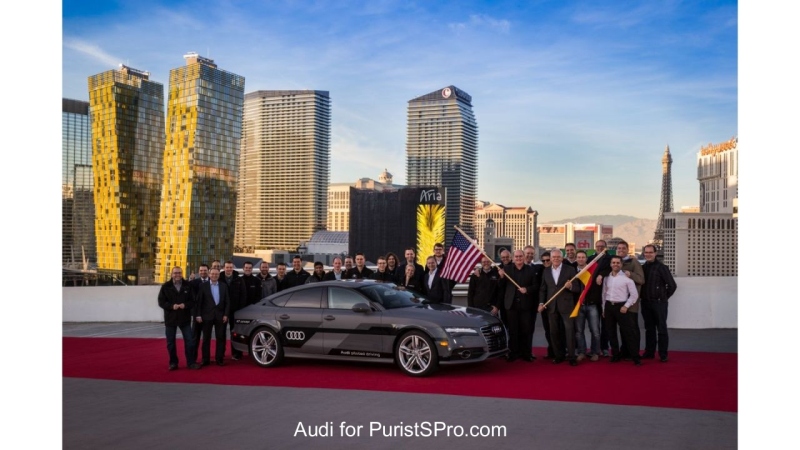
Ingolstadt/Las Vegas, January 5, 2015 – The long-distance test drive with the Audi A7 piloted driving concept concluded today following its 560-mile journey. A selected group of journalists were able to experience piloted driving from behind the wheel during the drive that began in Silicon Valley, California and ended in Las Vegas, Nevada in time to attend the International CES 2015 (Consumer Electronics Show). The concept vehicle impressed particularly through its ability to provide a comfortable drive in rear world, everyday driving situations.
Long-distance test drive successfully completed: Audi A7 Sportback piloted driving concept arrives in Las Vegas following 560 mile drive
§ The Audi A7 piloted driving concept ‘Jack’ impresses through its reliability and natural ability to drive in traffic
§ Piloted driving system proves its real world functions and application
§ Audi will show additional automotive innovations during the 2015 International Consumer Electronics Show (CES)
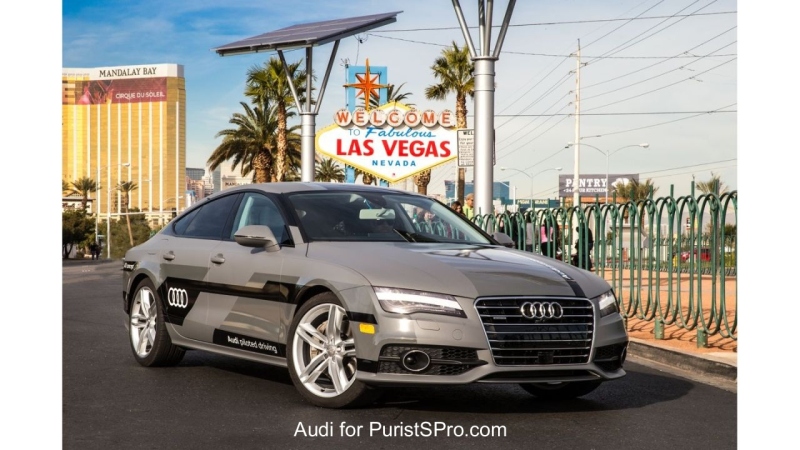
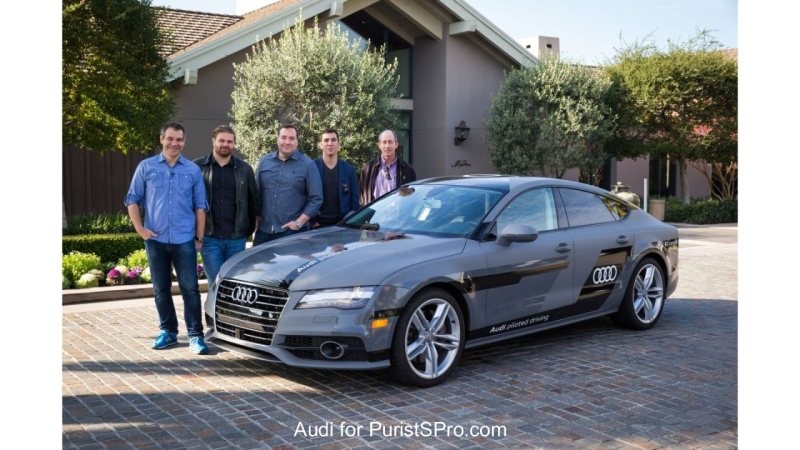
The Audi A7 3.0 TFSI quattro piloted driving concept proved itself very cabable of driving in traffic just as customers do on a daily basis. Journalists that were behind the wheel were impressed with the concept cars ability to drive comfortably and in the logical user interface for which Audi is known. „The results of the test drive underscores our piloted driving competency“, said Prof. Dr. Ulrich Hackenberg, Audi Board Member for Technical Development. „I‘d like to thank the team of Audi engineers, VW Group R&D and the Electronics Research Laboratory for making it such a great success.“
The test drive resulted in actionable data to help further development of Audi piloted driving. Even so it offered the longest drive at full highway speeds with members of the public behind the wheel. The journalists were able to experience piloted driving in 100 mile stints in various traffic situations on public highways . In total, the the drive was 560 miles long, or approximately 900 kilometers. As required by State laws in California, an experienced Audi test driver accompanied the drive from the passenger seat.
*The collective fuel consumption of all models named above and available on the German market can be found in the list provided at the end of this MediaInfo.
The concept vehicle utilizes various production-ready sensors as well as sensors integrated into production vehicles today that accurately detect the vehicles surroundings. Adaptive cruise control (ACC) and Audi side assist (ASA) long-range radar sensors as well as mid-range radar sensors at the front and the rear of the vehicle that are directed to the left and right of the vehicle provide the vehicle with a 360 degree view of its environment. Laser scanners are integrated into the front Singleframe grille as well the rear bumper to provide additional detailed recognition of static or dynamic objects. The redundance of the sensor data consists of a continuous plausibility check during piloted driving to ensure the correct decisions are being made the vehicle and the driver. Four smaller cameras at the front and rear of the vehicle provide short-range information of the surrounding environment. The hi-resolution, wide-angle 3D video camera, which will first see production in the new Audi Q7, observes the surrounding traffic surrounding the vehicle. The sensors utilizes is close to production and meets financial targets for inclusion into future products.
The concept relieves the driver of driving duties from 0 to 70 mph, or just over 110 km/h. The car can initiate lane changes and passing maneuvers as well as accelerate and brake independently. Before initiating a lane change to the left or the right (on US highways), the vehicle adapts its speed to surrounding vehicles. If the speed and distance calculation is deemed safe, the vehicle initiates the lane change with precision and in a timely manner.
Before the piloted driving system reaches its limitations, in city environments for example, the driver is requested to take control of the vehicle to ensure proper safety. Multiple warning signals work in unison: colored LEDs at the base of the windshield, signals in the driver information display, a Central Status Indicator (CSI), as well as a acoustic warning indicator requires the driver to retake control.
Audi will present its “Next Chapter” at CES from January 6th through 9th, 2015 in Las Vegas. The technologies of today and the projects of tomorrow will be presented at one of the most relevant, trendsetting electronic trade shows in the world. A multitude of technologies and two world premieres including the interior model of the new Q7 and another concept car will demonstrate the technological competencies of Audi. Primary topics will include new user and display interfaces, modern infotainment and new Audi connect solutions, as well as LED and laser-matrix lighting technologies will be presented. These and additional highlights of piloted driving will be shown. At the center of all of these topics is the car and its communication with its surroundings.
Audi MediaTV is broadcasting live from the International CES 2015 and is covering the Audi Press Conference on Tuesday, January 6, 2015 from 11:00 a.m. (Pacific Standard Time) / 8:00 p.m. (CET) in its entirety.
Fuel consumption of the models named above:
Audi Q7:
Combined fuel consumption in l/100 km: 10.7 – 7.2** (22.0 – 32.7 US mpg);
Combined CO2 emissions in g/km: 249 – 189** (400.7 – 304.2 g/mi)
**The fuel consumption and the CO2 emissions of a vehicle vary due to the choice of wheels and tires. They not only depend on the efficient utilization of the fuel by the vehicle, but are also influenced by driving behavior and other non-technical factors.
should there be an accident. This is going to re-write the Auto insurance policies. Nice but still scary...even though I trust electronics responses more than human, for consistency. Looking at the bright side, it will never get drunk! I'm not sure if I get to see this trend being a norm during my life time, but it sure is an achievement. Thank you for sharing. Rgds Raymond
which will lead to many changes in our lives... ... and taxies by the way as we won't need any driver for driving them anymore (which is a good thing in Paris as they are #%!@...) Thanks for sharing.
but now it looks like it will happen in our lifetime ;) Best D
Interactive glasses, Holograms or 3D pictures, ultrathin TVs, paying with fingerprints hardware... Need only an overboard and a flying car :) Cheers, Mark
They were talking about it on CNBC yesterday about who's responsible for the accident if a self-driving car gets into an accident? The driver? The manufacturer of the car? etc. It's a topic insurance companies will have to tackle. Cheers, Anthony
exhaustive article. Despite the fact that ever evolving and impresive technology exists today and new ideas are popping up daily. I love to get in to my car, drive and feel in control over the machine, I really hope that it stays this way for a long time! To me there is no better feeling in the world than driving through a winding mountainous scenic road.:) Regards Edward
This thread is active on the Automotive forum with 7 replies. Share your knowledge with fellow collectors.
Join the Discussion →


