
Review
Ping Tsai delivers an insightful review of the Audemars Piguet 37mm Selfwinding Royal Oak in rose gold, offering a fresh perspective on this iconic timepiece. Her article delves into the watch's historical significance and its place within the brand's esteemed lineage, providing valuable context for collectors and enthusiasts.


Audemars Piguet 37mm Selfwinding Royal Oak - Pink Gold
An On-the-Wrist Review
By Ping Tsai
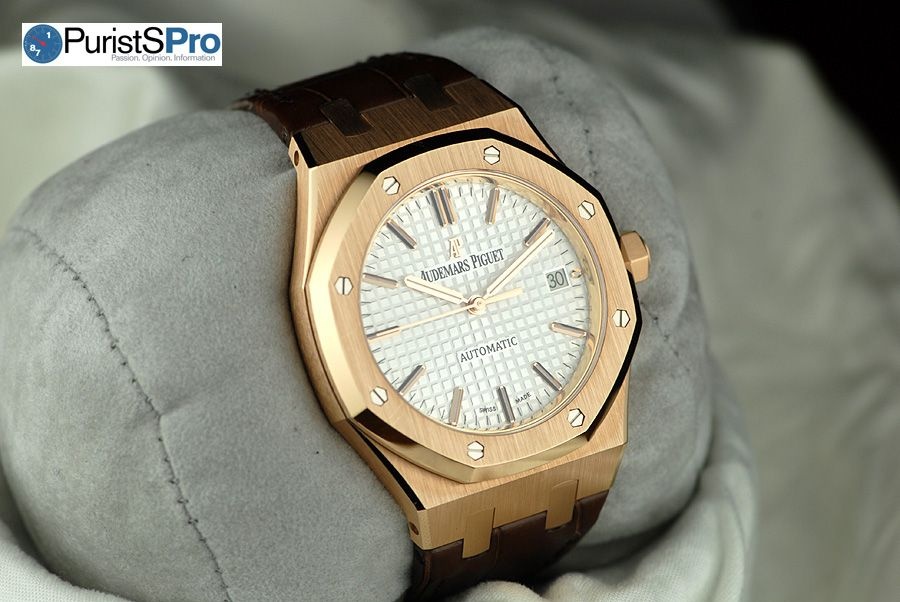
When one thinks of iconic watches that are still on the market today, a short list of candidates comes to mind. These are watches that have been well sought after throughout their histories. They’ve acquired their own identities and often carry the signature image of the brand. Perhaps one of the most iconic watches to date is none other than Audemars Piguet’s Royal Oak.
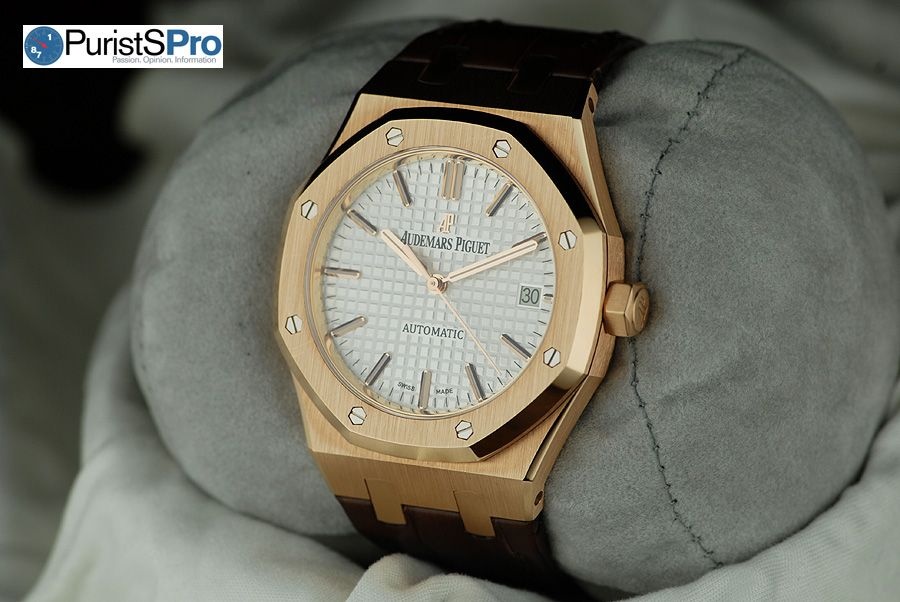
The Royal Oak has long since piqued my watch interests from the days when I watched stage-side in admiration as Jumbos were talked about and Alinghis were acquired. I saw T3s being fought over and Barrichellos introduced, all the while knowing that the spotlight wasn’t on me (being of the opposite sex) when it came to the focus of these watches. Sure there were some ladies versions but those seemed more like an afterthought and there simply isn’t much available when it comes to mechanical Royal Oaks in smaller sizes. I’m talking about the interesting ones that is. Yet I still welcome my first AP Royal Oak assignment. It will however, have to be an “up close and personal” review as opposed to an “on the wrist” review. Even with the new smaller 37mm Selfwinding Royal Oak, my small wrist could not do it justice. Having the chance to review an AP Royal Oak almost seems like a right of passage for well, people who review watches and finally the opportunity is now mine.
The History
The Royal Oak was first introduced to the watch public in 1972 by Audemars Piguet, a manufacture originating from Le Brassus that has all the makings of one of the top watch companies in the industry – a rich history, the most talented watchmakers and designers, great marketing and Swiss made tradition. Established in 1875, AP has come to be known as one of the “big three” Swiss watchmakers along with Patek Philippe and Vacheron Constantin.
The brand’s release of the Royal Oak in the 70’s, is thought to be revolutionary for its time, not only in design but price and material as well. Designed by the famous watchmaker Gerald Genta, the first Royal Oak was made of stainless steel and carried a price tag of about 3200 CHF. Even luxury watches in gold were less expensive at the time. In 1972 it was unheard of for a luxury sports watch, a stainless steel one for that matter, to be so highly priced. However it appears that this was precisely AP’s intention serving to create the exclusivity and intrigue behind the piece. The angular case and octagonal bezel were also atypical design features for a sports watch at the time but they gave the Royal Oak a unique identity that added to its allure. The Royal Oak was a bold move for the historical brand but one that paid off in the long run, saving the company from financial crisis and launching it into the world power watchmaking giant that it has become today.
37mm Selfwinding Royal Oak
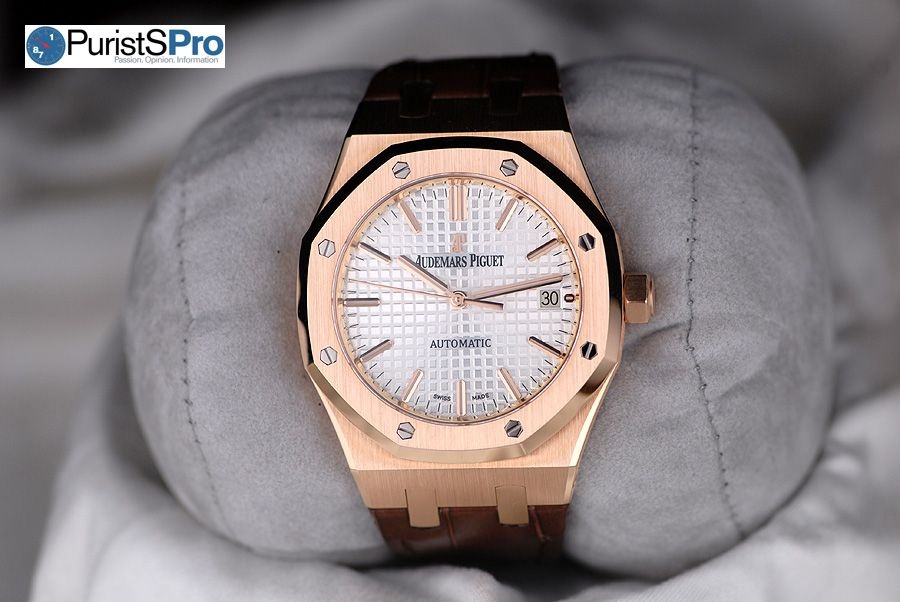
The Royal Oak is Audemars Piguet’s signature watch. As many people may already be aware, there are several variations of the Royal Oak; so many in fact that for a non-AP watch expert such as myself it was enough to make ones head spin. Needless to say, a bit of research was required to sort them all out. The specific watch that I have chosen for this review is one of the new 37mm Selfwinding Royal Oaks in 18 carat pink gold with a brown crocodile strap, date and central second hand – Reference 15450. To gain a better understanding of the Royal Oak in its totality it was important for me to find out where this watch placed in reference to the other models and the significance of its movement, Calibre 3120. I’ll attempt to provide a summary in brief.

The most coveted Royal Oaks for collectors are the “A series”. These were the original “Jumbos” that were part of the first 2000 piece series that were made back in the early 1970s. They contained an ultra thin self winding base Jaeger LeCoultre movement. AP later released B and C series. The current version of the original Royal Oak is the 39mm “Jumbo” Reference 15202 which is ultra-thin and lacks a second hand. The movement is AP’s Calibre 2121 which has the same base JLC Calibre 920. The 15202 has a higher price point and is a regular production piece but AP keeps the production low to preserve its desirability as a collectible.
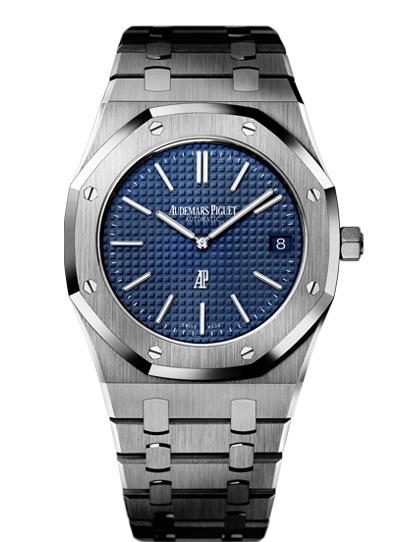
Royal Oak Jumbo 15202
AP also has the 39mm 15300 which is the same size as the Jumbo but slightly thicker, has a second hand and is less expensive. Just this year at SIHH, the brand discontinued production of the 15300 and replaced the 39mm with the 41mm 15400 and the 37mm 15450. All three models have a second hand and contain AP’s in-house movement Calibre 3120.
Excited
that AP had introduced a smaller sized “unisex" Royal Oak, I was curious to see how the fit
would be and how the sized down version would look compared to its larger
predecessor. It was a chance to experience an icon that has just been made more
accessible and relevant to a woman while still enjoying all the intricacies of
a legendary watch in its purest form. I was also amazed by AP’s ability to put
one movement into three different sized cases. It’s watchmaking efficiency at
its height and deserves a closer examination into the design and workmanship of
what has been created. Let us take a closer look at the 37mm Selfwinding Royal
Oak in all its greatness and elegance.
Case and Dial
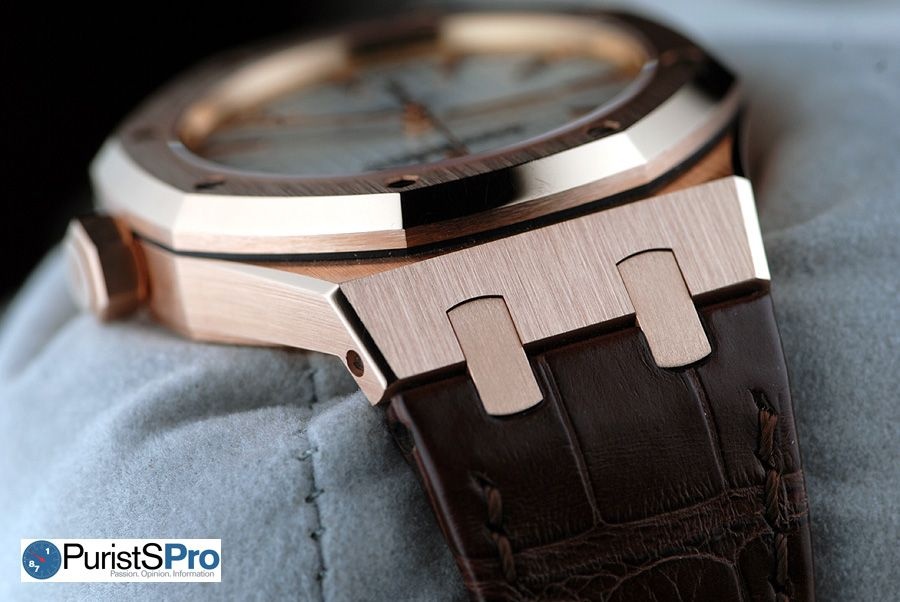
The Royal Oak was named after three historical warships in the British Royal Navy that date from the early 19th century. The naval inspiration evident in the name can also be seen in the shape of the case and bezel which is indicative of a porthole on a ship. The shape of the Royal Oak is distinctive, sporty and elegant with its octagonal appearance and hexagon shaped screws that circle the bezel. I don’t know of another watch that is more easily recognizable on someone’s wrist than the Royal Oak. It is one of those watches that with a single glance, someone can instantly tell that the watch is a Royal Oak. The signature lugs which provide smooth integration from the case to the strap instantly gives away the watch’s identity as well.

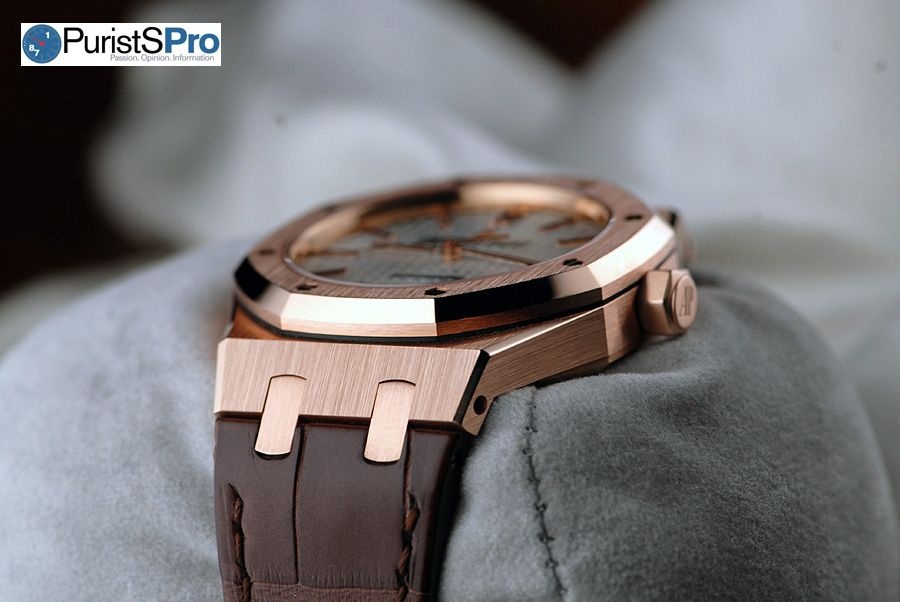
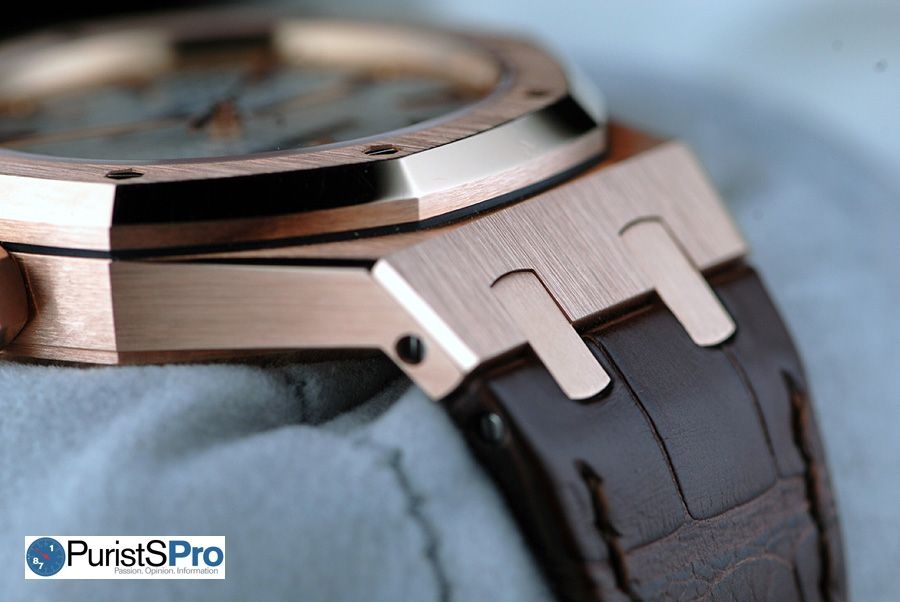
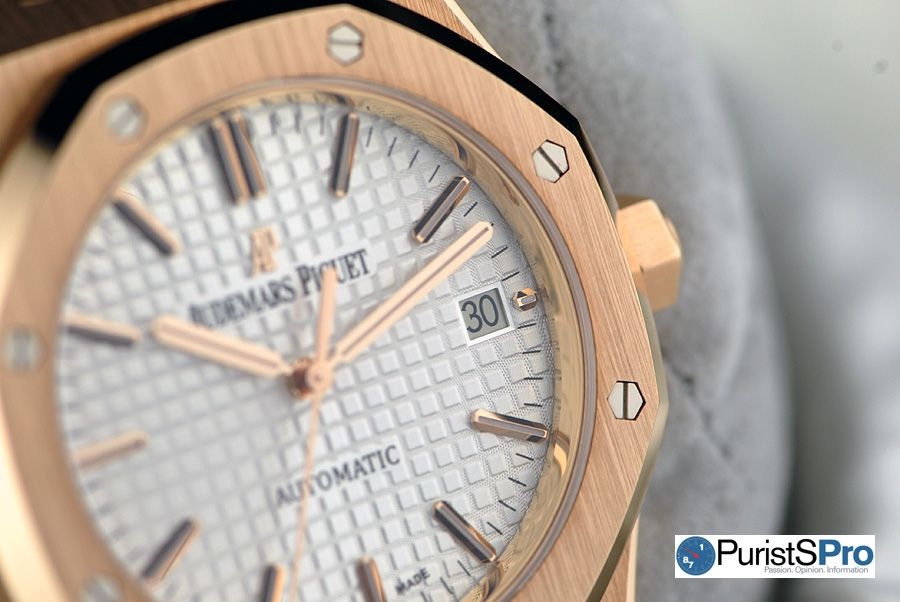
The pink gold version raises the watch’s sporty character to a whole new level of elegance and opulence. AP’s pink gold is simply beautiful with the perfect balance of warmth and richness. Its appearance varies depending on the type of light that surrounds it and the angle at which it hits the surface, illuminating all the edges and corners. The variations lend to the watch’s dynamic character.
Varied finishes also contribute to this dynamic play on light as the treatment alters between brushed and polished finishing. The polished outer and inner edges of the bezel and other edges not only illustrate this but also give the entire watch a heightened luxurious upscale look and feel. I am told that a lot of AP watches including Royal Oak Offshores do not have this polished inner bezel. The ends of the hour markers are reflected in the mirrored surface and extending their appearance on the dial.
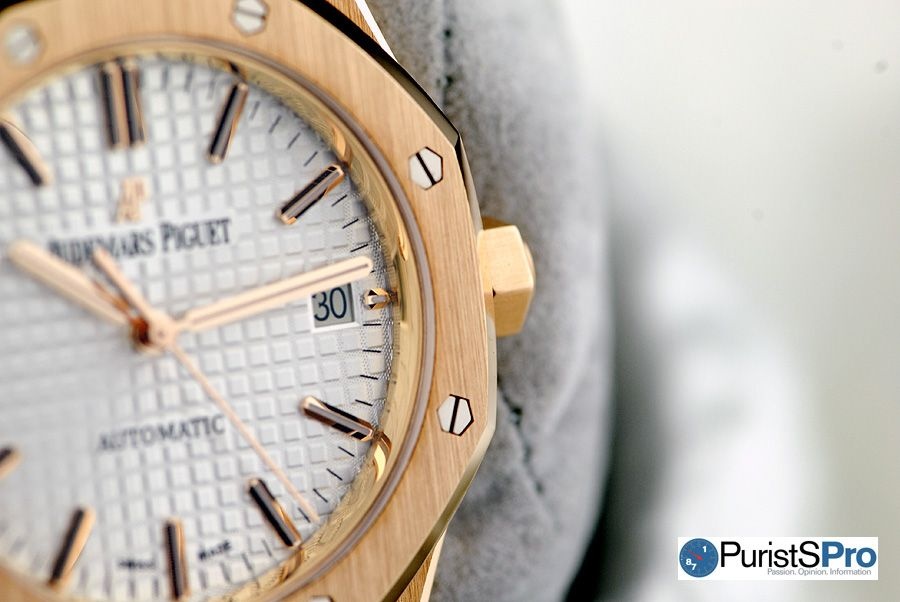
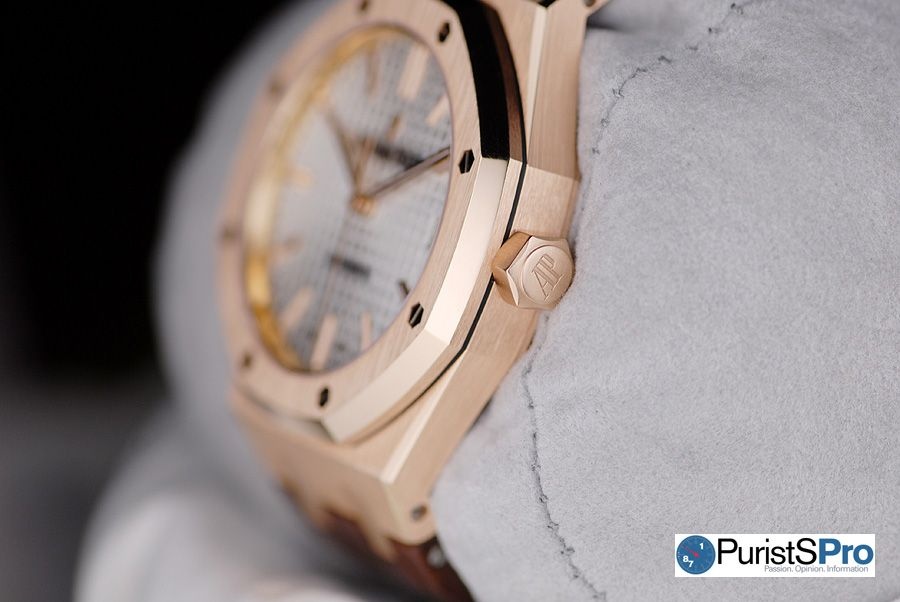
The case is constructed as a solid piece to ensure better water resistance, a “state-of-the-art engineered strongbox case”. The watch also has glare-proof sapphire crystal and caseback and a screw-down crown with a hexagonal profile, further adding to the sporty design. The case and all its details achieve the ideal balance between strength and prominence along with elegance and luxury.
“Grande Tapisserie”
The dial is silver and has pink gold applied hour-markers and Royal Oak hands with luminescent coating. The most striking aspect of the watch and my favorite by far is the signature design motif on the dial which AP calls “Grande Tapisserie”. The textured treatment has a metallic finish and checkered pattern that catches the light beautifully, creating angles of lighted and shadowed areas that move and change as I tilt the watch and roll my wrist around. The “Grande Tapisserie” pattern gives the dial a dynamic and 3-dimensional geometric feel while the silver finishing makes it more upscale and elegant.
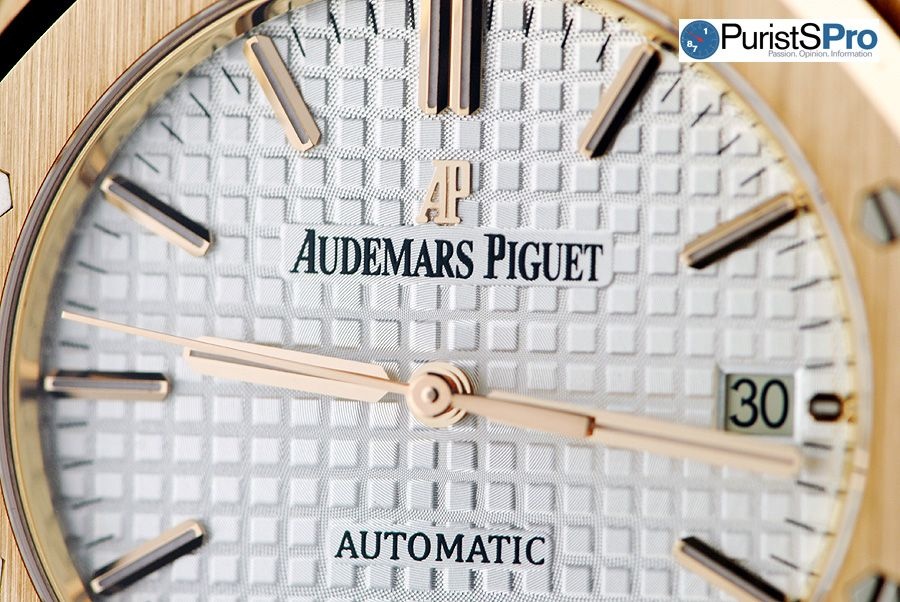
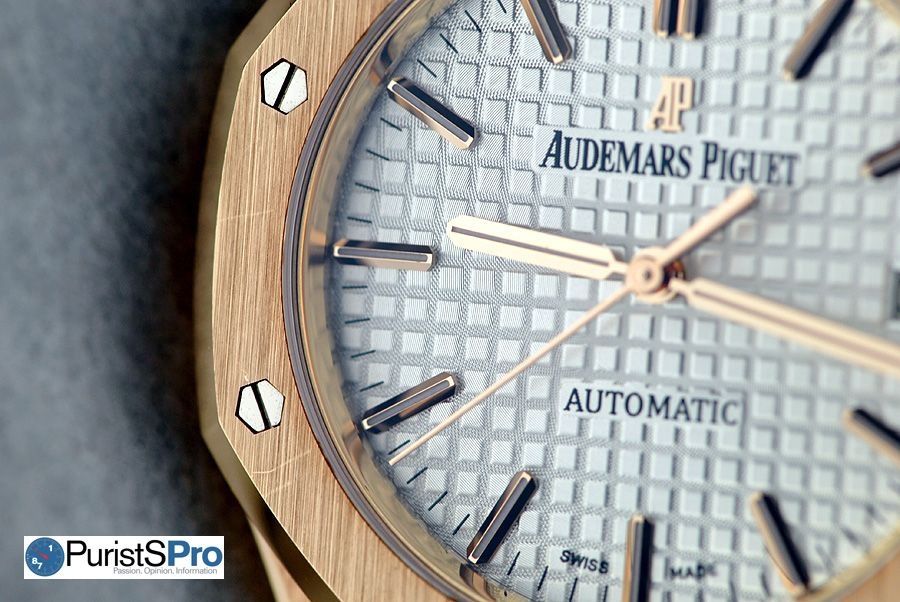
The Grande Tapisserie dials were made by dial manufacturer, Stern Creations in the past but are now made in house at the AP manufacture facilities. The process that is used to make them is not as high-tech as one might think. It actually involves a centuries old technique that dates back to the early 1600s using a pantograph like machine. The pantograph is a “mechanical linkage” system that uses parallelograms to connect a tracing element and the chisel. As the tracing element is guided across the “tapisserie” pattern on one end, the burin engraves that pattern into the dial on the other end thus duplicating the pattern. Employing ancient techniques in creating such a modern watch definitely gives it a specialized hand crafted character.
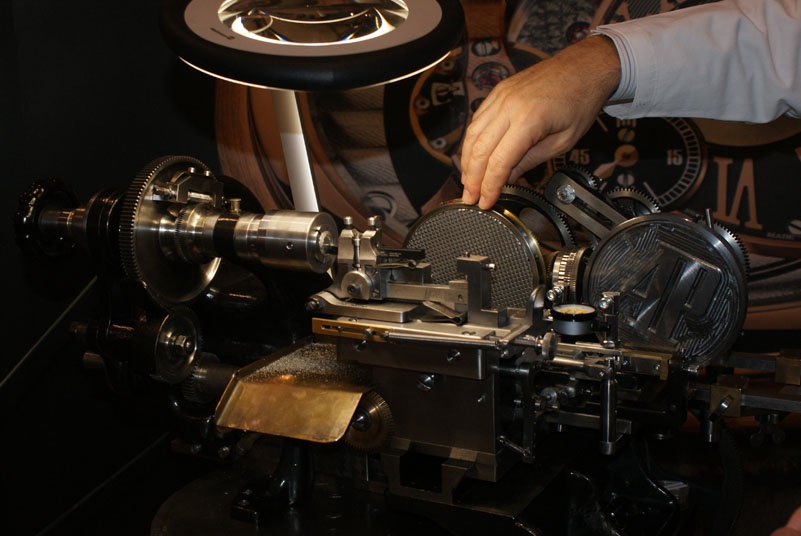
Machine for producing Tapisserie dials
I do have to say that I am not a big fan of the word “AUTOMATIC” printed in caps at 6 o’clock. Perhaps it was needed to balance the AP logo and name at 12 o’clock. I know that it keeps with tradition and that is why no one questions it. Having the simple “AP” initials at 6 o’clock in the Jumbo provides a cleaner look in my opinion.
Movement
The 37mm Selfwinding Royal Oak is equipped with Calibre 3120, AP’s excellent in-house movement which is also used in the 39mm and 41mm Royal Oaks as well. It has hour, minute, center second and date functions. Below are some quick specifications of the movement.
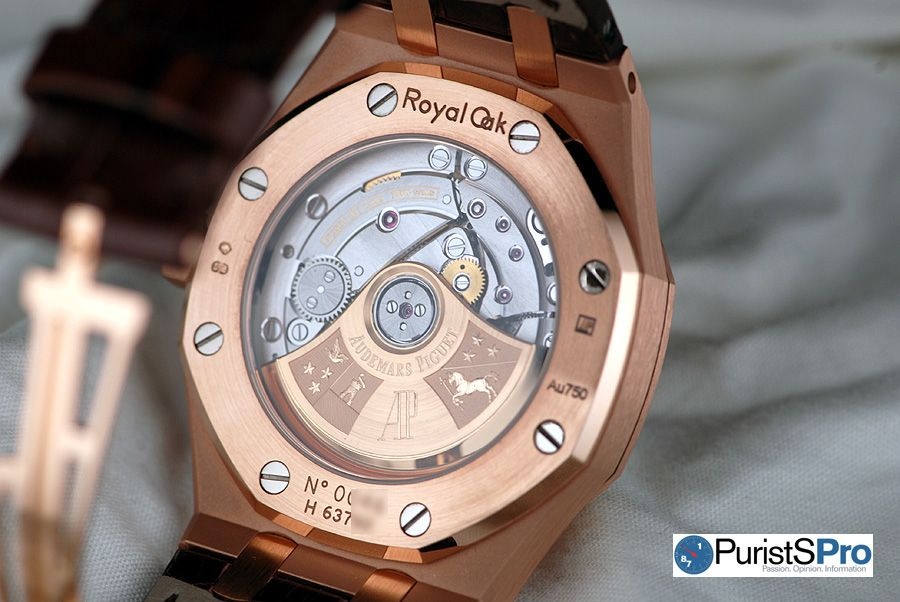
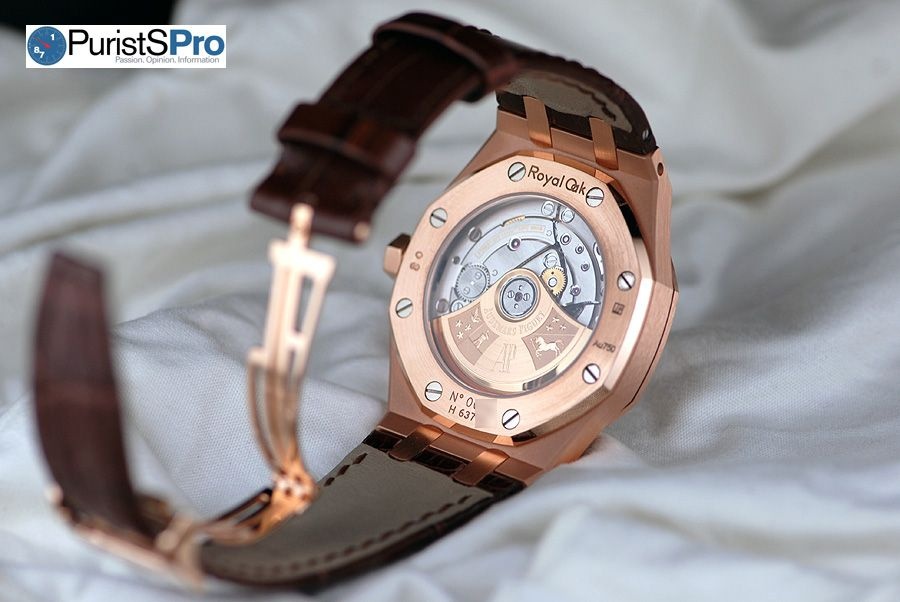
Movement Specifications
Specificities
When looking at the 3120 the first thing that catches my eye is the beautifully engraved rotor, which is completely made of 22K gold. The decorations on either side of the centered AP logo are the Audemars and Piguet family crests in relief. What is interesting about this rotor is its shape and angle of arch which appears to be smaller than most rotors. The rotors of most movements have arches that are closer to 180 degrees. The 3120 has a smaller arch likely to compensate for the solid gold construction which is heavier. The edges of the rotor have a gentle curve that offsets its substantial visual weight. It has massive presence but is well balanced and proportioned in accordance with its size and design.

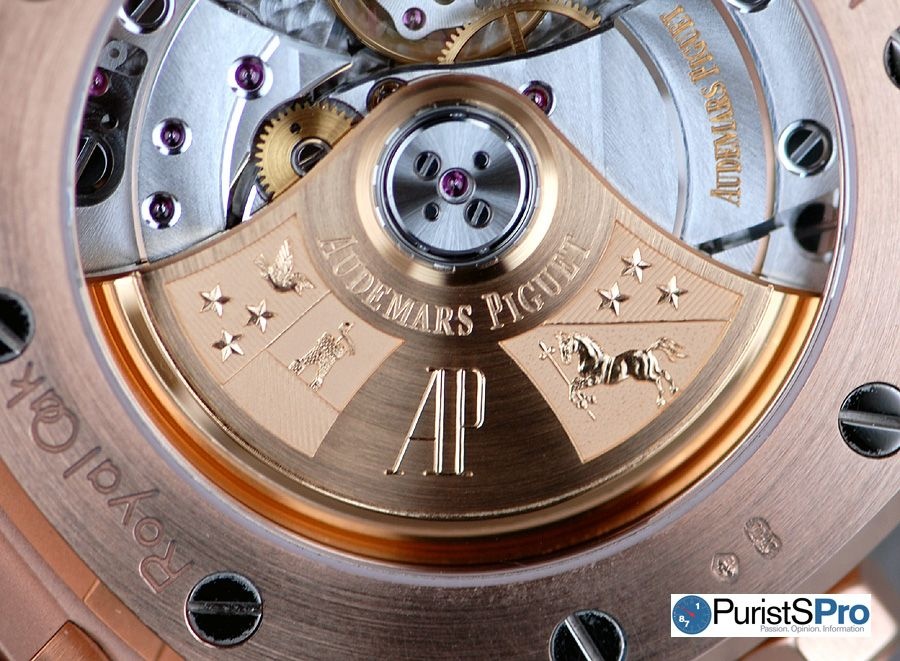
The design of the rest of the movement echoes this same mastery in balance and proportion. With a diameter of 26.6mm, AP has managed to fit a significant amount of material within a small volume of space. The components of the primary structure, such as the bridges and plates, all appear to be made of solid blocks of steel instead of thin sheets.
The movement also has a larger balance and barrel for its size, a feature that improves the watch’s performance. Peeping out from behind the balance wheel and bridge one can see the perlage finishing on the base plate. There isn’t a tremendous amount going on in terms of finishing and decoration. The beauty in the movement lies in its balance and exquisite proportions. You can read more about the 3120 in depth in an excellent movement breakdown review here.
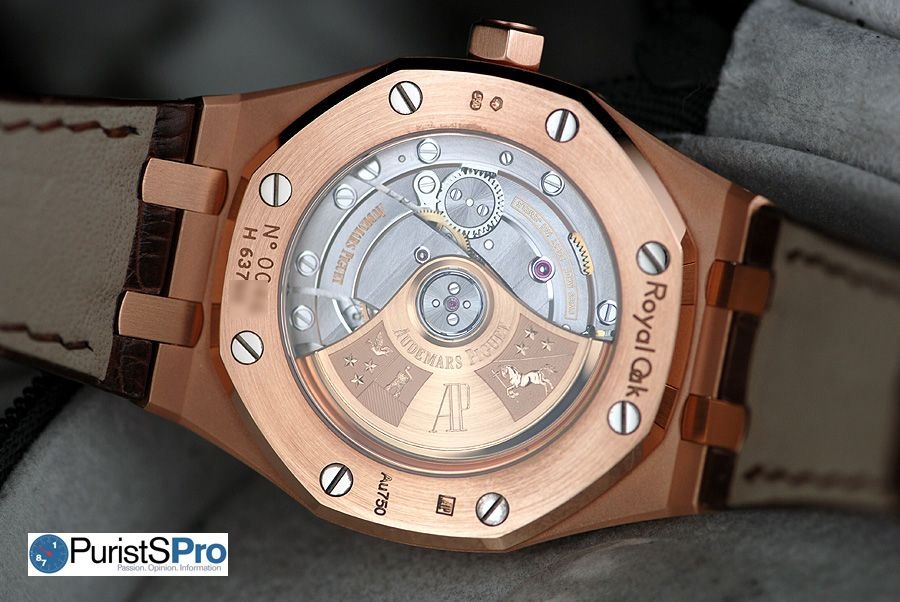
Strap and Fit
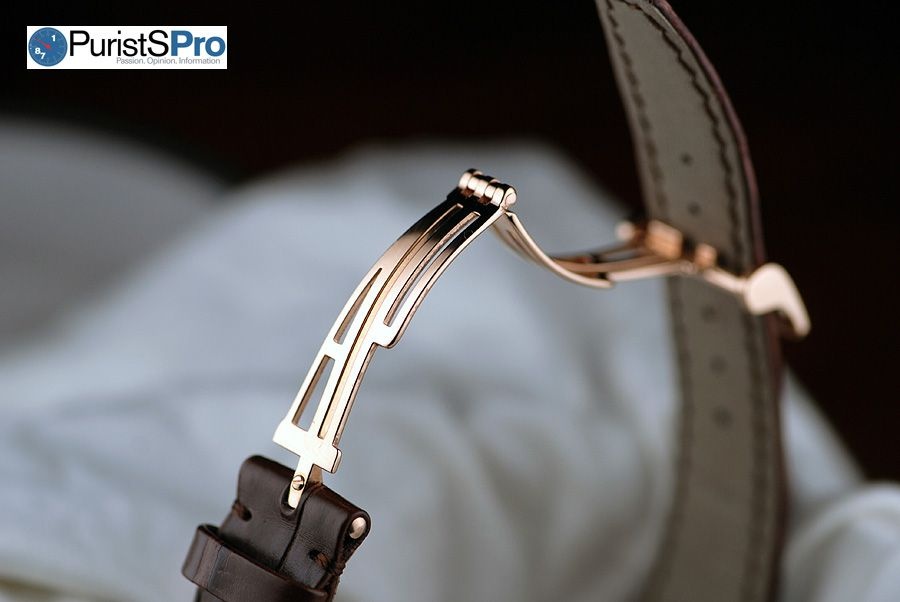
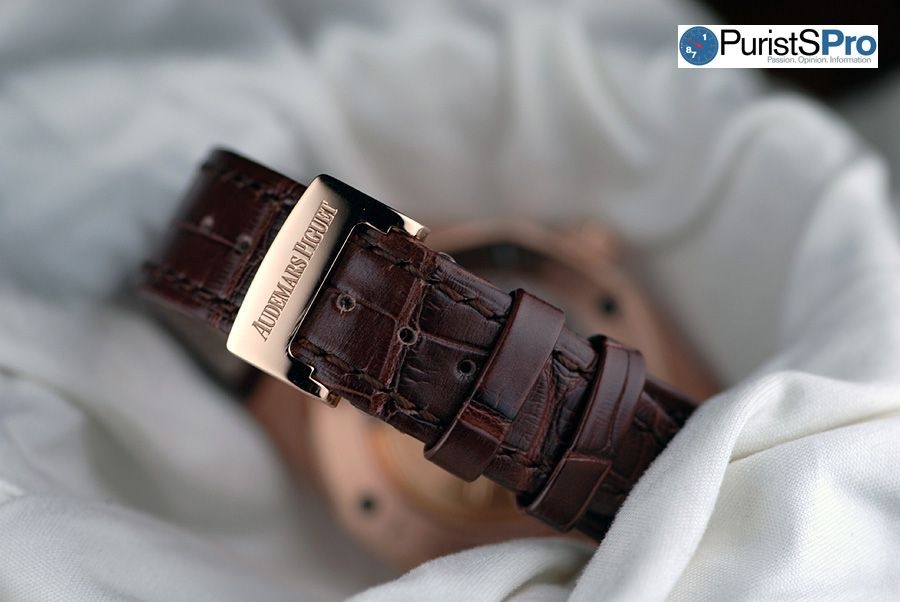
The 37mm Selfwinding Royal Oak in rose gold comes with a brown, hand-stitched "large square scale" crocodile strap with 18-carat pink gold AP folding clasp. The Royal Oak (and Offshore) isn’t an easy watch for people with small wrists to wear. Men with smaller wrists will now have the option of a smaller sized Royal Oak that may fit them better. Women with larger wrists will have the option of a larger “men’s” style watch in the 37mm Royal Oak.
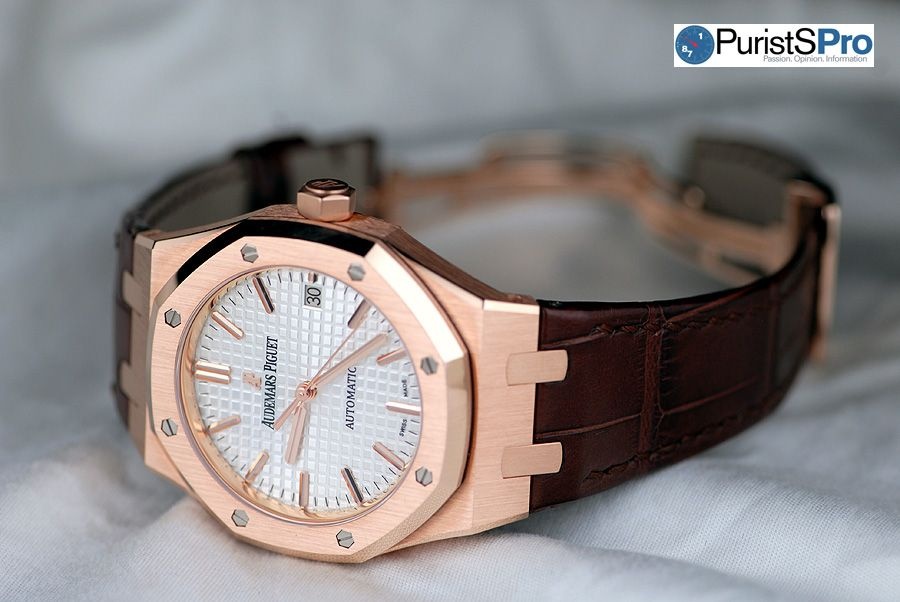
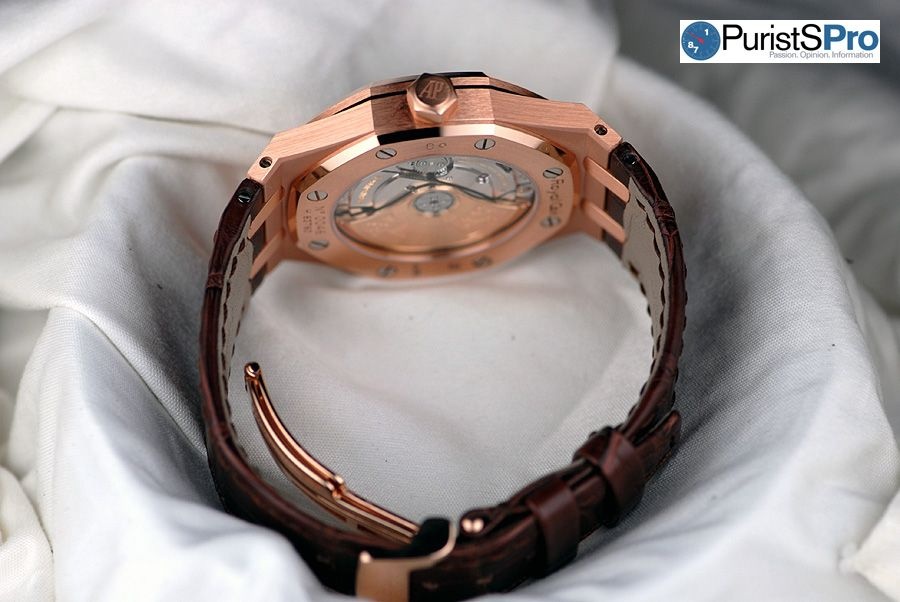
I found the watch to wear much larger than its size. 37mm felt more like 41mm or 42mm to me because of the lugs and extended top and bottom of the case. When you wear an AP Royal Oak, you are wearing a lot of case so anyone who is not used to this might find the watch slightly uncomfortable if it doesn’t fit the right way. For the most part, Royal Oaks are extremely comfortable to wear due to the integrated lug construction which allows a smoother transition from the case to the strap.
Final Thoughts
The AP Royal Oak reflects true sporting refinement in a watch. The 37mm Selfwinding Royal Oak in rose gold is the ultimate statement of this; driving the integration between sport and luxury to unimaginable heights. The watch is considered a sports watch but with the rose gold, you don’t feel like you are wearing a sports watch at all. One might even say that the rose gold version is a bit too dressy for everyday wear. Perhaps a businessman who lives in suits can pull it off without question. Regardless, an AP Royal Oak is desirable in any occasion.
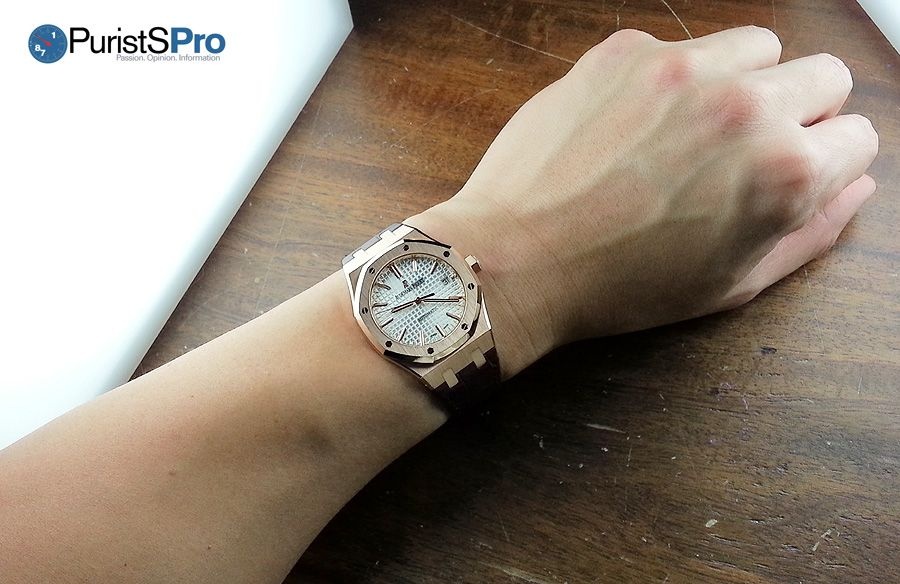
The 37mm Royal Oak is considered a unisex watch and has the benefit of appealing to men with smaller wrists who aren’t able to wear the larger Royal Oaks as well as women who want something larger than the designated ladies line of AP watches.
There has been criticism toward AP’s discontinuation of the 39mm Royal Oak and replacing it with the 41mm and 37mm ones. It forces people who want the 39mm size to buy the Jumbo which is more expensive or size up to the 41mm which may not be the ideal size. I think it’s ingenious marketing on AP’s part. They’ve made an attempt to answer to the needs of several groups in order to capture a larger portion of clientele. Perhaps AP wanted to size up the Royal Oak due to the trend towards larger watches. It’s nice to see that they didn’t neglect the individuals who prefer the smaller size by releasing the 37mm as well.
The 37mm Royal Oak 15450 retails for $16,300 in stainless steel and $31,000 in pink gold.
This message has been edited by pingtsai on 2012-12-04 21:11:23 This message has been edited by AnthonyTsai on 2012-12-17 19:11:08
The Audemars Piguet Royal Oak "Jumbo" ref. 15202 is a significant reference within the Royal Oak collection, known for its close adherence to the original 1972 design. It maintains the distinctive slim profile and integrated bracelet that defined the initial Royal Oak, distinguishing it from other Royal Oak models that introduced different sizes or complications. This reference is particularly valued for its historical continuity and minimalist approach to the Royal Oak aesthetic.
This reference features a 39mm case, typically crafted from yellow gold, with a thickness of 8.1mm. It is fitted with a sapphire crystal and offers a water resistance of 50 meters. Powering the watch is the self-winding Caliber 2121, a movement known for its slimness and a power reserve of approximately 40 hours. The dial is presented in blue, complementing the yellow gold case and bracelet.
For collectors, the 15202 represents a direct link to the Royal Oak's origins, appealing to those who prioritize historical accuracy and understated design. Its production run from 2012 to 2019 makes it a sought-after reference among enthusiasts of the "Jumbo" lineage. The combination of its classic dimensions, integrated bracelet, and the Caliber 2121 solidifies its position as a key reference in the Audemars Piguet catalog.
... may be good even for more small wrist :-) You made me want a Royal Oak someday even more. Thanks. Great review. Ken
....with the wear with Royal Oaks. But that's ok. I'm sure you would do great with one. Thanks Ken!
It's SOOOOOOOOO beautiful and so photogenic. I loved taking pics of my ex-Montoya rose gold and had a blast taking these Royal Oak rose gold. Anyways, thanks for the great review Ping. I really like the polished inner bezel because it's not something I'm used to from the Offshores I've owned before. It really gives the watch an extra umpf and "bang", adding to the already luxurious aura. With all the polished and brushed finish accents, this Royal Oak has a very tasteful bling, yet refined at th
Can you tell me your wristsize, as a point of reference, so that I know how it fits?
This thread is active on the Audemars Piguet forum with 32 replies. Share your knowledge with fellow collectors.
Join the Discussion →


