SuitbertW
2411

It's a bit comlicated, but here you go...
Hi Steve,
it's a bit complicated, but quite simple at the same time 
Please take all below with a grain of salt - it's what I believe is correct, but I don't consider this authoritatively.
All movements you mention share the same roots and in this case "roots" means they share the same going train.
The Valjoux 13''' family started out with a monopusher chrono which I believe was called cal. 13 only.
This was soon changed into cal. VZ - a two pusher chronograph movement (seconds on "9") with minute counter (on "3").
That's the base for the PP ref. 1518 in your first picture as well as for other PP "simple" chronos and rattrapantes of that period. The
perpetual calendar part is PP (and has nothing to do with Valjoux's own calendar versions, which are simple calendars) .
Valjoux's cal. VZ is the base of a whole family of iterations, mainly :
- VZ - base chrono with minute counter
- VZH - chrono with minute and hour counter
- VZQ - chrono with minute counter and simple calendar
- VZHQ - chrono with minute and hour counter and simple calendar
I'm unsure about an eventual calendar with moonphase version, but have seen references towards at least VZHQL which would mean chrono, minute and hoour counter and calendar with moonphase. But as said, I'm not 100% sure I've seen one in the flesh ( the simple versions are becoming rare, the calendar version even more ).
The next generation had soome changes to the chrono levers and springs, but going train and basic design remains - cal names changed into:
- 23
- 72
- 23C
- 72C
- 88 - minute and hour counter, calendar with moonphase
Even later there were an extended and partially revised range and the cal. numbers got three digit. Slightly altered beat rate was one
modification, but also flyback and a simple date with cut out at 6 for cal. 23 example. There are many and I'm not able to list them all out
of the top of my head.
A good and reliable going train of a chronograph movement was always considered a good base for a high precision time only as well - no wonder as the "power supply" is designed to serve for a complicated (and power consuming) movement, with reducing friction and complications time keeping can only improve. The time only with calendar calibers 78 and 90 are such "reduced" versions - 78 is calendar only and 90 with the calendar part of cal 88 which means full calendar with moonphase.
Some manufacturers, like PP and Audemars for good reasons chose this base caliber for their ww precision timekeepers. In later 40ties this caliber perfectly fitted the newly created ww movement observatory category oof 30mm movements. From PP I only know the VZ normal version with seconds at 9 - basically it's the stripped version of the chronograph. AP used three versions as time only, what they called the VZAS, VZAS and VZSSc. VZAS is time only with seconds at "9", VZSS is time only with seconds at "6" .
I believe the last "S" in AP terminology stands for seconde. For VZSS I believe the first "S" indicates "savonette" for the small second at v"6".
The VZSSc is the savonette version with an indirectly driven center sweep second.
The difference between VZAS and VZS base is mainly a swapped barrel and crown wheel position - they simply change place. The result beeing seconds on "9" (for the "original" chronoo going train layout) versus small seconds at "6" for VZSS, the savonette layout.
BTW, the last picture (which I believe is from Osterhausens ww chronometer book) is an error - the movement shown is the savonette version (VZSS) whille the pictures only show the seconds at "9" former chrono base layout (or one could also say Lepine, as originally this chrono layout was also used in open face pocket watches).
One should also note, that AP and PP both used a secial mainplate with this Valjoux based movements - among others it allows for solid pallet bankings (required by the geneva seal for example) and is well recognizable by the different pallet bridge (also steel instead of
brass here).
Hope this helps a bit - and of course all corrections and additions more than welcome!
Best regards
Suitbert
Seeking help identifying this Patek ebauche:
It's a bit comlicated, but here you go...
Thanks So Much! It helps a great deal, and my specific interest is in finding the
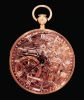

Audemars Piguet VZSS

